

Learning materials
05 November 2026
JRC study: floods leave lasting damage on European manufacturing firms
Learning materials
05 November 2026
Login / create an account to be able to react
-
9
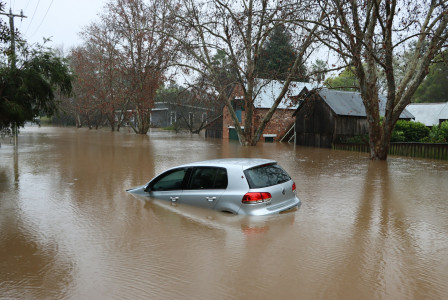
A study by researchers of the Commission's Joint Research Centre (JRC) shows that floods cut the assets, sales and employment of European manufacturing firms for years after the event, and can threaten their survival. An average flood reduces a firm's assets by about 2% in the following year and by up to 5% seven years later. The results, based on flood maps and firm locations for 2007 to 2018, are published in the Journal of Financial Stability.
Editorial team
Joint Research Centre
Topics
EU-27
Academic / Research and VET Institutions
Company with 250 or more employees
EU Institutions
Financial Institutions and Investors
SMEs (a company with less than 250 employees)
-
Advanced Manufacturing Organisation Types
-
-
Additive manufacturing company
-
Industrial Software & Technology Providers
-
Machine Tool Manufacturers
-
Other
-
Robotics and Automation Companies
-
-
Technology areas
-
-
3D Printing, Additive manufacturing
-
Advanced Computing
-
Advanced materials
-
Autonomous Systems, Robotics
-
Biotech
-
Blockchain, Distributed Ledger
-
Cloud & Infrastructure
-
Cybersecurity, Safety & Security, Digital Identity
-
Data, Dynamic Data
-
Electronics, Semiconductors, Power Electronics
-
Industrial AI
-
Internet of Things, AIDC
-
Networks & Connectivity
-
Quantum technologies
-
XR, VR, Augmented reality, Mixed reality, Metaverse
-
Share
Floods are not rare events for European industry. Between 2007 and 2018, about 78% of EU regions at the NUTS 3 level were flooded at least once, and about two-thirds were flooded several times. On average, a flood hit a given region every three years, and about 1% of manufacturing firms suffered water damage in a typical year. Earlier estimates cited by the researchers put flood-related losses in the EU at more than EUR 12 billion a year already, with much higher costs expected if warming continues.
To measure what this means for companies, the researchers combined a database of past natural hazards, detailed flood hazard maps and the exact location of manufacturing firms. This allowed them to separate firms that were actually hit by water from firms in the same region that were not, and to compare the two groups over time. The damage is large and lasting. An average flood lowers a firm's assets by about 2% in the next year and by up to 5% after seven years. Sales end up about 4.5% below the level they would have reached without the flood. Employment follows a similar path and shows no clear recovery in the medium term. Output per worker falls at first and begins to recover about three years after the event. The size of the flood matters: a major flood reduces assets by around 4% in the first year, compared with about 1% for a milder one. Firms hit by a flood are also less likely to still be active a year later, and highly indebted manufacturers are hit harder than others.
There is also a more hopeful result. Firms that are flooded repeatedly cope better than firms in areas where floods are rare, which points to real adaptation, such as protection of buildings and equipment, in flood-prone regions. In addition, firms in a flooded region that were not directly hit often do better afterwards, because economic activity moves towards sites shielded from the water. At regional level, statistics can therefore look positive even when the firms that were hit lose heavily.
For manufacturers, including machinery builders, the practical message is that a flood is a multi-year problem for the balance sheet, not a one-off repair bill. Capital-intensive plants with heavy equipment and long production chains are especially exposed. The findings give companies reasons to check the flood risk of their own sites and of key suppliers before choosing a location or expanding. Member States publish flood hazard and risk maps under the EU Floods Directive, and these can be used for such a check. Protecting critical machinery, keeping financial buffers and avoiding high debt help companies get through a flood.
#SupplyChainResilience #EUManufacturing
Comments (0)
Connected Partnership Opportunities
See also

How to submit content – Guide for EU Machinery and Advanced Manufacturing Ecosystem
- Categories
- Industrial Software & Technology Providers Machine Tool Manufacturers Other +16 more

How to register and get started – Guide for EU Machinery and Advanced Manufacturing Ecosystem
- Categories
- Industrial Software & Technology Providers Machine Tool Manufacturers Other +16 more

EU law framework: Cutting through the jargon - EU law in plain English
- Categories
- Industrial Software & Technology Providers Machine Tool Manufacturers Other +16 more