

Articles
13 May 2026
The cost of Textile-to-Textile recycling
Articles
13 May 2026
Login / create an account to be able to react
-
279
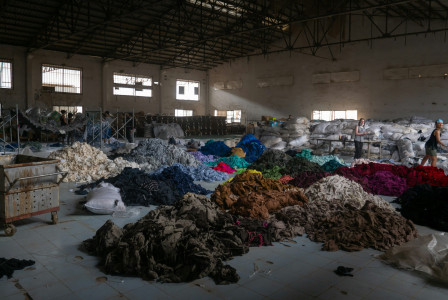
BCG's report 'Advancing Textile Circularity', as reported by Solo Moda Sostenibile, delivers estimates and insights on the future of Textile-to-Textile recycling, focusing on the advantages and financial constraints the transition is associated with.
Boston Consulting Group
Solo Moda Sostenibile
Topics
Albania
Armenia
Austria
Belgium
Bosnia and Herzegovina
Bulgaria
Croatia
Cyprus
Czechia
Denmark
Estonia
EU-27
Finland
France
Georgia
Germany
Greece
Hungary
Iceland
Ireland
Italy
Kosovo
Latvia
Liechtenstein
Lithuania
Luxembourg
Malta
Moldova
Montenegro
Netherlands
North Macedonia
Norway
Poland
Portugal
Romania
Serbia
Slovakia
Slovenia
Spain
Sweden
Switzerland
Türkiye
Ukraine
Other
Academic / Research and VET Institutions
Business Support Organisation
Company with 250 or more employees
Cluster Organisations
Consumer Organisations
Cultural and Heritage Organisations
Destination Management & Marketing Organisations
EU Institutions
Financial Institutions and Investors
Industry Associations and Chambers of Commerce
International Organisations
Local Authorities
Media / Journalist Organisations
National authorities
Networks and Federations / Confederations
NGOs / Non-profits
Notified Bodies
Regional Authorities
SMEs (a company with less than 250 employees)
Social Economy Entity
Trade Unions
Other
-
Transition Pathway's building blocks
-
-
Ecosystem's readiness to support EU strategic autonomy and defence efforts
-
Infrastructure
-
Investments and funding
-
R&I, techniques and technological solutions
-
Skills
-
Social dimension
-
Sustainable competitiveness
-
Regulation and public governance
-
-
Industrial ecosystems
-
-
Construction
-
Cultural and creative industries
-
Digital
-
Energy intensive industries
-
Energy-renewables
-
Mobility, transport, automotive
-
Proximity and social economy
-
Retail
-
Textile
-
Tourism
-
-
Textiles ecosystem areas
-
-
Fibres, yarns and fabrics
-
Apparel and clothing accessories
-
Technical textiles
-
Research and Innovation
-
Share
Post-consumption textile waste is one of the biggest problems within the textile and retail ecosystem: in 2022, the European Union (EU) generated approximately 16 kilograms of textile waste per person, and Europe generated 13.3 tons of post-consumption textile waste in 2025, of which barely more than 10% was collected and selected.
As reported by Solo Moda Sostenibile, Boston Consulting Group’s (BCG) report ‘Advancing textile circularity’ highlights how Textile-to-Textile (T2T) recycling remains limited and concentrated in its scope. Unless waste collection and selection increase, advancing along this trajectory will be highly challenging. The analysis emphasises the crucial role of three pillars to advance T2T practices: the increase in volumes of sorted recycling, the increase in amount and quality of waste sorting, and the development of resources and effectiveness of recycling.
Yet, BCG estimates that the fast fashion market will grow by 11% yearly from 2025 to 2035. This continuously reduces products’ life span, reinforcing unsustainable consumption habits. To scale T2T recycling, stakeholders must coordinate investments and concentrate efforts on new technologies. More specifically, BCG estimates that, to reach the 15% T2T recycling objective by 2035, there should be a €8-11 billion investment in CAPEX, which are one-time capital investments to build implants and infrastructure, and a yearly investment of €5-6.5 billion in OPEX, which are recurrent operational costs. While CAPEX costs are concentrated towards the end of the value chain, involving recycling stakeholders, CAPEX investment are focused on the collection, selection, and pre-treatment steps.
However, scaling up T2T systems significantly reduces companies’ earnings before interest and taxes, as the marginal cost of products and processes would increase due to the higher production standards and technology requirements. To solve this issue, BCG proposes structural support and shared risk mechanisms, starting with Extended Producer Responsibility (EPR) funds.
The key challenges that ecosystem stakeholders will face are tied to economic capacity and structural risks. The marginal retribution rate for these investments is significantly reduced and associated to high capital risk, thus not making the transition appealing from a financial standpoint. While T2T recycled fibres have a higher marginal production cost, they are not more competitive or profitable than comparable options on the market, indicating that there would be no economic premium for the advancement of these initiatives. Lastly, there is great uncertainty on recyclers’ stability and predictability in supplying post-consumption textile waste, and on long-term consumer preferences and demand.
Comments (0)
Connected Partnership Opportunities
See also

Finding the common thread: The EU Textiles Ecosystem Platform has officially launched!
- Categories
- Infrastructure Investments and funding R&I, techniques and technological solutions +28 more
A platform that connects, informs and inspires: highlights from the 2025 community engagement survey
- Categories
- Infrastructure Investments and funding R&I, techniques and technological solutions +28 more

Wrapping up the side event at OECD Forum ‘Finding the common thread: Joining the EU Textiles Ecosystem Platform’
- Categories
- Infrastructure Investments and funding R&I, techniques and technological solutions +28 more