

Articles
25 May 2026
ECOSYSTEX Insight Series #22 highlighted skills for the textile ecosystem’s transition
Articles
25 May 2026
Login / create an account to be able to react
-
29
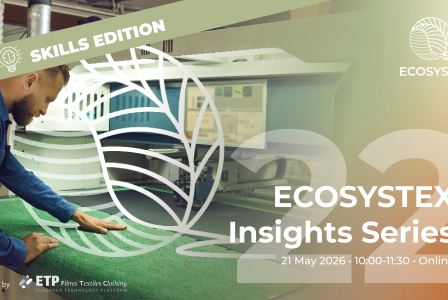
On 21 May 2026, the ECOSYSTEX Insight Series returned with its 22nd edition, dedicated to skills development, vocational education and training, and the future workforce needs of the European textile ecosystem.
The online session, organised within the ECOSYSTEX Skills Education Working Group, gathered strong interest from the community, with 123 registered participants and 87 attendees. Moderated by Pedro Gonçalves, EURATEX, the webinar brought together four Erasmus+ projects working on skills, sustainability, education and innovation across the Textile, Clothing, Leather and Footwear sectors: W4TEX, FEA-VEE, VETRINE and METASKILLS4TCLF.
EURATEX
CTCP - Portuguese Footwear Technological Centre
EURATEX
Textile ETP
Topics
Albania
Armenia
Austria
Belgium
Bosnia and Herzegovina
Bulgaria
Croatia
Cyprus
Czechia
Denmark
Estonia
EU-27
Finland
France
Georgia
Germany
Greece
Hungary
Iceland
Ireland
Italy
Kosovo
Latvia
Liechtenstein
Lithuania
Luxembourg
Malta
Moldova
Montenegro
Netherlands
North Macedonia
Norway
Poland
Portugal
Romania
Serbia
Slovakia
Slovenia
Spain
Sweden
Switzerland
Türkiye
Ukraine
Other
Academic / Research and VET Institutions
Business Support Organisation
Company with 250 or more employees
Cluster Organisations
Consumer Organisations
Cultural and Heritage Organisations
Destination Management & Marketing Organisations
EU Institutions
Financial Institutions and Investors
Industry Associations and Chambers of Commerce
International Organisations
Local Authorities
Media / Journalist Organisations
National authorities
Networks and Federations / Confederations
NGOs / Non-profits
Notified Bodies
Regional Authorities
SMEs (a company with less than 250 employees)
Social Economy Entity
Trade Unions
Other
-
Transition Pathway's building blocks
-
-
Investments and funding
-
R&I, techniques and technological solutions
-
Skills
-
Social dimension
-
Sustainable competitiveness
-
-
Industrial ecosystems
-
-
Textile
-
-
Textiles ecosystem areas
-
-
Fibres, yarns and fabrics
-
Apparel and clothing accessories
-
Household/interior textiles
-
Technical textiles
-
Leather and fur
-
Footwear
-
Research and Innovation
-
Technology and Machinery
-
Waste management, reuse and repair
-
Business support and Communication
-
Not area specific (interested in more than one of the above)
-
Share
A shared space for project results and cooperation
The session reflected the role of ECOSYSTEX as a European community of practice where EU-funded projects can exchange knowledge, present results and identify opportunities for cooperation. Skills are a central part of the textile ecosystem’s transition, as companies, education providers and workers need to respond to changing requirements linked to circularity, digitalisation, sustainable production, new business models and industrial competitiveness.
The four projects presented during the webinar approached these challenges from complementary perspectives. Together, they showed how European cooperation can help translate policy priorities into practical tools, training models and learning experiences for the sector.
Empowering women for leadership in sustainable textile management
The first presentation was delivered by Sara Harper, University of Borås, who presented W4TEX and its work on empowering women for leadership in sustainable textile management.
The project focused on strengthening managerial, entrepreneurial and sustainability competences, with particular attention to women with migrant or refugee backgrounds, including women affected by the war in Ukraine. W4TEX presented several outputs developed during the project, including the “Be A Manager” learning platform, the Women Think Green toolkit, ideathons and transnational learning activities.
Its contribution to the session underlined an important message for the textile ecosystem: skills development is not only about technical knowledge. It is also about inclusion, confidence, leadership and access to networks that allow more people to contribute to the sector’s transformation.
Building vocational excellence for the twin transition
The second presentation was delivered by Elena Kopanarova, who introduced FEA-VEE, the Fashion Earth Alliance project. Funded under the Erasmus+ Centres of Vocational Excellence initiative, FEA-VEE has worked to connect VET providers and entrepreneurship representatives across several European countries.
The project presented its work on modern VET curricula, internships, international study visits and its online cooperation platform. These activities aim to strengthen the link between education and the labour market, while supporting green and digital skills in fashion and textiles.
FEA-VEE highlighted the importance of creating long-term cooperation structures between schools, companies and sector representatives. For a sector largely composed of SMEs, such bridges are essential to ensure that training remains relevant to industrial needs and that learners can access real opportunities for mobility, work-based learning and professional development.
Moving from sustainability awareness to implementation
The third project, VETRINE, was presented by Ana Paula Dinis, Director-General of ATP Portugal. Her presentation focused on greening fashion education through VET innovation and industry collaboration, with a strong emphasis on practical application.
VETRINE presented the Entre-Fashion process, an eight-month simulation through which learners move from theoretical training to sustainable product development. The process includes mentoring, concept validation, material research, prototype development, market reflection and final presentation.
The project brought a particularly practical message to the discussion: sustainability cannot be learned only in classrooms. It must be tested through materials, production constraints, market expectations and collaboration with industry. VETRINE therefore showed how vocational education can become a bridge between sustainability knowledge and real industrial practice.
Coordinating a skills Blueprint for the TCLF sectors
The final project presentation was delivered by Rita Souto, CTCP, project coordinator of METASKILLS4TCLF. The project presented its work towards a more coordinated skills ecosystem for the Textile, Clothing, Leather and Footwear industries.
Building on the TCLF Pact for Skills and the previous Skills4Smart TCLF Blueprint, METASKILLS4TCLF focuses on digital and green skills, circular economy, innovative training methods, inclusion, attractiveness and competitiveness. The project presented ongoing work on skills strategies, training programmes, microcredentials, digital tools, augmented reality resources, virtual reality content and Metaverse Labs.
Its presentation showed the value of combining strategic coordination with innovative learning formats. As skills needs evolve, the sector requires both updated intelligence on emerging gaps and flexible training resources that can reach learners, trainers and companies across Europe.
Strengthening the European textile skills community
The ECOSYSTEX Insight Series #22 demonstrated the diversity of European skills initiatives and the added value of bringing them together in one exchange. Together, the projects showed that the textile ecosystem’s green and digital transition depends on people as much as on technologies, materials or regulations. Skills development must be inclusive, practical, future-oriented and closely connected to industrial realities.
Through its Insight Series and working groups, ECOSYSTEX continues to provide a valuable platform for EU-funded projects to share results, avoid fragmentation and strengthen collaboration across the European textile ecosystem. The Skills Edition confirmed that cooperation between projects, education providers, companies and sector organisations will remain essential to building a resilient, competitive and sustainable textile future.
Comments (0)
Related content
Connected Partnership Opportunities
See also
Introducing the ‘Themed Discussion Days’ on the EU Textiles Ecosystem Platform
- Categories
- Infrastructure Investments and funding R&I, techniques and technological solutions +26 more
A platform that connects, informs and inspires: highlights from the 2025 community engagement survey
- Categories
- Infrastructure Investments and funding R&I, techniques and technological solutions +28 more

The video tutorial on the EU Textiles Ecosystem Platform is now live!
- Categories
- Infrastructure Investments and funding R&I, techniques and technological solutions +26 more