

Articles
02 June 2026
Recap of the EU Textiles Ecosystem Platform Thematic Webinar on resilient TCLF value chains in times of crises
Articles
02 June 2026
Login / create an account to be able to react
-
<a href="/user/login?destination=/textiles/articles/recap-eu-textiles-ecosystem-platform-thematic-webinar-resilient-tclf-value-chains%23comment-form">Log in</a> or <a href="/user/register?destination=/textiles/articles/recap-eu-textiles-ecosystem-platform-thematic-webinar-resilient-tclf-value-chains%23comment-form">register</a> to post comments
-
97
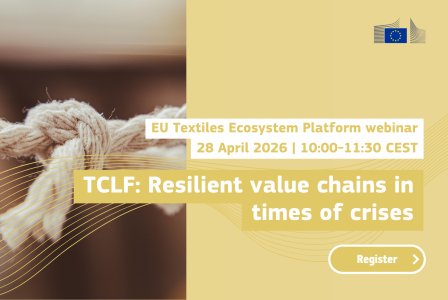
This article provides an overview of the EU Textiles Ecosystem Platform webinar “TCLF: Resilient value chains in times of crises”, held on 28 April 2026. It highlights the main objectives of the session, its agenda and key themes discussed, including supply chain resilience, competitiveness, innovation and best practices across the textiles, clothing, leather and footwear (TCLF) ecosystem.
Topics
Albania
Armenia
Austria
Belgium
Bosnia and Herzegovina
Bulgaria
Croatia
Cyprus
Czechia
Denmark
Estonia
EU-27
Finland
France
Georgia
Germany
Greece
Hungary
Iceland
Ireland
Italy
Kosovo
Latvia
Liechtenstein
Lithuania
Luxembourg
Malta
Moldova
Montenegro
Netherlands
North Macedonia
Norway
Poland
Portugal
Romania
Serbia
Slovakia
Slovenia
Spain
Sweden
Switzerland
Türkiye
Ukraine
Other
Academic / Research and VET Institutions
Business Support Organisation
Company with 250 or more employees
Cluster Organisations
Consumer Organisations
Cultural and Heritage Organisations
Destination Management & Marketing Organisations
EU Institutions
Financial Institutions and Investors
Industry Associations and Chambers of Commerce
International Organisations
Local Authorities
Media / Journalist Organisations
National authorities
Networks and Federations / Confederations
NGOs / Non-profits
Notified Bodies
Regional Authorities
SMEs (a company with less than 250 employees)
Social Economy Entity
Trade Unions
Other
-
Transition Pathway's building blocks
-
-
Infrastructure
-
Investments and funding
-
R&I, techniques and technological solutions
-
Skills
-
Sustainable competitiveness
-
Regulation and public governance
-
-
Industrial ecosystems
-
-
Digital
-
Energy intensive industries
-
Proximity and social economy
-
Retail
-
Textile
-
-
Textiles ecosystem areas
-
-
Fibres, yarns and fabrics
-
Apparel and clothing accessories
-
Household/interior textiles
-
Technical textiles
-
Leather and fur
-
Footwear
-
Research and Innovation
-
Technology and Machinery
-
Waste management, reuse and repair
-
Business support and Communication
-
Not area specific (interested in more than one of the above)
-
Share
On 28 April 2026, the European Commission, through the EU Textiles Ecosystem Platform, brought together stakeholders from across the textiles, clothing, leather and footwear (TCLF) ecosystem for an online thematic webinar, moderated by Melina Sachtleben Dahmann (ITA Institute for Textile Technology, RWTH Aachen University). The session gathered a broad audience of industry representatives, policymakers and support organisations to explore how value chains can strengthen their resilience in times of disruption. The webinar provided a structured programme of keynote insights and practical examples, offering participants a comprehensive overview of current challenges and emerging strategies across the ecosystem.
Resilience in a changing TCLF ecosystem
The session opened with welcome remarks and an introduction to the objectives of the webinar, followed by contributions from representatives of the European Commission. These initial interventions set the scene by outlining the current pressures on TCLF value chains, including increasing global competition, rising costs, supply chain disruptions and sustainability requirements.
A keynote intervention by Dirk Vantyghem, Director General of EURATEX and Ambassador of the EU Textiles Ecosystem Platform, further explored the structural challenges affecting the sector. His contribution emphasised the importance of coordinated European action, strategic adaptation and continued innovation to maintain competitiveness in a rapidly evolving global market.
Best practices: industry perspectives across value chains
A central part of the webinar focused on best practice examples from across different segments of the TCLF ecosystem.
Mario Jorge Machado, CEO of Adalberto Textile Solutions and President of EURATEX, shared insights from the textile manufacturing sector, focusing on how innovation, technological development and strategic adaptation can strengthen resilience across textile value chains.
Andreia Barbosa from Humana People to People, Ambassador of the EU Textiles Ecosystem Platform, presented perspectives from the clothing reuse and collection sector. Her contribution explored circular approaches, reuse systems and the importance of collaboration in supporting more resilient and sustainable textile ecosystems.
Representing the leather sector, Giacomo Zorzi, Executive Regional Office Veneto District at UNIC – Concerie Italiane, addressed current challenges related to PFAS management within leather value chains. His contribution highlighted the increasing environmental requirements affecting production processes, including strict standards related to water management and chemical use, as well as the growing importance of sustainable process innovation and responsible resource management across the sector.
Throughout the session, participants engaged with the speakers through dedicated Q&A discussions, reflecting strong interest from stakeholders across the ecosystem and enabling further exchange on practical challenges and solutions.
Supporting resilience through collaboration and international engagement
The programme was complemented by insights into international cooperation and support mechanisms available to companies operating in the TCLF sector. Gilles Trouveroy from the South East Asia IP SME Helpdesk introduced services supporting European SMEs in international markets, highlighting opportunities to strengthen competitiveness through knowledge sharing, capacity building and strategic partnerships beyond Europe.
Looking ahead: strengthening resilience through collaboration
The webinar concluded with closing remarks by Melina Sachtleben Dahmann, moderator of the session, who highlighted the key insights shared by the speakers and emphasised the importance of continued dialogue, collaboration and knowledge exchange across the TCLF ecosystem.
The discussions underscored that strengthening resilience in TCLF value chains requires a combination of innovation, policy support and active industry engagement. In this context, the EU Textiles Ecosystem Platform continues to play a key role in facilitating exchange and connecting stakeholders across the sector.
Participants were invited to continue the exchange within the relevant community workspaces of the EU Textiles Ecosystem Platform. Become a member of the Competitive and innovative supply chains workspace to follow up discussions, additional insights and responses to open Q&A questions from the webinar. Stakeholders are encouraged to join the conversation and contribute to the ongoing dialogue shaping a more resilient, sustainable and competitive European textiles ecosystem.
Comments (0)
Related content
Connected Partnership Opportunities
See also
A platform that connects, informs and inspires: highlights from the 2025 community engagement survey
- Categories
- Infrastructure Investments and funding R&I, techniques and technological solutions +28 more

Finding the common thread: The EU Textiles Ecosystem Platform has officially launched!
- Categories
- Infrastructure Investments and funding R&I, techniques and technological solutions +28 more
Wrapping up the side event at OECD Forum ‘Finding the common thread: Joining the EU Textiles Ecosystem Platform’
- Categories
- Infrastructure Investments and funding R&I, techniques and technological solutions +28 more