

Best practices
16 December 2025
Connecting actors of the textile value chain through digital platforms: the case of the Reverse Resources Platform
Best practices
16 December 2025
Login / create an account to be able to react
-
195
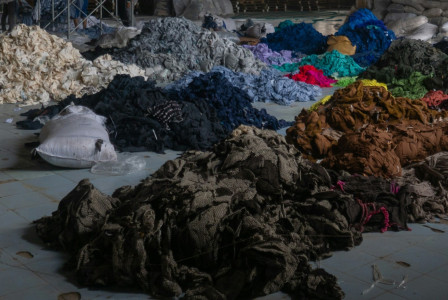
Reverse Resources is a digital platform that enables circular practices in the global textile industry by mapping, tracking and steering production leftovers towards high-value textile-to-textile recycling. By enhancing transparency, connecting previously disconnected actors and optimising the match between available waste streams and recyclers’ input needs, the platform demonstrates how digitalisation can unlock unused material flows and support the scaling of economically viable circular solutions.
Reverse Resources
Topics
Albania
Armenia
Austria
Belgium
Bosnia and Herzegovina
Bulgaria
Croatia
Cyprus
Czechia
Denmark
Estonia
EU-27
Finland
France
Georgia
Germany
Greece
Hungary
Iceland
Ireland
Italy
Kosovo
Latvia
Liechtenstein
Lithuania
Luxembourg
Malta
Moldova
Montenegro
Netherlands
North Macedonia
Norway
Poland
Portugal
Romania
Serbia
Slovakia
Slovenia
Spain
Sweden
Switzerland
Türkiye
Ukraine
Other
Academic / Research and VET Institutions
Business Support Organisation
Company with 250 or more employees
Cluster Organisations
Consumer Organisations
Cultural and Heritage Organisations
Destination Management & Marketing Organisations
EU Institutions
Financial Institutions and Investors
Industry Associations and Chambers of Commerce
International Organisations
Local Authorities
Media / Journalist Organisations
National authorities
Networks and Federations / Confederations
NGOs / Non-profits
Notified Bodies
Regional Authorities
SMEs (a company with less than 250 employees)
Social Economy Entity
Trade Unions
Other
-
Transition Pathway's building blocks
-
-
R&I, techniques and technological solutions
-
Social dimension
-
Sustainable competitiveness
-
-
Industrial ecosystems
-
-
Textile
-
-
Textiles ecosystem areas
-
-
Research and Innovation
-
Waste management, reuse and repair
-
Business support and Communication
-
Share
The Reverse Resources Platform development
Reverse Resources is an SME founded in 2014 from Estonia. Initially conceived as an online marketplace for leftover fabrics for upcycling designers, the company soon realised that the challenge within the global fashion value chain was not a lack of platforms, but the absence of reliable and traceable data on production waste, particularly cutting scraps.
For its first five years, the organisation operated largely as a research and mapping initiative, working with brands, factories, waste handlers and recyclers to understand where waste arose, in what quantities, how it was processed and why it often failed to reach textile-to-textile (T2T) recycling. They estimated that, even after process optimisation, over 25% of resources still spill out of original supply chains for a variety of reasons.
Building on this groundwork, Reverse Resources progressively developed a Software-as-a-Service (SaaS) platform designed to digitally and transparently track textile waste along global fashion supply chains. This work evolved into today’s fully operational platform, which currently connects 1 211 manufacturers, 239 recyclers, 166 waste handlers and 18 global brands, monitoring their waste flows.
How the Reverse Resources Platform supports circularity?
The platform connects actors across the textile ecosystem by creating a structured digital environment in which they can interact and share information. It digitally tracks waste as it moves from suppliers (organisations generating waste and providing detailed information on its composition, quality and origin), waste handlers performing fibre sorting, quality checks, volume aggregation or shredding, and recyclers producing recycled fibres or materials. This creates a comprehensive and continuously updated picture of available waste: its type, composition, volume and geographical distribution.
This visibility enables smarter matching between available waste and recyclers’ needs. With a global and constantly updated view of materials, recyclers can identify waste streams most closely aligned with their input requirements. Reverse Resources focuses particularly on diverting pre-consumer manufacturing waste with high potential for high-value textile-to-textile recycling, preventing it from being downcycled or landfilled.
Furthermore, through its backend logic, the platform helps users assess partners, verify data and determine the most suitable commercial or operational relationships, thus supporting informed decision-making throughout the matchmaking process.
Thanks to the company’s strong technical background and the potential of digitalisation, Reverse Resources absorbs much of the underlying complexity of waste-data management. This allows users to integrate the platform into their daily operations, making traceability a natural by-product rather than an administrative burden.
The Impact
The company collaborates with global brands such as H&M Group, C&A, Bestseller and PVH Corp. (Calvin Klein, Tommy Hilfiger), as well as several other leading fashion companies, and it has established numerous partnerships across the ecosystem, for example with Global Fashion Agenda (GFA) through the Circular Fashion Partnership, and with Fashion for Good projects.
Overall, Reverse Resources has traced over 100,000 tonnes of textile waste through its platform, with around 50% successfully directed to textile-to-textile recycling (source: Fashion for Good). In 2022, the platform helped nearly 4 000 tonnes of waste reach high-end textile-to-textile recycling.
The service offered met a market need and this has allowed the company to grow between 2019 and 2024 the number of employees almost tripled and revenue from service provision increased more than ten-fold. In parallel, the company is developing and adapting its tools for post-consumer waste streams with the aim of integrating them into future circular systems.
Conclusion
As textile-to-textile recycling technologies scale towards capacities of several hundred thousand tonnes per year, the demand for stable, high-quality feedstock is rising rapidly. Reverse Resources addresses this challenge at its origin. Beyond reporting, this real-time data infrastructure enhances decision-making and integrates with emerging systems such as Digital Product Passports and Global Recycled Standard (GRS) certification. Such digital foundations are essential not only for building an effective circular economy, but also for enabling broader Industry 4.0 applications.
Comments (0)
See also

Prolonging the lifespan of denim: repair and reuse services at Nudie Jeans
- Categories
- R&I, techniques and technological solutions Skills Social dimension +10 more

BALI Chaire: Multi-stakeholder collaboration as a driver of systemic change
- Categories
- R&I, techniques and technological solutions Skills Social dimension +9 more

Driving circularity and social inclusion: the case of the United Repair Centre
- Categories
- Skills Social dimension Sustainable competitiveness +4 more