

Library and support resources
16 June 2026
UNECE Recommendation No. 49: Transparency at scale - Fostering sustainable value chains
Library and support resources
16 June 2026
Login / create an account to be able to react
-
38

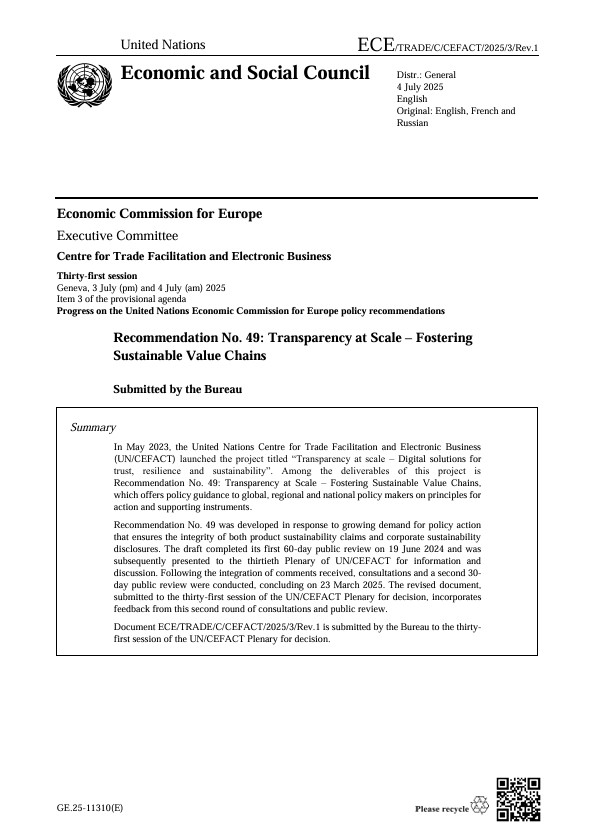
Recommendation No. 49: Transparency at Scale – Fostering Sustainable Value Chains promotes a global approach to making sustainability information trustworthy, interoperable and accessible across global value chains. As a policy guidance document, it outlines principles and digital tools to help governments and stakeholders ensure the credibility and integrity of product sustainability claims and corporate disclosures, supporting informed decision-making across the entire product lifecycle and progress toward sustainable consumption and production (SDG 12).
UNECE
Topics
Albania
Armenia
Austria
Belgium
Bosnia and Herzegovina
Bulgaria
Croatia
Cyprus
Czechia
Denmark
Estonia
EU-27
Finland
France
Georgia
Germany
Greece
Hungary
Iceland
Ireland
Italy
Kosovo
Latvia
Liechtenstein
Lithuania
Luxembourg
Malta
Moldova
Montenegro
Netherlands
North Macedonia
Norway
Poland
Portugal
Romania
Serbia
Slovakia
Slovenia
Spain
Sweden
Switzerland
Türkiye
Ukraine
Other
Business Support Organisation
Company with 250 or more employees
Cluster Organisations
Consumer Organisations
EU Institutions
Financial Institutions and Investors
Industry Associations and Chambers of Commerce
Local Authorities
National authorities
Networks and Federations / Confederations
NGOs / Non-profits
Notified Bodies
Regional Authorities
SMEs (a company with less than 250 employees)
Social Economy Entity
Trade Unions
Other
-
Transition Pathway's building blocks
-
-
Infrastructure
-
Investments and funding
-
R&I, techniques and technological solutions
-
Skills
-
Social dimension
-
Sustainable competitiveness
-
Regulation and public governance
-
-
Industrial ecosystems
-
-
Agri-food
-
Construction
-
Cultural and creative industries
-
Digital
-
Energy intensive industries
-
Energy-renewables
-
Health
-
Mobility, transport, automotive
-
Proximity and social economy
-
Retail
-
Textile
-
Tourism
-
-
Textiles ecosystem areas
-
-
Fibres, yarns and fabrics
-
Apparel and clothing accessories
-
Household/interior textiles
-
Technical textiles
-
Leather and fur
-
Footwear
-
Research and Innovation
-
Technology and Machinery
-
Waste management, reuse and repair
-
Business support and Communication
-
Not area specific (interested in more than one of the above)
-
Share
With financial support from the Directorate-General for International Partnerships (DG INTPA) and developed under the United Nations Centre for Trade Facilitation and Electronic Business (UN/CEFACT), Recommendation No. 49 provides policy guidance to strengthen trust, accountability and efficiency in international trade and production systems by improving the quality and exchange of sustainability information. It emphasizes that such information should be accurate, verifiable, interoperable, accessible and privacy-preserving, while remaining under the control of value chain actors. The Recommendation identifies practical areas for action, including developing national policies, deploying supporting instruments and digital infrastructures, establishing government services, and encouraging broad stakeholder uptake. It aims to reduce compliance costs and complexity, support risk-based due diligence, facilitate market access and competitiveness, and create a level playing field, particularly for small and medium-sized enterprises (SMEs).
Comments (0)
Connected Partnership Opportunities
See also

Small mid‑caps: bridging the gap between SMEs and large companies
- Categories
- Infrastructure Investments and funding R&I, techniques and technological solutions +28 more
Get the most out of the EU Textiles Ecosystem Platform: the Beginner kit is now available
- Categories
- Infrastructure Investments and funding R&I, techniques and technological solutions +28 more

The EU’s vision for sustainable fashion: transforming the textiles sector by 2030
- Categories
- Infrastructure Investments and funding R&I, techniques and technological solutions +28 more