

Opinions
27 April 2026
EU textiles regulations: are we sharing more… but understanding less?
Opinions
27 April 2026
Login / create an account to be able to react
-
324
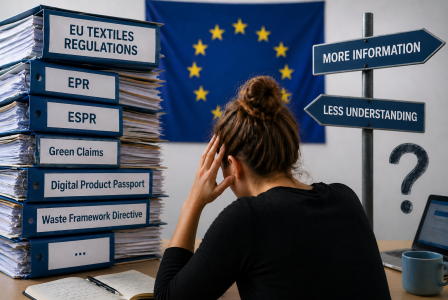
From the EU Strategy for Sustainable and Circular Textiles to Ecodesign, Digital Product Passports and EPR schemes, textiles and fashion stakeholders get overwhelmed with articles, reports, webinars and events to inform and explain how to transition to a circular and sustainable industry. The myriad of resulting social media posts moves at a speed that is hard to keep up with.
Topics
Albania
Armenia
Austria
Belgium
Bosnia and Herzegovina
Bulgaria
Croatia
Cyprus
Czechia
Denmark
Estonia
EU-27
Finland
France
Georgia
Germany
Greece
Hungary
Iceland
Ireland
Italy
Kosovo
Latvia
Liechtenstein
Lithuania
Luxembourg
Malta
Moldova
Montenegro
Netherlands
North Macedonia
Norway
Poland
Portugal
Romania
Serbia
Slovakia
Slovenia
Spain
Sweden
Switzerland
Türkiye
Ukraine
Other
Other
-
Transition Pathway's building blocks
-
-
Regulation and public governance
-
-
Industrial ecosystems
-
-
Textile
-
-
Textiles ecosystem areas
-
-
Fibres, yarns and fabrics
-
Apparel and clothing accessories
-
Household/interior textiles
-
Technical textiles
-
Leather and fur
-
Footwear
-
Research and Innovation
-
Technology and Machinery
-
Waste management, reuse and repair
-
Business support and Communication
-
Not area specific (interested in more than one of the above)
-
Share
There is no shortage of information sharing on EU textiles regulations.
Yet, a simple and common thread keeps coming back in my daily conversations with the industry, regardless the quality and professionalism of all communication:
More information does not necessarily lead to better understanding.
Spoiler alert: this is not another attempt to share and explain.
Multiple signals suggest this is not just a perception. Industry organisations and EU-level initiatives increasingly highlight the need to help companies navigate regulations, pointing to challenges such as regulatory complexity, fragmentation and lack of harmonisation.
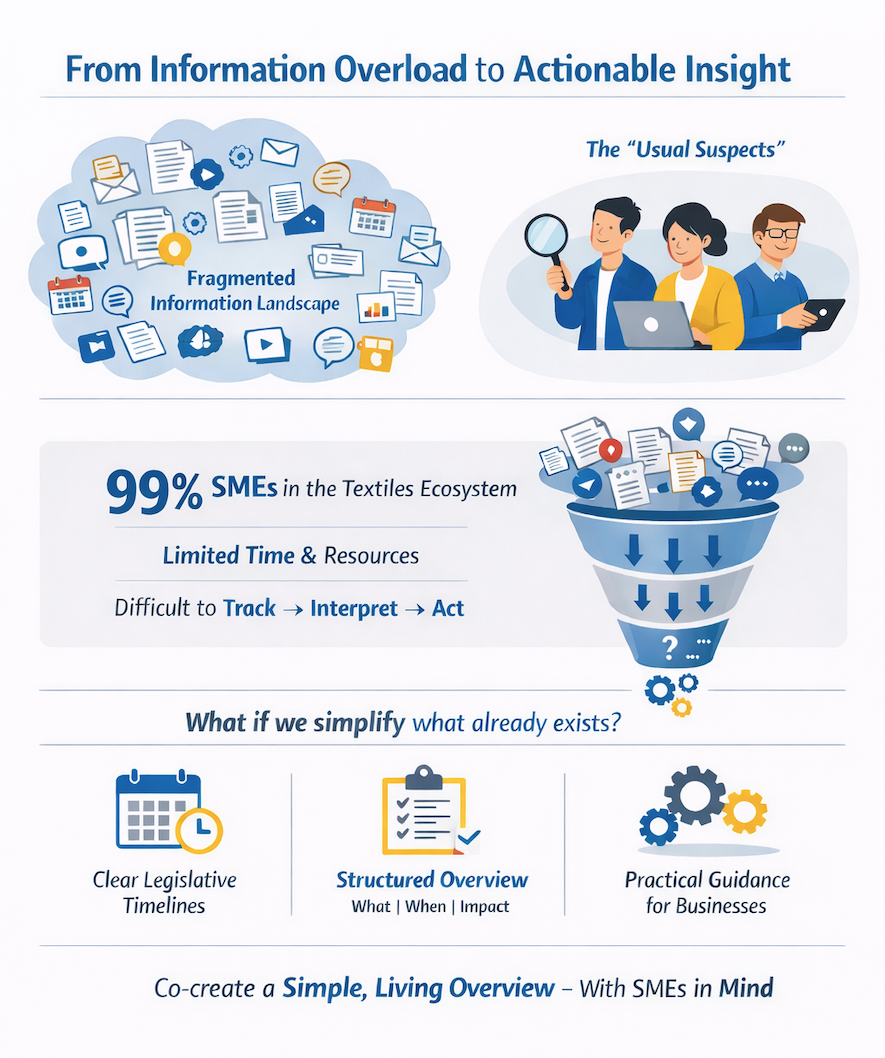
While larger organisations typically have dedicated resources to remain engaged, smaller organisations struggle to filter, interpret and act. While larger organisations often have access to better structured information through several memberships with relevant associations, smaller and medium-sized companies often lack the budget for such memberships and may therefore miss out on valuable information. So, not all players in the value circle are on the same page, at least not to the same extent nor at the same time.
This is particularly relevant given that 99% of companies are SMEs, often with limited capacity to follow the developments in the rush towards a more sustainable business.
For the record: it is not unusual — nor necessarily problematic — that larger companies move faster, supported by greater resources and a dedicated workforce. To some extent, this reflects the dynamics of competition, which plays an important role in driving progress. Early movers often help pave the way for their followers.
However, when it comes to fundamental transitions, progress cannot remain limited to frontrunners only. The entire value circle needs to move forward — meaning that, ultimately, no one can be left behind.
We need to help all companies navigate legislation. The issue is not the lack of information sharing, but how to access and digest information in a timely manner.
On top of that, current economic and geopolitical evolutions put ever growing pressure on industry in general. No matter what size the company, all struggle to keep daily business running, leaving no time and resources – let alone appetite – to keep up with the growing complexity of regulations
There is simply no time to follow webinars, no capacity to read long reports and sometimes even not enough expertise to translate official texts into business decisions.
This is the key paradox: more information does not necessarily equals better and substantiated decisions. Despite the growing amount of information, there is also a risk of fragmented or inconsistent interpretation leading to even more confusion, completing the vicious circle. At the end, there’s no guarantee that we even speak the same language.
What is often lacking is a translation layer between regulation oriented information and its implementation. Companies need answers to very practical questions:
- What does this piece of regulation mean for my product?
- As of when do I need to comply?
- How do I prioritize actions with limited resources?
Many valuable initiatives already exist, often developed within larger funded projects that bring together multiple stakeholders across the value circle. While these efforts generate relevant insights and practical guidance, they are typically limited to the duration of the project itself. As a result, promising attempts to support with actionable information in the field are too often discontinued, leaving outputs that are no longer updated and hence gradually lose their relevance over time.
The question is not whether information exists and is available. The main question is whether it actually leads to clear and aligned understanding across the ecosystem. Regulation and related information on their own will not create impact. The holy grail is in implementation and execution.
The challenge therefore may not be to create yet another source of information, but to better channel, structure, translate and disseminate what is being generated anyway and keep that overview up-to-date.
Those who are active already in communities — including this EU Textiles Ecosystem Platform - apparently do find their way. Else you would not be reading here. But in reality, a large share of companies is not at that level.
We do not need more content. We need clear information, visuals explaining timelines and obviously guidelines for practical interpretation.
Call to action
- Do you recognise these gaps between information availability, understanding and ability to implement?
- Which public and reliable sources do you consider truly useful today?
- What would make information on EU legislation more actionable and accessible in practice, particularly for SMEs?
Would there be interest to explore a simple, structured and living overview of EU textile legislation, building on existing sources?
Join the debate in the Sustainable business Community workspace and share your perspective.
<pictures are AI-generated>
Comments (0)
See also
The JRC 3rd milestone – Report on Recycled Content
- Categories
- Infrastructure Investments and funding R&I, techniques and technological solutions +16 more
The JRC 3rd milestone – Report on Repair And Repairability
- Categories
- Infrastructure Investments and funding R&I, techniques and technological solutions +16 more

EUDR and Italian Fashion: navigating the debate
- Categories
- Social dimension Sustainable competitiveness Regulation and public governance +19 more