

Articles
14 July 2026
Learn more about the “Bioeconomy in motion” conference
Articles
14 July 2026
Login / create an account to be able to react
-
<a href="/user/login?destination=/textiles/articles/learn-more-about-bioeconomy-motion-conference%23comment-form">Log in</a> or <a href="/user/register?destination=/textiles/articles/learn-more-about-bioeconomy-motion-conference%23comment-form">register</a> to post comments
-
29

On 16 June 2026, Portuguese footwear industry stakeholders and institutional partners presented the results of the BioShoes4All project, aimed at improving sustainability and innovation within the European footwear industry.
CEC
Permanent Representation of Portugal to the European Union, APICCAPS
Topics
EU-27
Portugal
Academic / Research and VET Institutions
Business Support Organisation
Company with 250 or more employees
Cluster Organisations
Consumer Organisations
Cultural and Heritage Organisations
Destination Management & Marketing Organisations
EU Institutions
Financial Institutions and Investors
Industry Associations and Chambers of Commerce
International Organisations
Local Authorities
Media / Journalist Organisations
National authorities
Networks and Federations / Confederations
NGOs / Non-profits
Notified Bodies
Regional Authorities
SMEs (a company with less than 250 employees)
Social Economy Entity
Trade Unions
Other
-
Transition Pathway's building blocks
-
-
Infrastructure
-
Investments and funding
-
R&I, techniques and technological solutions
-
Skills
-
Social dimension
-
Sustainable competitiveness
-
Regulation and public governance
-
-
Industrial ecosystems
-
-
Retail
-
Textile
-
-
Textiles ecosystem areas
-
-
Footwear
-
Waste management, reuse and repair
-
Share
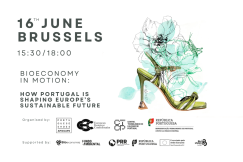
On 16 June 2026, the Permanent Representation of Portugal to the European Union hosted the conference “Bioeconomy in motion: How Portugal is shaping Europe's sustainable future.” The event, organised through the joint effort of Portuguese footwear industry representatives and institutional partners, brought together policymakers, industry experts, and European partners to discuss the future of the footwear industry within a global contest.
The conference revealed the large scale of environmental challenges that the industry is facing in Europe. As reported by the European Footwear Industry Confederation (CEC) and underscored during the event, the 1.98 billion pairs of shoes which the EU imports every year translate into 1.22 million tonnes of potential waste, thus calling for urgent action to tighten the environmental requirements for the industry. The Portuguese industry presents itself as a sustainable, alternative model, focused on high-quality, sustainable production.
Associação Portuguesa Ind. Calçado Componentes Artigos Pele Sucedaneos (APICCAPS) presented the outcome of the BioShoes4All project, funded through the Recovery and Resilience Plan (PRR). Over the past three years, the project united seventy partners in a consortium to produce fifty new eco-products and biomaterials. This industry-level collaboration aims to accelerate the transition of the footwear value chain towards the bioeconomy, emphasising the importance of biomaterials, innovative processes, digitalisation, and waste recovery.
The Portuguese footwear industry has driven change and innovation in the bioeconomy through such initiative. The BioShoes4All project is firmly grounded in the principles of biomaterials, ecological footwear, circular economy, advanced production technologies, and training and promotion. Its results indicated that the Portuguese model could be an inspiration for new initiatives focused on innovation, sustainability, and quality.
Comments (0)
Related content
Connected Partnership Opportunities
See also
A platform that connects, informs and inspires: highlights from the 2025 community engagement survey
- Categories
- Infrastructure Investments and funding R&I, techniques and technological solutions +28 more

Finding the common thread: The EU Textiles Ecosystem Platform has officially launched!
- Categories
- Infrastructure Investments and funding R&I, techniques and technological solutions +28 more
Wrapping up the side event at OECD Forum ‘Finding the common thread: Joining the EU Textiles Ecosystem Platform’
- Categories
- Infrastructure Investments and funding R&I, techniques and technological solutions +28 more