

Best practices
30 September 2026
From digital design to production: additive manufacturing in footwear
Best practices
30 September 2026
Login / create an account to be able to react
-
47
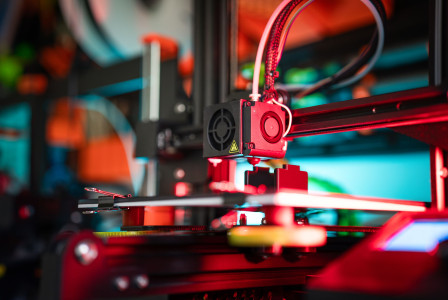
3D printing has progressively expanded beyond prototyping into end-use footwear manufacturing, with applications ranging from individual components up to complete shoes. Callnak is an example of a footwear company applying the technology to shoe production, alongside digital design, on-demand manufacturing and online sales.
Callnak
Topics
Spain
SMEs (a company with less than 250 employees)
-
Transition Pathway's building blocks
-
-
R&I, techniques and technological solutions
-
-
Industrial ecosystems
-
-
Textile
-
-
Textiles ecosystem areas
-
-
Footwear
-
Share
The evolution of 3D printing in footwear manufacturing
3D printing has been used in footwear for more than a decade, initially – and still widely – for prototyping and tooling, before expanding into functional components. Orthopaedic and customised insoles were among the earliest end-use applications, followed by components such as midsoles and outsoles.1
In product development, 3D printing allows designs to be modified more quickly, shortening development cycles. In manufacturing, producing directly from digital files increases design freedom, facilitates customisation and reduces the need for dedicated moulds. This can make small production runs and on-demand manufacturing more viable and help to reduce inventory risk and unsold stock.2
When used in footwear manufacturing, 3D printing is often employed alongside established techniques, for instance to produce individual components that are then integrated into conventionally manufactured shoes. For example, Framas, a manufacturer of performance plastic components for the footwear industry, has recently industrialised a sole unit combining 3D-printed inserts with conventional injection and casting processes to achieve enhanced performance characteristics.3 The production of complete shoes through 3D printing is also being explored in the industry, with examples including the US-German footwear technology company Zellerfeld and, more recently, Spain-based Callnak.
Building a 3D-printed footwear brand: the case of Callnak
Additive manufacturing is at the core of Callnak’s production model. Founded in 2025 by a footwear designer and a 3D-printing specialist, the start-up is based in Elda, one of Spain’s main footwear manufacturing hubs. Its production is fully on demand and relies on a fleet of 30 printers, which the company plans to expand while improving automation and productivity. Moving from a digital design to a production-ready model currently takes around three to four weeks, compared with several months in conventional production (company data). In addition, the absence of moulds makes it possible to produce geometries that are difficult to obtain with conventional processes and potentially enables greater customisation.
The production system is integrated with the company’s digital design and sales channels. Callnak sells primarily through its e-commerce platform, complemented at present by a multi-brand store in Valencia, with the strategic focus on growing its own direct-to-consumer brand. Building on the same digital design and manufacturing infrastructure, the company is also exploring the expansion of its product range beyond footwear, progressively moving into other fashion products and accessories.
In 2025, Callnak closed a EUR 200,000 financing round, combining EUR 100,000 in private capital with a EUR 100,000 participative loan from ENISA, Spain’s state-owned company supporting innovative start-ups and SMEs.4 The company received assistance from Miguel Hernández University Science Park (PCUMH) during the financing round, alongside broader entrepreneurship and legal support.
Conclusion
Recent industrial developments and investments suggest further scope for 3D printing in footwear manufacturing. The case of Callnak shows that this technology can be applied to the production of complete shoes, from digital design to manufacturing. Although printing times and material costs may still pose constraints, the technology can support the development of innovative business models in the footwear sector, combining digital design, on-demand production and e-commerce sales.
1. Source: Cui, T.Z., Raji, R.K., Han, J.L. and Chen, Y. (2024), Application of 3D Printing Technology in Footwear Design and Manufacture – A Review of Developing Trends, Textile & Leather Review, 7, pp. 1304–1321.
2. Source: SmarTech Analysis, 3D Printing in Footwear.
3. Source: Arsutoria, Combining materials and processes to make soles and shoes with superior performances
4. Source: Universidad Miguel Hernández de Elche, La empresa Callnak del Parque Científico de la UMH cierra una inyección de capital por valor de 200.000 euros.
Comments (0)
Connected Partnership Opportunities
See also

BALI Chaire: Multi-stakeholder collaboration as a driver of systemic change
- Categories
- R&I, techniques and technological solutions Skills Social dimension +9 more
Resource-Saving Innovation in the Tanning Industry: The Example of Hearth Leather by Rino Mastrotto
- Categories
- Sustainable competitiveness Textile Apparel and clothing accessories +4 more

Leveraging collective action to decarbonise supply chains: the Carbon Reduction Initiative of the European Outdoor Group
- Categories
- Infrastructure Investments and funding R&I, techniques and technological solutions +11 more