

Best practices
24 February 2026
Driving circularity and social inclusion: the case of the United Repair Centre
Best practices
24 February 2026
Login / create an account to be able to react
-
161
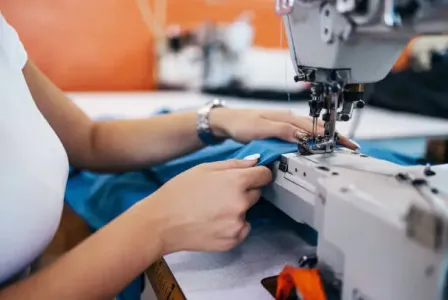
United Repair Centre (URC) is a Dutch B2B clothing repair company providing scalable, high-quality repair solutions to global apparel brands seeking to extend product lifespans and advance circularity. The company has built a business model generating a positive environmental impact through large-scale garment repair while creating inclusive employment opportunities for people facing barriers to the labour market.
United Repair Centre
Topics
Albania
Armenia
Austria
Belgium
Bosnia and Herzegovina
Bulgaria
Croatia
Cyprus
Czechia
Denmark
Estonia
EU-27
Finland
France
Georgia
Germany
Greece
Hungary
Iceland
Ireland
Italy
Kosovo
Latvia
Liechtenstein
Lithuania
Luxembourg
Malta
Moldova
Montenegro
Netherlands
North Macedonia
Norway
Poland
Portugal
Romania
Serbia
Slovakia
Slovenia
Spain
Sweden
Switzerland
Türkiye
Ukraine
Other
Academic / Research and VET Institutions
Business Support Organisation
Company with 250 or more employees
Cluster Organisations
Consumer Organisations
Cultural and Heritage Organisations
Destination Management & Marketing Organisations
EU Institutions
Financial Institutions and Investors
Industry Associations and Chambers of Commerce
International Organisations
Local Authorities
Media / Journalist Organisations
National authorities
Networks and Federations / Confederations
NGOs / Non-profits
Notified Bodies
Regional Authorities
SMEs (a company with less than 250 employees)
Social Economy Entity
Trade Unions
Other
-
Transition Pathway's building blocks
-
-
R&I, techniques and technological solutions
-
Skills
-
Social dimension
-
Sustainable competitiveness
-
-
Industrial ecosystems
-
-
Textile
-
-
Textiles ecosystem areas
-
-
Apparel and clothing accessories
-
Waste management, reuse and repair
-
Business support and Communication
-
Share
A business model with a twofold objective
United Repair Centre is a B2B clothing repair service offering high-quality, scalable repair solutions to global brands, helping them extend garment lifespans. The company, founded in 2021 and headquartered in the Netherlands, currently operates in Amsterdam and London. The company became B Corp in 2024.
Since its start, the business model has not only been centred on an environmentally virtuous circle, but also on a social dimension: creating job opportunities for people facing barriers to entering the labour market.
An inclusive and diverse workforce
According to its last impact report, as of July 2025, United Repair Centre can count on a team of 52 workers, with 18 new hires in 2024.
The team composition reflects the company’s commitment to building a more inclusive labour market: 63% of tailors are women, 75% are newcomers with refugee backgrounds, and 18 nationalities are represented in the workforce. Furthermore, to reinforce its commitment, the company employs 2.9 FTE (full-time equivalent) individuals with disabilities, including occupational disabilities, and 1.6 FTE individuals with a history of long-term unemployment. By embedding inclusion into its recruitment and workforce structure, the company enables employees to develop professional skills while strengthening their language proficiency, thereby facilitating their integration into the labour market. In 2024, the company strengthened this pathway by launching the United Repair Academy with ROC van Amsterdam (Fashion Studies). This work-learning programme trains aspiring garment repairers and supports their transition into paid roles.
Scaling environmental benefits through repair
As the workforce and skills base expanded, the company scaled up its operational capacity and environmental impact. In 2024, it repaired an estimated 29,545 garments, corresponding to average CO₂ savings of 159,247 kg. By July 2025, the cumulative number of repaired items had further reached 72,000.
Partnerships with brands and collaborative initiatives
According to its latest impact report, as of July 2025, United Repair Centre has onboarded 27 brand partners, including 14 new partners in 2024. Starting with Patagonia, the company has since added several industry leaders, including The North Face, Arc’teryx, Jack Wolfskin, Rapha, Lululemon, Decathlon, and Levi’s. In some cases, these collaborations also include on-site repair stations (e.g. the one implemented in 2024 at North Face in Switzerland), repair pop-ups activated in high-traffic settings to deliver live garment fixes and engage customers around circularity (e.g. with Patagonia at the Down The Rabbit Hole festival, 2024) or hands-on workshop with store managers, offering them direct experience of the repair process and demonstrating its tangible impact (e.g. Lululemon).
The company also launched the Renew service (assessment and grading, washing, reproofing, and repair), which converts unsold or returned items into resale-ready products, helping brands boost their circularity profile and engage customers.
Conclusion
The company’s results - growth in brand collaborations, workforce expansion, and the rising number of garments repaired - demonstrate that clothing repair can scale in a way that is both commercially viable and socially responsible. By combining measurable environmental benefits with inclusive employment and skills development, United Repair Centre is building a model that delivers impact at scale.
Additionally, United Repair Centre tackles a systemic challenge: green transition cannot be delivered by brands alone. By providing scalable repair infrastructure and expertise that brands might lack in-house, it removes operational barriers and accelerates circularity implementation.
Comments (0)
See also
Prolonging the lifespan of denim: repair and reuse services at Nudie Jeans
- Categories
- R&I, techniques and technological solutions Skills Social dimension +10 more

BALI Chaire: Multi-stakeholder collaboration as a driver of systemic change
- Categories
- R&I, techniques and technological solutions Skills Social dimension +9 more
Industrial symbiosis: textile waste as a resource for furniture production
- Categories
- Infrastructure Investments and funding R&I, techniques and technological solutions +10 more