

Best practices
18 August 2026
Improving textile waste collection through digitalisation: the case of Sensoneo smart waste monitoring technology
Best practices
18 August 2026
Login / create an account to be able to react
-
121
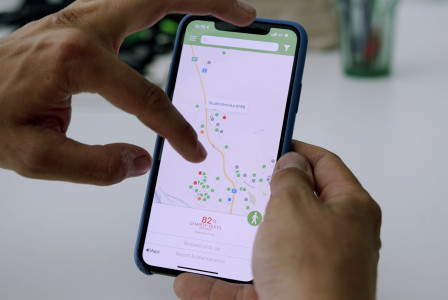
Since January 2025, EU Member States have been required to collect textiles separately for reuse and recycling, increasing the volumes that collection operators must manage. Handling this growth well depends on efficient, well-functioning collection systems, which are the basis of a circular textile value chain. In this context, digital technologies offer a way to make textile collection more efficient and economically viable. Sensoneo, a Slovak waste-management technology provider, provides an example of how smart ultrasonic fill-level sensors can shift bin servicing from fixed schedules to actual demand, cutting collection costs and unnecessary vehicle journeys while improving service reliability.
Sensoneo
Topics
Albania
Armenia
Austria
Belgium
Bosnia and Herzegovina
Bulgaria
Croatia
Cyprus
Czechia
Denmark
Estonia
EU-27
Finland
France
Georgia
Germany
Greece
Hungary
Iceland
Ireland
Italy
Kosovo
Latvia
Liechtenstein
Lithuania
Luxembourg
Malta
Moldova
Montenegro
Netherlands
North Macedonia
Norway
Poland
Portugal
Romania
Serbia
Slovakia
Slovenia
Spain
Sweden
Switzerland
Türkiye
Ukraine
Other
Academic / Research and VET Institutions
Business Support Organisation
Company with 250 or more employees
Cluster Organisations
Consumer Organisations
Cultural and Heritage Organisations
Destination Management & Marketing Organisations
EU Institutions
Financial Institutions and Investors
Industry Associations and Chambers of Commerce
International Organisations
Local Authorities
Media / Journalist Organisations
National authorities
Networks and Federations / Confederations
NGOs / Non-profits
Notified Bodies
Regional Authorities
SMEs (a company with less than 250 employees)
Social Economy Entity
Trade Unions
Other
-
Transition Pathway's building blocks
-
-
R&I, techniques and technological solutions
-
Sustainable competitiveness
-
-
Industrial ecosystems
-
-
Textile
-
-
Textiles ecosystem areas
-
-
Waste management, reuse and repair
-
Share
The challenges of post-consumer textile waste collection
The vast majority (87%) of European textile waste (15 MT in 2025) consists of post-consumer textiles, mainly discarded by households.1 Most of these textiles are collected from bins and drop-off points through which citizens return used clothing.
The revised Waste Framework Directive, which requires EU Member States to collect textiles separately for reuse and recycling since 1 January 2025, has increased the volumes that operators must manage and represents a fundamental step towards circularity. At the same time, the resulting increase in collected volumes places additional pressure on collection networks, requiring operators to service a larger number of bins while controlling transport, labour and logistics costs. This makes more accurate monitoring increasingly important, creating a clear role for digital technologies in improving the efficiency and economic sustainability of collection systems.
Sensoneo: a technology provider for data-driven waste management
Sensoneo is a Slovak-founded technology company established in 2017 that develops and provides smart, data-driven solutions for waste management and the circular economy. The company reports a turnover of EUR 15 million2 and a total workforce of more than 160 people, 128 of whom are in Slovakia. Sensoneo has an active presence in Europe, the United States, and Asia. Its technology is designed and developed in-house, and its hardware production takes place in the European Union.
The company’s activity centres on data-driven waste management and the digitalisation of circular-economy processes. It began with ultrasonic fill-level sensors combined with a cloud-based Waste Management System and has since broadened its portfolio to include route planning and collection optimisation, bin access management, factory waste management, take-back and reverse-logistics systems, and end-to-end IT systems for nationwide deposit-return schemes. Sensoneo has implemented and operated Deposit Return Scheme IT systems in nine countries.
In the textile collection sector, the company develops ultrasonic sensors for installation in textile collection bins. They transmit real-time fill-level data to the WMS, which supports route planning and a citizen-facing app, allowing operators to service bins according to actual demand rather than a fixed schedule. Sensoneo refers to this approach as dynamic collection, particularly suited to textile bins, whose filling patterns tend to be irregular and difficult to predict.
The adoption of smart sensors in textile waste collection: examples in Central and Eastern Europe
Two operators in Central and Eastern Europe, Ekocharita and TexCycle, provide examples of successful applications of Sensoneo’s technology for post-consumer textile collection. Both manage networks of bins through which citizens return used clothing and introduced fill-level sensors to replace fixed collection schedules with demand-based servicing.
Ekocharita is a Slovak non-profit association that collects, sorts, and directs used clothing, footwear, and household textiles towards reuse, donation, recycling, or other forms of recovery. It manages a network of around 1,300 bins in Slovakia and collects approximately 3,000 tonnes of textiles each year. After installing fill-level sensors in 600 of its bins in 2021, Ekocharita reported a 22% reduction in collection costs and a 29% reduction in the time required to collect each tonne of material. The new technology has enabled Ekocharita to guarantee the daily collection volume needed for smoother warehouse management. It has also improved reliability and prevented overflowing containers, translating into a competitive advantage over competitors.
TexCycle provides a second example with broader geographical scope. Established in Bulgaria in 2000, the company collects textile waste across Bulgaria, Romania, and Greece. It sorts approximately 70 tons of garments per day for reuse, maintains a mechanical recycling capacity of 1.5 tons per hour, and distributes second-hand clothing across five continents. Through these operations, TexCycle ranks among the region's largest full-circularity providers for managing textile waste.To optimize logistics, the company has also installed more than 400 sensors in bins across over 15 cities with sensors transmitting fill-level data to Sensoneo’s Waste Management System and the associated app making information on collection points available to citizens.
Operational, environmental and social benefits
The adoption of smart monitoring systems generates benefits that extend beyond direct savings in collection costs. For textile collectors, reliable servicing reduces the risk of overflowing bins and improves the quality of service offered to schools, universities, shopping centres, and other sites that host collection points. According to Ekocharita, this greater reliability also helped the organisation secure locations that competing operators had previously managed. At the same time, more predictable collection volumes support warehouse and logistics planning, while continuous monitoring can help identify irregular activity and reduce the risk of theft.
The same operational improvements also produce environmental benefits. Servicing bins according to their actual fill levels reduces unnecessary vehicle journeys, fuel consumption, and associated emissions, while also limiting traffic, noise, and litter around collection points. For example, in an interview published by Waste Management World, Sensoneo reported that some customers had reduced route duration and kilometres travelled by between 30% and 60%. These figures indicate the potential scale of the efficiency gains. The improvements in drivers’ working conditions add a further social dimension.
Conclusion
Digitalising textile waste collection does not, by itself, close the material loop. However, it can strengthen a critical part of the circular value chain: the use of smart monitoring technology illustrates how accurate, real-time data can make collection more reliable, efficient, and economically viable. These aspects are crucial as operators continue to face persistently narrow margins that may discourage them from maintaining or expanding their collection activities. In addition, data-driven collection and route optimisation can generate broader environmental and social benefits by reducing unnecessary vehicle journeys and associated emissions, preventing overflowing containers, keeping public spaces cleaner, and improving working conditions for collectors.
1.Advancing Textile Circularity: Europe’s Textile Waste Surge. The Case for System-Level Scale-Up, Boston Consulting Group and ReHubs, 2026.
2. Data refers to SENSONEO j. s. a.., year 2025. Source: Orbis database, Bureau van Dijk / Moody’s Analytics.
Comments (0)
Connected Partnership Opportunities
See also

BALI Chaire: Multi-stakeholder collaboration as a driver of systemic change
- Categories
- R&I, techniques and technological solutions Skills Social dimension +9 more

Driving circularity through waste-derived materials in Textiles and Leather
- Categories
- Sustainable competitiveness Textile Fibres, yarns and fabrics +4 more
The role of trade fairs in supporting an ecosystem approach: the case of Textiles Recycling Expo
- Categories
- Infrastructure Investments and funding R&I, techniques and technological solutions +11 more