

Best practices
22 May 2026
Scaling industrial textile production in Bulgaria, with attention to environmental impacts: the case of E. Miroglio
Best practices
22 May 2026
Login / create an account to be able to react
-
198
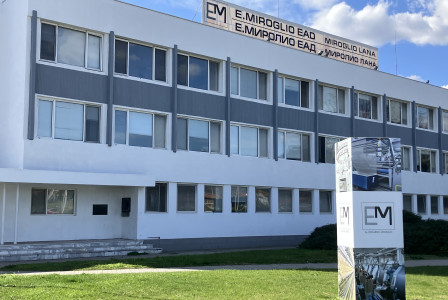
Bulgaria is a significant textile and clothing manufacturing hub in Europe, particularly for nearshoring and flexible production serving Western European markets. E. Miroglio, a company established through Italian investment and active in spinning, weaving, and clothing manufacturing, illustrates how industrial-scale textile production can be combined with active environmental management.
E. Miroglio
Topics
Albania
Armenia
Austria
Belgium
Bosnia and Herzegovina
Bulgaria
Croatia
Cyprus
Czechia
Denmark
Estonia
EU-27
Finland
France
Georgia
Germany
Greece
Hungary
Iceland
Ireland
Italy
Kosovo
Latvia
Liechtenstein
Lithuania
Luxembourg
Malta
Moldova
Montenegro
Netherlands
North Macedonia
Norway
Poland
Portugal
Romania
Serbia
Slovakia
Slovenia
Spain
Sweden
Switzerland
Türkiye
Ukraine
Other
Academic / Research and VET Institutions
Business Support Organisation
Company with 250 or more employees
Cluster Organisations
Consumer Organisations
Cultural and Heritage Organisations
Destination Management & Marketing Organisations
EU Institutions
Financial Institutions and Investors
Industry Associations and Chambers of Commerce
International Organisations
Local Authorities
Media / Journalist Organisations
National authorities
Networks and Federations / Confederations
NGOs / Non-profits
Notified Bodies
Regional Authorities
SMEs (a company with less than 250 employees)
Social Economy Entity
Trade Unions
Other
-
Transition Pathway's building blocks
-
-
Investments and funding
-
R&I, techniques and technological solutions
-
Sustainable competitiveness
-
-
Industrial ecosystems
-
-
Textile
-
-
Textiles ecosystem areas
-
-
Fibres, yarns and fabrics
-
Apparel and clothing accessories
-
Share
Bulgaria, a flexible textile manufacturing hub in Europe
Within the EU textile and clothing sector, Bulgaria is not one of the largest markets, but it plays a strategically relevant role as a competitive nearshoring and flexible manufacturing hub, primarily supporting apparel production for Western European brands. The sector counts approximately 4,000 companies active in textile and clothing production, including private-label manufacturers.1 Total Bulgarian textile and apparel production ranks the country among the top 10 in terms of turnover, just behind Poland and Romania in Eastern Europe.
E.Miroglio, a long history of investment in Bulgaria
In the mid-1990s, the Italian textile group Miroglio made its first investment in Bulgaria, attracted by competitive manufacturing costs, proximity to European markets, and access to skilled labour and technical expertise. The investment began with the acquisition of the Sliven wool mill, a historic site of the Bulgarian wool industry formerly known as Slitex. This allowed the company to develop production of worsted and woollen fabrics for men’s and women’s apparel, as well as yarns for knitwear. In 2006, the company was fully acquired by Edoardo Miroglio and became E. Miroglio EAD. Headquartered in Sliven, the company has vertically integrated operations, with manufacturing facilities in Sliven and Yambol, and a retail presence through the DiKa clothing brand in Sliven, Burgas, Varna, Sofia, Plovdiv and Veliko Tarnovo.2 The company employed 2,269 workers and generated EUR 130 million in turnover in 2024, growing by 20% in the last five years (source: Orbis database, Bureau van Dijk / Moody’s Analytics). Its activities include carded and worsted spinning of wool and cotton, weaving, dyeing and finishing, knitting, and the design and manufacture of clothing models.
Embedding Sustainability in Industrial Textile Manufacturing
The company works with major global fashion brands and has invested in modern textile technologies, for both woven and knitted textiles, and sustainable manufacturing processes to improve efficiency and reduce environmental impacts. As set out in its ESG report, the company is committed to sustainable development and environmental protection, integrating environmental management, certified materials, traceability, and resource-efficiency measures throughout its production chain. It operates under a range of internationally recognised frameworks and certifications, including SA8000, ISO 14001, ISO 45001, ISO 9001, FSC, OEKO-TEX® STeP, Standard 100, Higg Index, ZDHC, GOTS, GRS, OCS, RWS and has also invested in lifecycle assessment (LCA), wastewater monitoring, and eco-certified yarns. As part of its efforts to reduce its carbon footprint, the company has established an annual data collection and reporting process aimed at tracking resource use over time and driving improvements in production efficiency and environmental performance.
Conclusion
E. Miroglio’s efforts to reduce environmental impacts while operating at an industrial scale make it a useful example of good practice in the transition towards a more circular and transparent textile industry. Given its scale and prominence in Bulgaria, the company is of particular significance at the national level, while its role as a supplier to the European textile value chain makes it significant also for the broader regional ecosystem.
1 Eurostat. Enterprise statistics by size class and NACE Rev. 2 activity (from 2021 onwards). Structural Business Statistics, dataset (NACE 13: 725 companies, NACE 14: 3,204 companies)
2 The company also has workshops in Italy.
Comments (0)
Connected Partnership Opportunities
See also
The role of trade fairs in supporting an ecosystem approach: the case of Textiles Recycling Expo
- Categories
- Infrastructure Investments and funding R&I, techniques and technological solutions +11 more
Industrial symbiosis: textile waste as a resource for furniture production
- Categories
- Infrastructure Investments and funding R&I, techniques and technological solutions +10 more
Prolonging the lifespan of denim: repair and reuse services at Nudie Jeans
- Categories
- R&I, techniques and technological solutions Skills Social dimension +10 more