

Articles
10 February 2026
Earning travelers’ trust with personal data
Articles
10 February 2026
Login / create an account to be able to react
-
180
Tourism & hospitality organisations must do more than tick legal boxes if they want to earn real trust and acceptance from travelers when handling their personal data. A new international study reveals what travelers truly expect and what tourism businesses should do to meet that expectation.
Today’s tourism industry collects and processes large, varied volumes of travelers’ personal data, from basic identification and contact details to preferences, consumption patterns, and sensitive travel-related information. At the same time, digital technologies are expanding the scale and complexity of data handling across hotels, travel agencies, airlines, and other tourism actors.
Against rising concerns about data protection and privacy, researchers from Babeș-Bolyai University (Romania) and Auckland University of Technology (New Zealand) investigated the key factors and conditions that enable tourism and hospitality organisations to gain travelers’ trust and social license (i.e., genuine acceptance) in how they manage personal data.
Babeş-Bolyai University
Auckland University of Technology
Babeş-Bolyai University
Topics
Romania
Company with 250 or more employees
Consumer Organisations
Destination Management & Marketing Organisations
Industry Associations and Chambers of Commerce
SMEs (a company with less than 250 employees)
-
Specific types of tourism
-
-
Adventure tourism
-
Coastal, maritime and inland water tourism
-
Cultural tourism
-
Ecotourism
-
Education tourism
-
Festival tourism
-
Gastronomy tourism
-
Health and medical tourism
-
MICE tourism
-
Mountain tourism
-
Religious tourism
-
Rural tourism
-
Sports tourism
-
Urban/city tourism
-
Wellness tourism
-
-
Transition Pathway Strategic Areas
-
-
Digitalisation of tourism SMEs and destinations
-
Tools for data on tourism
-
-
Business activities
-
-
Activities of amusement parks and theme parks
-
Activities of associations and other organisations supporting tourism
-
Air passenger transport
-
Camping grounds, recreational vehicle parks and trailer parks
-
Events catering and other food services
-
Festivals, cultural and entertainment activities
-
Gardens and nature reserves activities
-
Holiday Housing / Apartments and other short stay accommodation
-
Hotel and similar accommodation
-
Mobile beverage services
-
Mobile food services
-
Museums
-
Operation of historical sites
-
Other
-
Other accommodation
-
Other amusement and recreation activities
-
Other food and beverage services
-
Other holiday reservation services
-
Other tourism transportation activities
-
Rail Passenger transport
-
Recreational and sport activities
-
Restaurants, cafes and bars (Food and Beverage serving activities)
-
Road passenger transport
-
Tour operator activities
-
Travel agency activities
-
Water (sea, coastal and inland) passenger transport
-
Share
Tourism is increasingly driven by data. Across the traveler journey, from online searches and bookings to check-in, on-site services, and loyalty programs, tourism & hospitality organizations collect and process large volumes of personal information.
As digital technologies become standard across the sector, including mobile travel apps, contactless services, digital keys, the amount and sensitivity of traveler data processed by tourism and hospitality organizations continue to grow. At the same time, data breaches, opaque data uses, and growing public awareness of privacy rights have increased travelers’ concerns about how their personal information is handled and whether data requests are justified and fair.
Against this backdrop, a new study by researchers from Babeș-Bolyai University and Auckland University of Technology identifies the key drivers and conditions that enable tourism and hospitality organizations to gain travelers’ trust in their personal data practices, moving the focus beyond formal compliance toward perceived fairness, transparency, usefulness, and user control.
Beyond compliance: what travelers really want
Based on a survey of 875 travelers, the study shows that simply having privacy policies or consent checkboxes does not mean that travelers genuinely accept how their personal data is collected and used. Legal compliance is just not enough.
Real acceptance (i.e., social license) and trust occur only when, beyond legal compliance, tourism & hospitality organizations (hotels, travel agencies, airlines etc.) demonstrate:
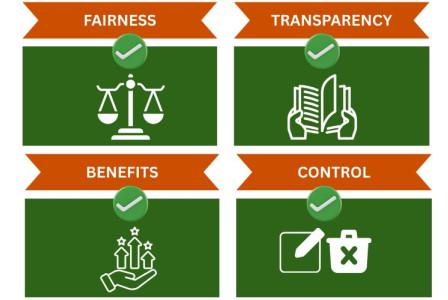
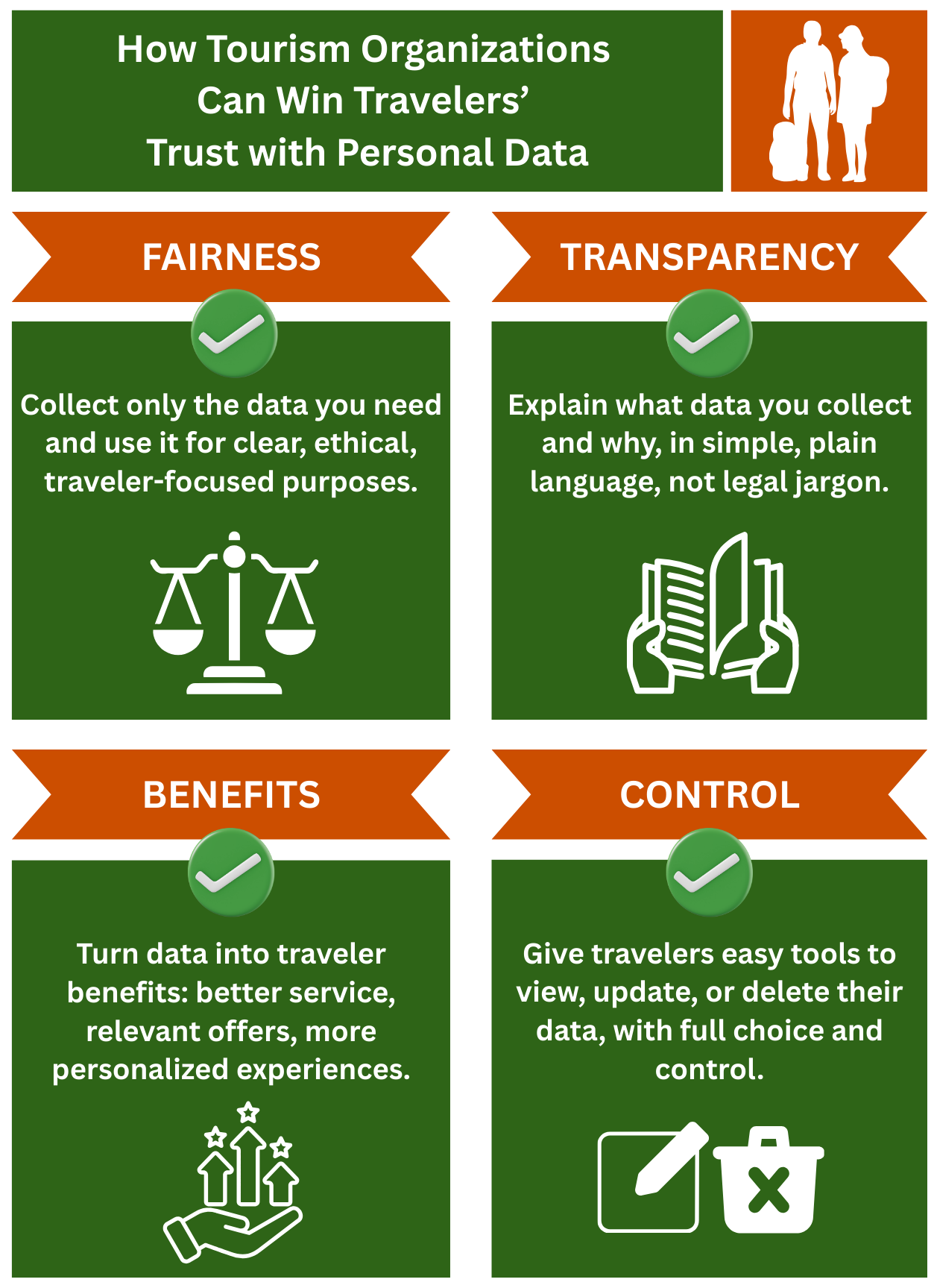
- Fairness. Travelers need to feel that their data is collected for justified reasons and used in their best interest.
- Transparency. Clear, easy-to-understand explanations about what data is collected and why are essential.
- Usefulness. Travelers must also see concrete benefits from sharing their data, such as better services, more relevant offers, faster processes, and more personalized experiences.
- Privacy control. Giving travelers meaningful control over their personal data is also a key trust builder.
Fairness is the key driver
The findings show that fairness is the strongest predictor of travelers' trust in personal data management and the social license they grant to tourism & hospitality organizations to handle their data (i.e., genuine acceptance of personal data collection and processing).
In practice, this means travelers are far more willing to share data when companies are perceived as:
- not collecting excessive or irrelevant information;
- using data responsibly for meaningful outcomes;
- acting in a customer-focused way rather than for purely commercial reasons.
Practical actions for tourism & hospitality organisations
For tourism & hospitality companies, the study's findings translate into concrete actions that are needed to build trust and, eventually, to obtain travelers' social license for data practices:
- Organizations should clearly explain the customer the reason and benefit behind each data request. For example, a hotel might state: “We ask for this information to reduce your check-in time.”
- Data collection should be directly linked to visible and useful features, such as room personalization or faster customer support.
- Companies should avoid excessive or precautionary data collection without a clear purpose.
- Companies should communicate their data practices in transparent, accessible language, not only through complex legal phrasing.
- Just as importantly, travelers should be given simple ways to update or delete their stored personal data, ensuring real control over the information they share.
Fairness, transparency, user benefits, and user control are essential drivers of trust and willingness to share personal data with tourism companies. It is not just about protecting data, but about collecting it with clear justification and using it responsibly and in the traveler’s interest
The research conducted by Anca C. Yallop (AUT Business School, Auckland University of Technology), Ovidiu I. Moisescu (Faculty of Economics and Business Administration, Babeș-Bolyai University), and Oana A. Gică (Faculty of Business, Babeș-Bolyai University) was published in the Journal of Hospitality Marketing & Management (Taylor & Francis). The full paper is freely accessible at https://doi.org/10.1080/19368623.2026.2623416
Comments (1)
Related content


See also

From Guesswork to Governance: The EU’s Move Toward Smarter STR Data
- Categories
- Coastal, maritime and inland water tourism Cultural tourism Ecotourism +64 more

Best Practices and National Tourism Strategies Across the European Union
- Categories
- Coastal, maritime and inland water tourism Cultural tourism Ecotourism +64 more

Strengthening the Foundations of Sustainable Tourism through Data: The Role of ETDS and Key EU Projects
- Categories
- Coastal, maritime and inland water tourism Cultural tourism Ecotourism +42 more
PricewaterhouseCoopers Business Solutions SA,
Greece
Very insightful research! it shows that real trust in personal data use in the tourism sector goes far beyond formal compliance. What truly matters to travellers is fairness, transparency and meaningful control.