

Funding Toolkit
Using the Toolkit
EU funding programmes offer important opportunities for tourism businesses, especially small and medium sized enterprises (SMEs), to innovate, cooperate and contribute to wider EU policy objectives. However, EU funding is competitive and follows specific rules and expectations that may differ from national or regional support schemes.
This Toolkit is designed to help tourism businesses, especially SMEs operating in the tourism ecosystem (accommodation, tour operators, experiences, attractions, destination services, and tourism tech), by highlighting common good practices (Dos) and frequent mistakes (Don’ts) observed across EU tourism related funding programmes
The Toolkit is comprised of four main sections, namely: the Frequently Asked Questions (FAQs), the Dos and Don’t Manual, the General Guidelines for improving the quality of applications, and the Compendium of Best Practices. Albeit the four can be used as standalone documents, together they aim to assist the tourism business stakeholders, especially SMEs in their journey for securing funding.
The Frequently Asked Questions (FAQs)
The Frequently Asked Questions (FAQs) section provides practical answers to the most common questions tourism SMEs and other stakeholders encounter when exploring EU funding opportunities. It explains key concepts, eligibility requirements, application processes and funding rules in clear and accessible language, helping users better understand how EU funding works and what to expect when preparing an application. While the FAQs offer practical guidance and orientation, applicants should always refer to the specific documentation and requirements of each funding opportunity before applying.

Dos and Don’ts Manual
The Dos and Don’ts Manual covers the full application lifecycle: selecting the right call, designing a fundable project, producing a complete application (forms, narrative, annexes), submitting through the relevant portal, and preparing for contracting and reporting.
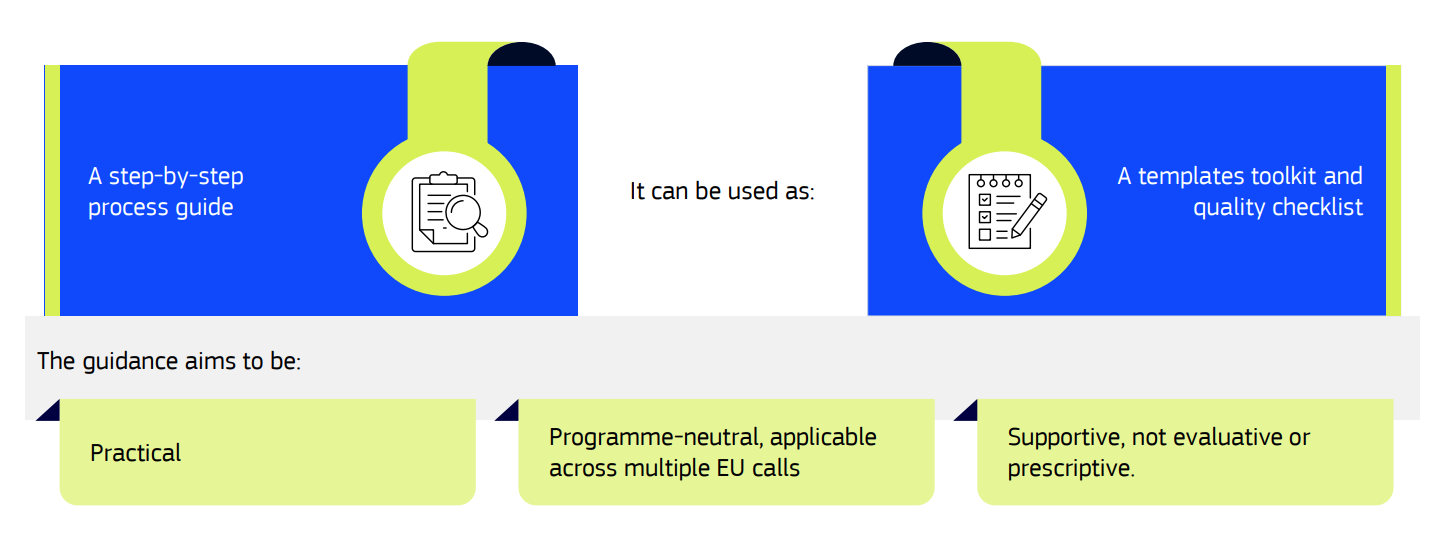
It is noted that where a call provides its own template or other specific instructions, the applicant should always follow the call’s requirements and templates.

General Guidelines
The General Guidelines respond to the need to improve the quality, effectiveness, and success of tourism SMEs applications to EU funding programmes. Its purpose is to provide a set of clear, evidence-based general guidelines that support tourism SMEs in navigating the complexity of EU funding mechanisms and in submitting stronger and more competitive applications.

Compendium of Best Practices
The Compendium of Best Practices is a practical, evidence-based reference that showcases how tourism organisations have successfully accessed European, national and regional funding. Drawing on real examples, it provides SMEs with practical insights into funding pathways, common challenges and the organisational and strategic factors that support successful applications. By illustrating how funding has been secured in practice, the Compendium aims to help tourism SMEs better understand available opportunities, reduce uncertainty and strengthen their capacity to access public funding. The common mistakes when applying for EU funding sub-section complements the Compendium by presenting the “negative mirror” of successful applications, and it is based on barriers, challenges and lessons learned reported by SMEs, comparative analysis across successful trajectories and reconstruction of failure patterns from real application experience.

Reusable components checklist

This Toolkit does not replace official call documents, nor does it guarantee funding. Its purpose is to help applicants better understand what evaluators typically expect and how to avoid avoidable weaknesses.