

Best practices
26 October 2026
Casa da Guitarra - Using Specialized Platforms to Accelerate Access to Funding
Best practices
26 October 2026
Login / create an account to be able to react
-
3
Editorial team
Topics
Albania
Armenia
Austria
Belgium
Bosnia and Herzegovina
Bulgaria
Croatia
Cyprus
Czechia
Denmark
Estonia
EU-27
Finland
France
Georgia
Germany
Greece
Hungary
Iceland
Ireland
Italy
Kosovo
Latvia
Liechtenstein
Lithuania
Luxembourg
Malta
Moldova
Montenegro
Netherlands
North Macedonia
Norway
Poland
Portugal
Romania
Serbia
Slovakia
Slovenia
Spain
Sweden
Switzerland
Türkiye
Ukraine
Other
Academic / Research and VET Institutions
Business Support Organisation
Company with 250 or more employees
Cluster Organisations
Consumer Organisations
Cultural and Heritage Organisations
Destination Management & Marketing Organisations
EU Institutions
Financial Institutions and Investors
Industry Associations and Chambers of Commerce
International Organisations
Local Authorities
Media / Journalist Organisations
National authorities
Networks and Federations / Confederations
NGOs / Non-profits
Notified Bodies
Regional Authorities
SMEs (a company with less than 250 employees)
Social Economy Entity
Trade Unions
Other
-
Specific types of tourism
-
-
Adventure tourism
-
Coastal, maritime and inland water tourism
-
Cultural tourism
-
Ecotourism
-
Education tourism
-
Festival tourism
-
Gastronomy tourism
-
Health and medical tourism
-
MICE tourism
-
Mountain tourism
-
Religious tourism
-
Rural tourism
-
Sports tourism
-
Urban/city tourism
-
Wellness tourism
-
-
Transition Pathway Strategic Areas
-
-
Accessible tourism services
-
Best practices, peer learning and networking
-
Changes in tourism demand and opportunities
-
Circularity of tourism services
-
Coordinated information on travelling
-
Cross-border travelling
-
Digitalisation of tourism SMEs and destinations
-
Equal and fair tourism jobs
-
Funding and support measures
-
Governance of tourism destinations
-
Green Transition of Tourism Companies and SMEs
-
Improving formal education
-
Improving statistics and indicators
-
Innovative tourism services
-
Multimodal travelling
-
Online visibility of tourism offer
-
Pact for skills
-
Promoting PEF/OEF methods for tourism
-
R&I on climate-friendly tourism
-
R&I on digital tools for tourism
-
Short-term rentals
-
Skills needs for twin transition
-
Sustainable mobility
-
Tools for data on tourism
-
Tourism strategies
-
Training opportunities
-
Well-being of residents
-
-
Business activities
-
-
Activities of amusement parks and theme parks
-
Activities of associations and other organisations supporting tourism
-
Air passenger transport
-
Camping grounds, recreational vehicle parks and trailer parks
-
Events catering and other food services
-
Festivals, cultural and entertainment activities
-
Gardens and nature reserves activities
-
Holiday Housing / Apartments and other short stay accommodation
-
Hotel and similar accommodation
-
Mobile beverage services
-
Mobile food services
-
Museums
-
Operation of historical sites
-
Other
-
Other accommodation
-
Other amusement and recreation activities
-
Other food and beverage services
-
Other holiday reservation services
-
Other tourism transportation activities
-
Rail Passenger transport
-
Recreational and sport activities
-
Restaurants, cafes and bars (Food and Beverage serving activities)
-
Road passenger transport
-
Tour operator activities
-
Travel agency activities
-
Water (sea, coastal and inland) passenger transport
-
Share
Scope of the programme
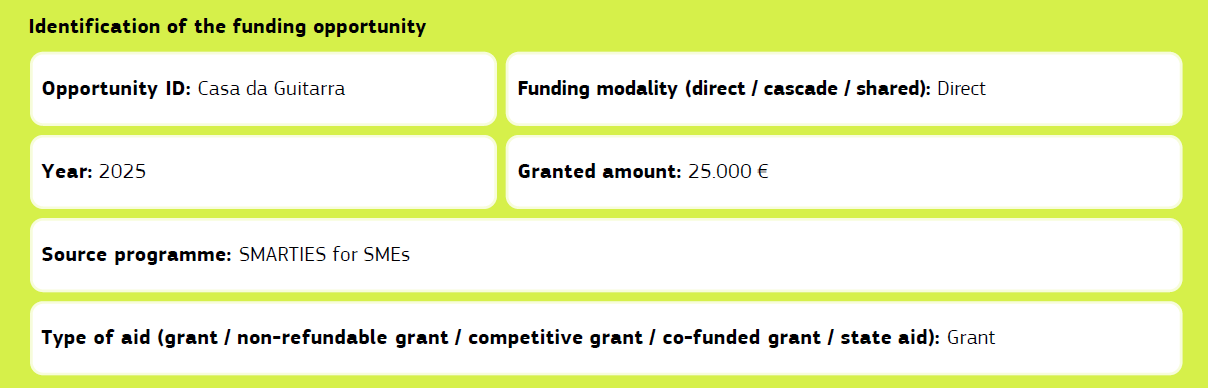
• Countries impacted: The SMARTIES for SMEs funding scheme targets SMEs across five Mediterranean countries: Italy, Greece, Slovenia, Portugal, and Cyprus.
• Thematic axis:
- Green & Digital Transition: Supporting tourism SMEs in adopting environmentally sustainable practices and digital innovations to strengthen resilience and competitiveness.
- Regenerative Tourism: Promoting tourism models that restore, enhance, and positively impact local communities and environments, moving beyond traditional sustainability.
- Tourism–Agri-Food Synergies: Encouraging integration between tourism and the agri-food ecosystem, with a strong emphasis on the Mediterranean Diet as a sustainability & cultural anchor.
• Funding programme lineage (EU, national, regional): national
Description of the project
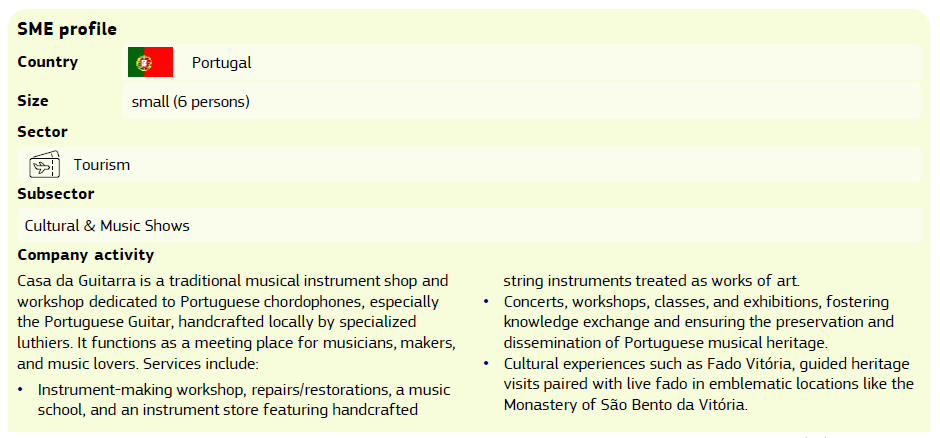
• Project objective(s): Given its strong experience-based model (craftsmanship, performances, cultural storytelling), the project’s aims to enhance digital transformation (e.g., digital storytelling, online cultural products, ticketing, immersive presentations).
• Duration: 10 months (from January 2025 to October 2025)
• Main activities: The focus of the project was the digitalization of an exhibition we have here about the history of the Portuguese string instruments, the main activities are:
- To capture the exhibition & to make it online in our website.
- The second biggest part was to do a 3D model of the Portuguese guitars because they have an old collection of them.
- Lastly, they developed a lot of research about the history of Fado in Porto.
• Outputs: N/A
Type of application
• Single applicant: Yes
• Consortium members: N/A
• Subcontractor: No
Success Factors
• Strategic fit with call priorities: The strategic fit of Casa da Guitarra’s project was decisive in securing the funding because the proposal aligned perfectly with the call’s core priority: the digitalisation of cultural and tourism-related content. As the only business in Porto dedicated to preserving and showcasing the history of Portuguese string instruments, Casa da Guitarra offered a uniquely relevant cultural asset that matched the programme’s objective of promoting sustainable and digital tourism experiences. Their plan to digitalise their physical exhibition, create 3D models of historic instruments, and expand research on the cultural heritage of Fado directly mirrored the call’s intent to broaden access to cultural knowledge through digital channels.
• Use of support ecosystems: UPTEC played a central and indispensable role in Casa da Guitarra’s success in securing the funding, acting as the key enabling institution throughout the entire process. First, UPTEC was the organisation that initially informed them about the call, channelled through the Tourism Institute of Porto, ensuring the company became aware of an opportunity that was very likely to fit their profile. UPTEC also guided them through the proposal-development phase by providing a session where the guidelines were explained and by offering direct support through a contact person available for questions during the final days of preparation. Once the project was approved, UPTEC continued to be instrumental: they assigned a dedicated grant manager who held periodic follow-up meetings and monitored progress, and they also provided access to a pool of mentors from which Casa da Guitarra selected the two specialists who supported branding, cultural content, and technological aspects of the project. These mentors, funded as part of the call’s benefits, opened doors to new technical contacts and helped overcome internal capability gaps.
Barriers & Challenges
• Time & resource constraints: The main difficulty faced by Casa da Guitarra during the project was the limited financial support provided, which proved insufficient to execute the digitalisation plan as originally conceived. Although the 25.000 € grant enabled progress, the cost of core activities (particularly the 3D modelling of historical Portuguese instruments) far exceeded the available budget, with the company noting that a single 3D scan could consume the entire funding amount. As a result, they were forced to significantly adapt the scope, opting for lower-cost photographic 3D models that could not fully capture the texture and technical detail they had initially intended to showcase. This financial constraint not only reduced the ambition of the digital outputs but also required revising the project approach and timeline to fit within the restricted resources.
Lessons learned
• Reaffirming the Value of the Project’s Core Concept: Casa da Guitarra would fully repeat the core idea of the project, as its strong alignment with the call’s priorities proved to be one of the main reasons for its success. The concept of digitalising their unique cultural exhibition, creating 3D representations of historic Portuguese instruments, and expanding access to musical heritage perfectly matched the fund’s focus on sustainable and digital tourism. They emphasised that the proposal was conceptually solid, beneficial for their long-term strategy, and well-positioned within the cultural-tourism landscape of Porto.
• Deep analysis of technical and financial requirements before applying: The main lesson learned was the importance of researching technical & financial requirements more thoroughly before defining the project scope. The team realised that key components were far more expensive and complex than anticipated. This lack of early technical research led to significant delays, forced them to reconsider their approach, & ultimately required scaling down the original ambition to fit the limited budget.
This best practice shows that tourism SMEs can boost their chances of winning digital-innovation funding by using specialised support platforms. Casa da Guitarra’s experience demonstrates that aligning a project with programme priorities and relying on expert guidance (from incubators or mentoring networks) helps overcome technical gaps and strengthens proposals.
Comments (0)
Connected Partnership Opportunities
See also
ENNOV Solutions - Building a Competitive EU Funding Proposal as a Solo Founder
- Categories
- Coastal, maritime and inland water tourism Cultural tourism Ecotourism +64 more
Conrad Events - Prototype-Driven Access to EU Funding for Innovation-Heavy Tourism SMEs
- Categories
- Coastal, maritime and inland water tourism Cultural tourism Ecotourism +64 more
Fattoria delle Api - Leveraging Small Cascade Funding to Build Sustainability Capacity
- Categories
- Coastal, maritime and inland water tourism Cultural tourism Ecotourism +64 more