

Best practices
26 October 2026
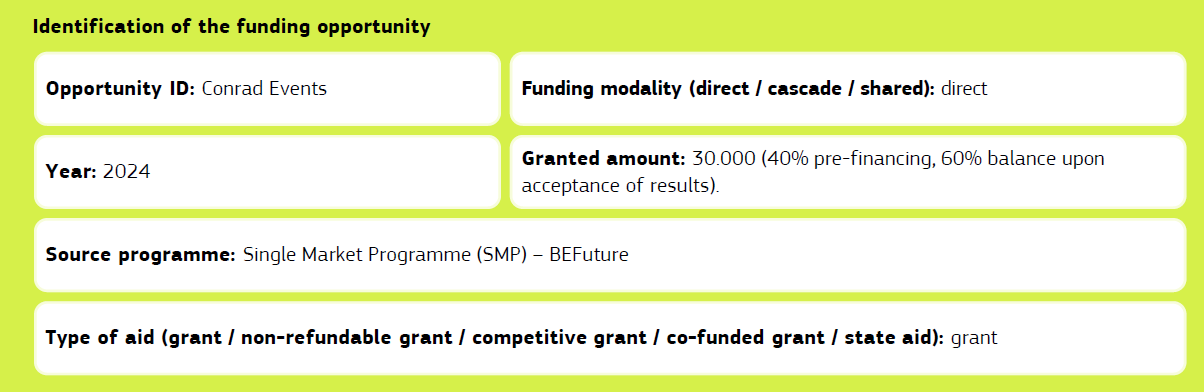
Conrad Events - Prototype-Driven Access to EU Funding for Innovation-Heavy Tourism SMEs
Best practices
26 October 2026
Login / create an account to be able to react
-
2
Editorial team
Topics
Albania
Armenia
Austria
Belgium
Bosnia and Herzegovina
Bulgaria
Croatia
Cyprus
Czechia
Denmark
Estonia
EU-27
Finland
France
Georgia
Germany
Greece
Hungary
Iceland
Ireland
Italy
Kosovo
Latvia
Liechtenstein
Lithuania
Luxembourg
Malta
Moldova
Montenegro
Netherlands
North Macedonia
Norway
Poland
Portugal
Romania
Serbia
Slovakia
Slovenia
Spain
Sweden
Switzerland
Türkiye
Ukraine
Other
Academic / Research and VET Institutions
Business Support Organisation
Company with 250 or more employees
Cluster Organisations
Consumer Organisations
Cultural and Heritage Organisations
Destination Management & Marketing Organisations
EU Institutions
Financial Institutions and Investors
Industry Associations and Chambers of Commerce
International Organisations
Local Authorities
Media / Journalist Organisations
National authorities
Networks and Federations / Confederations
NGOs / Non-profits
Notified Bodies
Regional Authorities
SMEs (a company with less than 250 employees)
Social Economy Entity
Trade Unions
Other
-
Specific types of tourism
-
-
Adventure tourism
-
Coastal, maritime and inland water tourism
-
Cultural tourism
-
Ecotourism
-
Education tourism
-
Festival tourism
-
Gastronomy tourism
-
Health and medical tourism
-
MICE tourism
-
Mountain tourism
-
Religious tourism
-
Rural tourism
-
Sports tourism
-
Urban/city tourism
-
Wellness tourism
-
-
Transition Pathway Strategic Areas
-
-
Accessible tourism services
-
Best practices, peer learning and networking
-
Changes in tourism demand and opportunities
-
Circularity of tourism services
-
Coordinated information on travelling
-
Cross-border travelling
-
Digitalisation of tourism SMEs and destinations
-
Equal and fair tourism jobs
-
Funding and support measures
-
Governance of tourism destinations
-
Green Transition of Tourism Companies and SMEs
-
Improving formal education
-
Improving statistics and indicators
-
Innovative tourism services
-
Multimodal travelling
-
Online visibility of tourism offer
-
Pact for skills
-
Promoting PEF/OEF methods for tourism
-
R&I on climate-friendly tourism
-
R&I on digital tools for tourism
-
Short-term rentals
-
Skills needs for twin transition
-
Sustainable mobility
-
Tools for data on tourism
-
Tourism strategies
-
Training opportunities
-
Well-being of residents
-
-
Business activities
-
-
Activities of amusement parks and theme parks
-
Activities of associations and other organisations supporting tourism
-
Air passenger transport
-
Camping grounds, recreational vehicle parks and trailer parks
-
Events catering and other food services
-
Festivals, cultural and entertainment activities
-
Gardens and nature reserves activities
-
Holiday Housing / Apartments and other short stay accommodation
-
Hotel and similar accommodation
-
Mobile beverage services
-
Mobile food services
-
Museums
-
Operation of historical sites
-
Other
-
Other accommodation
-
Other amusement and recreation activities
-
Other food and beverage services
-
Other holiday reservation services
-
Other tourism transportation activities
-
Rail Passenger transport
-
Recreational and sport activities
-
Restaurants, cafes and bars (Food and Beverage serving activities)
-
Road passenger transport
-
Tour operator activities
-
Travel agency activities
-
Water (sea, coastal and inland) passenger transport
-
Share
Scope of the programme
• Countries impacted: Spain, Belgium, France, Germany, The Netherlands and Italy
• Thematic axis:
- sustainability transition,
- digital transformation,
- innovation support,
- cross-border collaboration.
• Funding programme lineage (EU, national, regional): National (EU-framed initiative implemented regionally (EU-coordinated concept delivered through regional/national tourism boards)
Description of the project
• Project objective(s): design and prototype an open-ear, bone-conduction headset (“CHEERS – Choose Your Ears”) tailored to the MICE context, enabling guided tours/workshops where users must hear their surroundings (traffic, colleagues). Also make a demo of working prototypes at IBTM Barcelona and advance TRL for a manufacturable product and explore market/industrialisation pathways.
• Duration: 12 months (started spring 2024, active work extended about a year)
• Main activities:
- Technical benchmarking against existing open-ear devices.
- Hardware design and rapid prototyping with suppliers in Israel, Hong Kong and China.
- Branding/website and minimal marketing within tight category caps.
- Piloting/demos at IBTM Barcelona, kick-off and closing events (Brussels, Ghent).
- Compliance exploration (Bluetooth qualification, patent/licensing risk review)
• Outputs:
- +5 working prototypes showcased at IBTM.
- A functioning product concept ready for first 1,000–2,000-unit order (pending IP risk mitigation).
- Brand/name (CHEERS) and a basic website/promo asset
Type of application
• Single applicant: Yes
• Consortium members: No
• Subcontractor: No
Success Factors
• Quality of proposal
- Clear, tangible hardware outcome solving an operational pain point for guided activities where situational awareness is critical.
- Direct industry fit (MICE) and live trade-fair demonstration plan.
- Lean collaboration with a highly skilled wireless engineer, accelerating technical problem-solving.
• Strategic fit with call priorities
• It addressed innovation in business events, safety/usability in urban environments, and deployable prototypes for immediate industry uptake (exactly what the BeFuture call sought to surface for Europe’s events ecosystem).
• Team design & resources
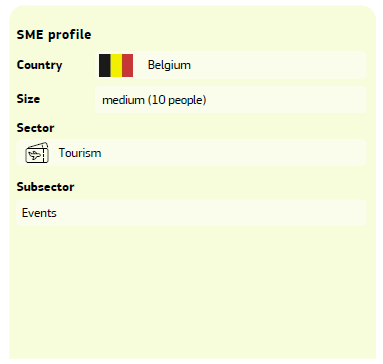
- Core SME team (10 staff) led development, with the CEO investing +300 personal hours.
- External wireless expert contributed significant specialist R&D time.
- Coach embedded by the programme for guidance.
- Suppliers in Israel/Hong Kong/China for fast prototyping.
• Use of support ecosystems
- Close, human support from Tourism Flanders/Brussels (direct email/phone contact, responsive clarification).
- Trade-fair organisers provided a platform (though booth placement/exposure was suboptimal—see challenges).
Barriers & Challenges
• Time & resource constraints
- Rigid budgeting Excel “straight-jacket” with narrow cost categories and caps (e.g., marketing max 15%).
- Ineligibility of own staff time, despite R&D-heavy work (CEO alone invested +300 hours unfunded).
• Lack of support ecosystem: Sought risk/production insurance (e.g., via Flanders Investment & Trade or private insurers) for the first 1,000–2,000 units, but no suitable cover for the real commercial risks (IP challenges, DOA batches) was found.
Lessons learned
• Innovation & Market Deployment: Hardware projects require risk-sharing tools. No insurer or public scheme would cover real manufacturing risks (e.g., patent claims, defective batches) so IP planning must start early. EU suppliers respond slowly; parallel prototyping outside the EU may accelerate progress.
• Stakeholder Engagement & Ecosystem Support: Direct, human support from regional tourism boards is highly valuable (Tourism Flanders/Brussels provided responsive, personalised guidance that made implementation manageable) and coaching can be useful, but only when it adds real value.
• Administrative Process & Implementation: Keep procedures simple and proportionate to the small funding amount.
This best practice is highly relevant for tourism SMEs developing tangible, innovation-intensive products, especially those in hardware. It shows how even small teams can leverage EU cascade instruments to validate concepts through rapid prototyping and trade-fair demonstrations. The approach is useful for SMEs needing early-stage, low-budget funding to build and test real prototypes while navigating market, IP, and industrialisation challenges.
Comments (0)
Connected Partnership Opportunities
See also
ENNOV Solutions - Building a Competitive EU Funding Proposal as a Solo Founder
- Categories
- Coastal, maritime and inland water tourism Cultural tourism Ecotourism +64 more
JHT Sweden - Evidence-Led Destination Marketing with Strong Ecosystem Anchoring
- Categories
- Coastal, maritime and inland water tourism Cultural tourism Ecotourism +64 more
Fattoria delle Api - Leveraging Small Cascade Funding to Build Sustainability Capacity
- Categories
- Coastal, maritime and inland water tourism Cultural tourism Ecotourism +64 more