

Best practices
26 October 2026
JHT Sweden - Evidence-Led Destination Marketing with Strong Ecosystem Anchoring
Best practices
26 October 2026
Login / create an account to be able to react
-
5
Editorial team
Topics
Albania
Armenia
Austria
Belgium
Bosnia and Herzegovina
Bulgaria
Croatia
Cyprus
Czechia
Denmark
Estonia
EU-27
Finland
France
Georgia
Germany
Greece
Hungary
Iceland
Ireland
Italy
Kosovo
Latvia
Liechtenstein
Lithuania
Luxembourg
Malta
Moldova
Montenegro
Netherlands
North Macedonia
Norway
Poland
Portugal
Romania
Serbia
Slovakia
Slovenia
Spain
Sweden
Switzerland
Türkiye
Ukraine
Other
Academic / Research and VET Institutions
Business Support Organisation
Company with 250 or more employees
Cluster Organisations
Consumer Organisations
Cultural and Heritage Organisations
Destination Management & Marketing Organisations
EU Institutions
Financial Institutions and Investors
Industry Associations and Chambers of Commerce
International Organisations
Local Authorities
Media / Journalist Organisations
National authorities
Networks and Federations / Confederations
NGOs / Non-profits
Notified Bodies
Regional Authorities
SMEs (a company with less than 250 employees)
Social Economy Entity
Trade Unions
Other
-
Specific types of tourism
-
-
Adventure tourism
-
Coastal, maritime and inland water tourism
-
Cultural tourism
-
Ecotourism
-
Education tourism
-
Festival tourism
-
Gastronomy tourism
-
Health and medical tourism
-
MICE tourism
-
Mountain tourism
-
Religious tourism
-
Rural tourism
-
Sports tourism
-
Urban/city tourism
-
Wellness tourism
-
-
Transition Pathway Strategic Areas
-
-
Accessible tourism services
-
Best practices, peer learning and networking
-
Changes in tourism demand and opportunities
-
Circularity of tourism services
-
Coordinated information on travelling
-
Cross-border travelling
-
Digitalisation of tourism SMEs and destinations
-
Equal and fair tourism jobs
-
Funding and support measures
-
Governance of tourism destinations
-
Green Transition of Tourism Companies and SMEs
-
Improving formal education
-
Improving statistics and indicators
-
Innovative tourism services
-
Multimodal travelling
-
Online visibility of tourism offer
-
Pact for skills
-
Promoting PEF/OEF methods for tourism
-
R&I on climate-friendly tourism
-
R&I on digital tools for tourism
-
Short-term rentals
-
Skills needs for twin transition
-
Sustainable mobility
-
Tools for data on tourism
-
Tourism strategies
-
Training opportunities
-
Well-being of residents
-
-
Business activities
-
-
Activities of amusement parks and theme parks
-
Activities of associations and other organisations supporting tourism
-
Air passenger transport
-
Camping grounds, recreational vehicle parks and trailer parks
-
Events catering and other food services
-
Festivals, cultural and entertainment activities
-
Gardens and nature reserves activities
-
Holiday Housing / Apartments and other short stay accommodation
-
Hotel and similar accommodation
-
Mobile beverage services
-
Mobile food services
-
Museums
-
Operation of historical sites
-
Other
-
Other accommodation
-
Other amusement and recreation activities
-
Other food and beverage services
-
Other holiday reservation services
-
Other tourism transportation activities
-
Rail Passenger transport
-
Recreational and sport activities
-
Restaurants, cafes and bars (Food and Beverage serving activities)
-
Road passenger transport
-
Tour operator activities
-
Travel agency activities
-
Water (sea, coastal and inland) passenger transport
-
Share
Scope of the programme
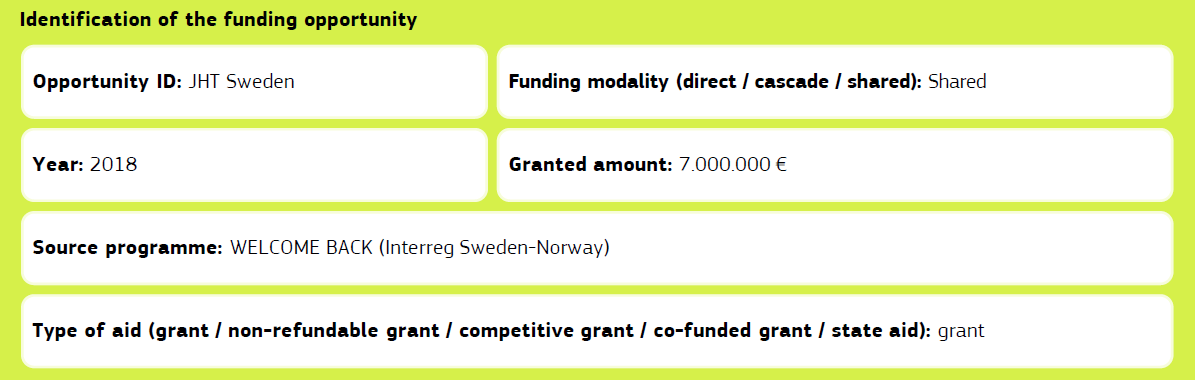
• Countries impacted: Sweden and Norway
• Thematic axis: SME growth in tourism via destination marketing, internationalisation and export readiness.
• Funding programme lineage (EU, national, regional): national
Description of the project
• Project objective(s):
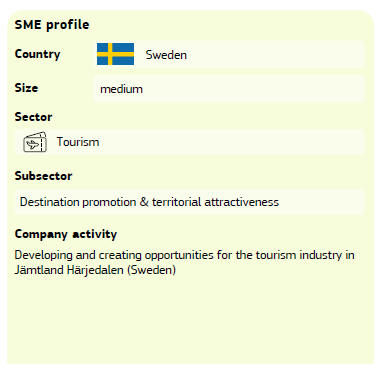
- Increase international awareness of Jämtland Härjedalen.
- Build export readiness among SMEs; strengthen support structures.
- Convert awareness into trade relationships with international tour operators.
• Duration: 45 months (from 20 December 2018 to 30 September 2022)
• Main activities:
- Market development via tour operators
- Media & campaigns
- Content & tools
• Outputs:
- Market development via tour operators: Engaged +80 international tour operators (workshops, FAM trips), +60 new packages produced by regional actors for international markets and at least 14 packages identified as already on sale.
- Media & campaigns: +20 press visits from target markets, features in Forbes (US), The Times (UK), Politiken (DK), Dutch Financial Times (NL), Landhaus Living (DE), Nordis (DE). Social campaigns in Finland & Denmark reached +12.5m impressions and +2.6m unique people.
- Content & tools: 86 new web articles, 3 films, 500 photos, German travel guide, 2 maps, and an Export Guide for SMEs
Type of application
• Single applicant: Yes
• Consortium members: N/A
• Subcontractor: No
Success Factors
• Quality of proposal: The use of pre-existing evidence significantly strengthened the proposal’s credibility, alignment with programme priorities, and perceived feasibility. JHT prepare the proposal with a full analytical phase covering market conditions, target segments, export readiness, and SME needs, including training gaps in sales and internationalisation. This systematic preparation allowed the team to present a proposal with a solid justification and clear strategic focus.
• Previous experience with funding: JHT is recognised regionally and nationally as a reliable, experienced, and financially disciplined organisation, which strongly enhances its success odds. They note themselves that they are “known as a good project owner” with strong control over finances and processes.
• Use of support ecosystems: JHT’s deep anchoring in the regional tourism ecosystem is one of its strongest success factors, enabling exceptional stakeholder mobilisation and a unified territorial strategy. Their governance structure includes the main destination companies of the region (such as SkiStar) and facilitates close collaboration with Visit Sweden, providing both legitimacy and access to national-level promotional channels. This ecosystem strength is demonstrated by their ability to effectively engage SMEs and international partners.
Barriers & Challenges
• Eligibility criteria: Finding the “middle line” in eligibility & additionality. The project must add value beyond the organisation’s ordinary mandate (e.g., marketing) without being “too far out”.
• Administrative burden: Application platforms and rules are hard to navigate, requires money in the bank, specific “EU language”, and connections with managing bodies (not beginner-friendly, risking that funds flow to the same mature).
Lessons learned
• Importance of rigorous pre-writing evidence: A strong evidence base proved essential for credibility and competitiveness. JHT’s preparatory work (market analysis, baseline assessment, segmentation, demand mapping, and clear need/impact logic) significantly strengthened the proposal. This groundwork enabled the team to articulate a compelling intervention rationale, demonstrate measurable gaps in international demand, and link activities directly to expected outcomes.
• Effective Ecosystem Mobilisation: JHT’s ability to convene and mobilise the tourism ecosystem (regional destinations, Visit Sweden, SMEs, incoming operators, and local stakeholders) was a key factor to succeed. This created a multiplier effect: destinations contributed content and expertise; Visit Sweden amplified exposure; SMEs provided authentic product; and operators converted interest into market-ready packages. This mobilisation translated into concrete outputs, such as new operator packages, press interest, and earned media that JHT alone could not have achieved. The collaborative model also enabled a coherent national-level narrative, increasing trust from both EU evaluators and commercial partners.
• Strengthening Financial Preparedness and Cash-Flow Capacity: One of the primary challenges was meeting co-funding and early cash-flow requirements. For SMEs and regional organisations, the initial liquidity strain can be significant (especially since EU disbursements are typically back-loaded). JHT would benefit from securing more upfront capital (internal reserves, bridge financing, or guaranteed co-funding commitments) before submitting a proposal. This would reduce operational stress, avoid delays in activity launch, and allow the organisation to seize opportunities without being constrained by funding cycles.
This best practice shows that tourism SMEs can strengthen their chances of securing destination-marketing or internationalisation funding by grounding their proposals in solid evidence and leveraging strong regional ecosystems. JHT Sweden’s experience illustrates how rigorous market analysis and deep collaboration with local stakeholders make projects more credible and impactful. Other SMEs can replicate this by building data-driven strategies and activating partnerships that enhance visibility, alignment, and feasibility.
Comments (0)
Connected Partnership Opportunities
See also
ENNOV Solutions - Building a Competitive EU Funding Proposal as a Solo Founder
- Categories
- Coastal, maritime and inland water tourism Cultural tourism Ecotourism +64 more
Conrad Events - Prototype-Driven Access to EU Funding for Innovation-Heavy Tourism SMEs
- Categories
- Coastal, maritime and inland water tourism Cultural tourism Ecotourism +64 more
Fattoria delle Api - Leveraging Small Cascade Funding to Build Sustainability Capacity
- Categories
- Coastal, maritime and inland water tourism Cultural tourism Ecotourism +64 more