

Best practices
26 October 2026
ENNOV Solutions - Building a Competitive EU Funding Proposal as a Solo Founder
Best practices
26 October 2026
Login / create an account to be able to react
-
4
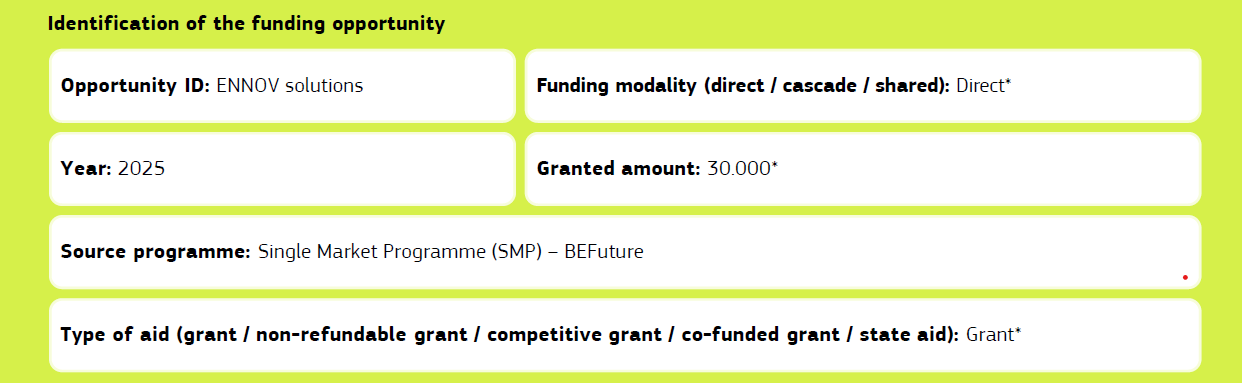
(*) Although the SME ultimately did not receive program funding, we consider her involvement as a mentor a good practice, as it provides an indirect way for SMEs to access funding that may be of interest to them.
Editorial team
Topics
Albania
Armenia
Austria
Belgium
Bosnia and Herzegovina
Bulgaria
Croatia
Cyprus
Czechia
Denmark
Estonia
EU-27
Finland
France
Georgia
Germany
Greece
Hungary
Iceland
Ireland
Italy
Kosovo
Latvia
Liechtenstein
Lithuania
Luxembourg
Malta
Moldova
Montenegro
Netherlands
North Macedonia
Norway
Poland
Portugal
Romania
Serbia
Slovakia
Slovenia
Spain
Sweden
Switzerland
Türkiye
Ukraine
Other
Academic / Research and VET Institutions
Business Support Organisation
Company with 250 or more employees
Cluster Organisations
Consumer Organisations
Cultural and Heritage Organisations
Destination Management & Marketing Organisations
EU Institutions
Financial Institutions and Investors
Industry Associations and Chambers of Commerce
International Organisations
Local Authorities
Media / Journalist Organisations
National authorities
Networks and Federations / Confederations
NGOs / Non-profits
Notified Bodies
Regional Authorities
SMEs (a company with less than 250 employees)
Social Economy Entity
Trade Unions
Other
-
Specific types of tourism
-
-
Adventure tourism
-
Coastal, maritime and inland water tourism
-
Cultural tourism
-
Ecotourism
-
Education tourism
-
Festival tourism
-
Gastronomy tourism
-
Health and medical tourism
-
MICE tourism
-
Mountain tourism
-
Religious tourism
-
Rural tourism
-
Sports tourism
-
Urban/city tourism
-
Wellness tourism
-
-
Transition Pathway Strategic Areas
-
-
Accessible tourism services
-
Best practices, peer learning and networking
-
Changes in tourism demand and opportunities
-
Circularity of tourism services
-
Coordinated information on travelling
-
Cross-border travelling
-
Digitalisation of tourism SMEs and destinations
-
Equal and fair tourism jobs
-
Funding and support measures
-
Governance of tourism destinations
-
Green Transition of Tourism Companies and SMEs
-
Improving formal education
-
Improving statistics and indicators
-
Innovative tourism services
-
Multimodal travelling
-
Online visibility of tourism offer
-
Pact for skills
-
Promoting PEF/OEF methods for tourism
-
R&I on climate-friendly tourism
-
R&I on digital tools for tourism
-
Short-term rentals
-
Skills needs for twin transition
-
Sustainable mobility
-
Tools for data on tourism
-
Tourism strategies
-
Training opportunities
-
Well-being of residents
-
-
Business activities
-
-
Activities of amusement parks and theme parks
-
Activities of associations and other organisations supporting tourism
-
Air passenger transport
-
Camping grounds, recreational vehicle parks and trailer parks
-
Events catering and other food services
-
Festivals, cultural and entertainment activities
-
Gardens and nature reserves activities
-
Holiday Housing / Apartments and other short stay accommodation
-
Hotel and similar accommodation
-
Mobile beverage services
-
Mobile food services
-
Museums
-
Operation of historical sites
-
Other
-
Other accommodation
-
Other amusement and recreation activities
-
Other food and beverage services
-
Other holiday reservation services
-
Other tourism transportation activities
-
Rail Passenger transport
-
Recreational and sport activities
-
Restaurants, cafes and bars (Food and Beverage serving activities)
-
Road passenger transport
-
Tour operator activities
-
Travel agency activities
-
Water (sea, coastal and inland) passenger transport
-
Share
Scope of the programme
• Countries impacted: Spain, Belgium, France, Germany, The Netherlands and Italy
• Thematic axis:
- sustainability transition,
- digital transformation,
- innovation support,
- cross-border collaboration.
• Funding programme lineage (EU, national, regional): national (EU-framed initiative implemented regionally (EU-coordinated concept delivered through regional/national tourism boards)
Description of the project
• Project objective(s): reduce the per-participant carbon footprint at events by improving mobility choice (awareness of public transport, shared mobility, first/last-mile options).
• Duration: N/A
• Main activities: build a rapid MVP build of a basic yet reliable app and curation of local transport data around pilot events and testing with event organizers.
• Outputs: a functioning MVP app, a playbook for onboarding new venues/events, and early carbon-saving estimates tied to modal shift.
Type of application
• Single applicant: Yes
• Consortium members: No
• Subcontractor: No
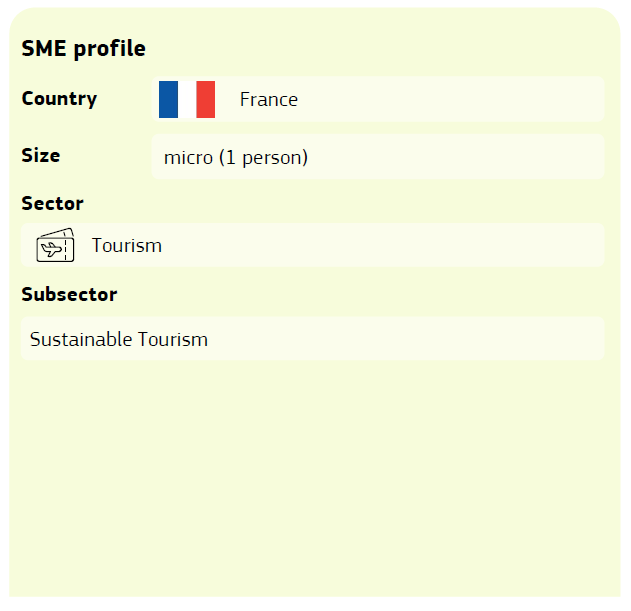
Success Factors
• Strategic fit with call priorities: Problem–solution fit, ENNOV Solutions targeted a clear pain point at events (visitors don’t know local transport option) with a simple, testable tool. Although the company did not receive the funds, its experience and capability allow her to be a mentor for other SMEs that receive funds in the same call.
Barriers & Challenges
• Eligibility criteria: Evaluators flagged ENNOV’s app cost analysis as insufficient. The company recognizes her presentation style likely underplayed feasibility evidence and risk mitigation
• Time & resource constraints: Post-results benchmarking showed several larger companies (tens of staff, significant turnover) winning the funds, while ENNOV’s micro-proposal was rejected.
Lessons learned
• Importance of over-document feasibility: Don’t assume pragmatism speaks for itself, the application must show the numbers, the delivery plan, and the evidence that contributes to the proposed goal.
• Design for evaluation optics: Build a richer narrative around context, market need, and policy alignment; anticipate comparative scoring against larger corporate decks.
This case is relevant to micro-entrepreneurs across the EU who aim to develop digital, low-carbon solutions for the tourism and events ecosystem, even with very limited internal capacity. It shows how solo founders can remain competitive by tightly framing their proposal around EU priorities and by clearly evidencing feasibility despite small budgets.
Comments (0)
Connected Partnership Opportunities
See also
Watershed Fly Fishing - Securing EU Funding Through Program Alignment
- Categories
- Coastal, maritime and inland water tourism Cultural tourism Ecotourism +64 more
Anonymous accommodation company - A Lean SME's Path to Tourism Modernisation
- Categories
- Coastal, maritime and inland water tourism Cultural tourism Ecotourism +64 more
FACILITATE Project Wins EU Tourism Platform Online Challenge
- Categories
- Coastal, maritime and inland water tourism Cultural tourism Ecotourism +64 more