

Best practices
22 October 2026
Watershed Fly Fishing - Securing EU Funding Through Program Alignment
Best practices
22 October 2026
Login / create an account to be able to react
-
10
Editorial team
Topics
Albania
Armenia
Austria
Belgium
Bosnia and Herzegovina
Bulgaria
Croatia
Cyprus
Czechia
Denmark
Estonia
EU-27
Finland
France
Georgia
Germany
Greece
Hungary
Iceland
Ireland
Italy
Kosovo
Latvia
Liechtenstein
Lithuania
Luxembourg
Malta
Moldova
Montenegro
Netherlands
North Macedonia
Norway
Poland
Portugal
Romania
Serbia
Slovakia
Slovenia
Spain
Sweden
Switzerland
Türkiye
Ukraine
Other
Academic / Research and VET Institutions
Business Support Organisation
Company with 250 or more employees
Cluster Organisations
Consumer Organisations
Cultural and Heritage Organisations
Destination Management & Marketing Organisations
EU Institutions
Financial Institutions and Investors
Industry Associations and Chambers of Commerce
International Organisations
Local Authorities
Media / Journalist Organisations
National authorities
Networks and Federations / Confederations
NGOs / Non-profits
Notified Bodies
Regional Authorities
SMEs (a company with less than 250 employees)
Social Economy Entity
Trade Unions
Other
-
Specific types of tourism
-
-
Adventure tourism
-
Coastal, maritime and inland water tourism
-
Cultural tourism
-
Ecotourism
-
Education tourism
-
Festival tourism
-
Gastronomy tourism
-
Health and medical tourism
-
MICE tourism
-
Mountain tourism
-
Religious tourism
-
Rural tourism
-
Sports tourism
-
Urban/city tourism
-
Wellness tourism
-
-
Transition Pathway Strategic Areas
-
-
Accessible tourism services
-
Best practices, peer learning and networking
-
Changes in tourism demand and opportunities
-
Circularity of tourism services
-
Coordinated information on travelling
-
Cross-border travelling
-
Digitalisation of tourism SMEs and destinations
-
Equal and fair tourism jobs
-
Funding and support measures
-
Governance of tourism destinations
-
Green Transition of Tourism Companies and SMEs
-
Improving formal education
-
Improving statistics and indicators
-
Innovative tourism services
-
Multimodal travelling
-
Online visibility of tourism offer
-
Pact for skills
-
Promoting PEF/OEF methods for tourism
-
R&I on climate-friendly tourism
-
R&I on digital tools for tourism
-
Short-term rentals
-
Skills needs for twin transition
-
Sustainable mobility
-
Tools for data on tourism
-
Tourism strategies
-
Training opportunities
-
Well-being of residents
-
-
Business activities
-
-
Activities of amusement parks and theme parks
-
Activities of associations and other organisations supporting tourism
-
Air passenger transport
-
Camping grounds, recreational vehicle parks and trailer parks
-
Events catering and other food services
-
Festivals, cultural and entertainment activities
-
Gardens and nature reserves activities
-
Holiday Housing / Apartments and other short stay accommodation
-
Hotel and similar accommodation
-
Mobile beverage services
-
Mobile food services
-
Museums
-
Operation of historical sites
-
Other
-
Other accommodation
-
Other amusement and recreation activities
-
Other food and beverage services
-
Other holiday reservation services
-
Other tourism transportation activities
-
Rail Passenger transport
-
Recreational and sport activities
-
Restaurants, cafes and bars (Food and Beverage serving activities)
-
Road passenger transport
-
Tour operator activities
-
Travel agency activities
-
Water (sea, coastal and inland) passenger transport
-
Share
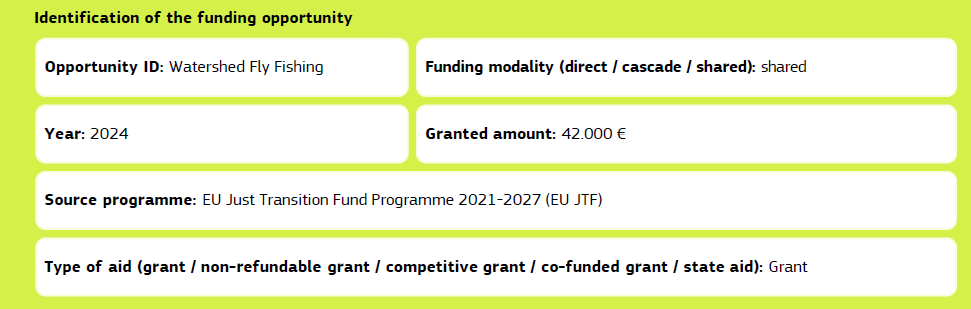
Scope of the programme
• Countries impacted: All 27 EU Member States
• Thematic axis: To mitigate the adverse effects of climate transition by supporting the most affected territories and workers concerned and to promote a balanced socio-economic transition.
• Funding programme lineage (EU, national, regional): regional. In the Irish EU JTF context, the regions and communities in the Midlands that are most affected by the transition to climate neutrality: the full counties of Laois, Westmeath, Offaly, Longford and Roscommon and the municipal districts of Ballinasloe in Galway, Carrick-on-Suir and Thurles in Tipperary, and Athy and Clane in Kildare.
Description of the project
• Project objective(s): Develop a “catch and release” fishing initiative as a guiding service under the principles of eco guiding in Ireland.
• Duration: 4 months
• Main activities: Acquire a fishing boat suitable for operations, obtain comprehensive insurance coverage for the boat and business activities and secure all required legal licenses and permits to operate as a commercial fishing business in Ireland.
• Outputs: N/a.
Type of application
• Single applicant: Yes
• Consortium members: N/a
• Subcontractor: No
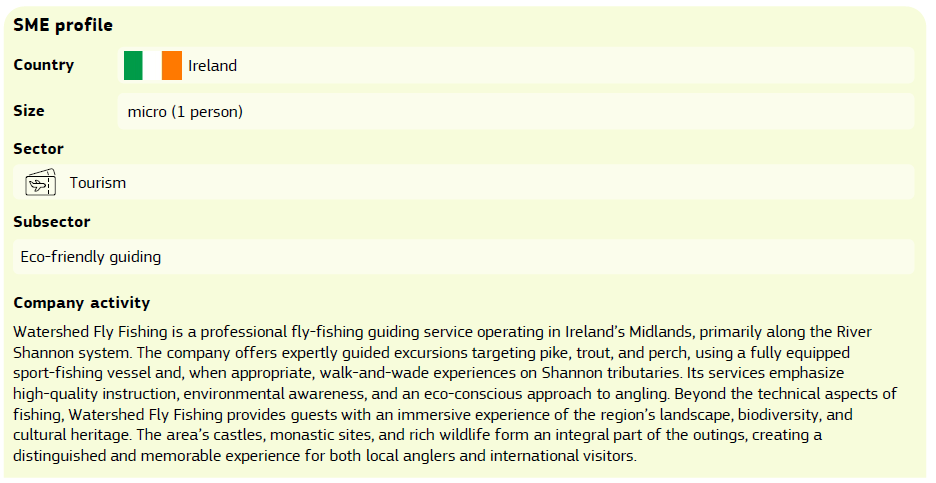
Success Factors
• Strategic fit with call priorities
• Emphasising the uniqueness of the local area, showcasing its rare and largely unseen natural landscape as a valuable and exclusive tourist experience.
• Positioning the project as nature-friendly, highlighting that although it involves fishing, it is specifically fly fishing, a method widely recognised as a low-impact and environmentally conscious practice.
Barriers & Challenges
• Lack of support ecosystem
• Received external support from the Irish Tourist Board and from a Local Enterprise Office, the latter providing guidance through a public procurement mentor.
• Participated in public information sessions as part of the local support ecosystem.
• Although support from the ecosystem was available, it often arrived too late and ultimately offered limited practical value.
Lessons learned
Apply a Methodological Framework Steps for Ensuring Strong Project–Programme Alignment:
• Conduct a comprehensive analysis and diagnostic review of the EU programme, examining its strategic objectives, priorities, eligibility criteria, and expected impacts.
• Define the programme’s objectives in detail, breaking them down into specific, actionable components to fully understand what the funding body aims to achieve.
• Match each programme objective with elements of the proposed project, ensuring clear, direct connections between the programme’s priorities and the project’s planned activities, outcomes, and added value.
• Adapt and refine the project design where necessary, aligning its scope, methodology, sustainability approach, and expected results to better reflect and support the programme’s goals.
Ensuring Full Compliance with Legal Regulations:
• Develop a thorough understanding of all relevant legal regulations and operational limitations applicable to the proposed project, including sector-specific requirements, licensing obligations, environmental rules, and any local compliance frameworks.
• Identify potential legal risks early on, acknowledging that certain regulatory issues may arise during implementation. Even if such risks do not ultimately materialise, proactively assessing them strengthens project feasibility and credibility.
• Ensure full awareness of all local legislative requirements, as compliance is the responsibility of the project promoter, not the funding authority. EU funders generally assume that applicants understand and can manage their legal obligations, rather than verifying every detail themselves.
Comments (0)
Connected Partnership Opportunities
See also
ENNOV Solutions - Building a Competitive EU Funding Proposal as a Solo Founder
- Categories
- Coastal, maritime and inland water tourism Cultural tourism Ecotourism +64 more
Anonymous accommodation company - A Lean SME's Path to Tourism Modernisation
- Categories
- Coastal, maritime and inland water tourism Cultural tourism Ecotourism +64 more
FACILITATE Project Wins EU Tourism Platform Online Challenge
- Categories
- Coastal, maritime and inland water tourism Cultural tourism Ecotourism +64 more