

Best practices
26 October 2026
MUZEJ UJA (Olive Oil Museum) - Diversifying Heritage Olive-Oil Tourism through EU-Supported Rural Accommodation
Best practices
26 October 2026
Login / create an account to be able to react
-
7
.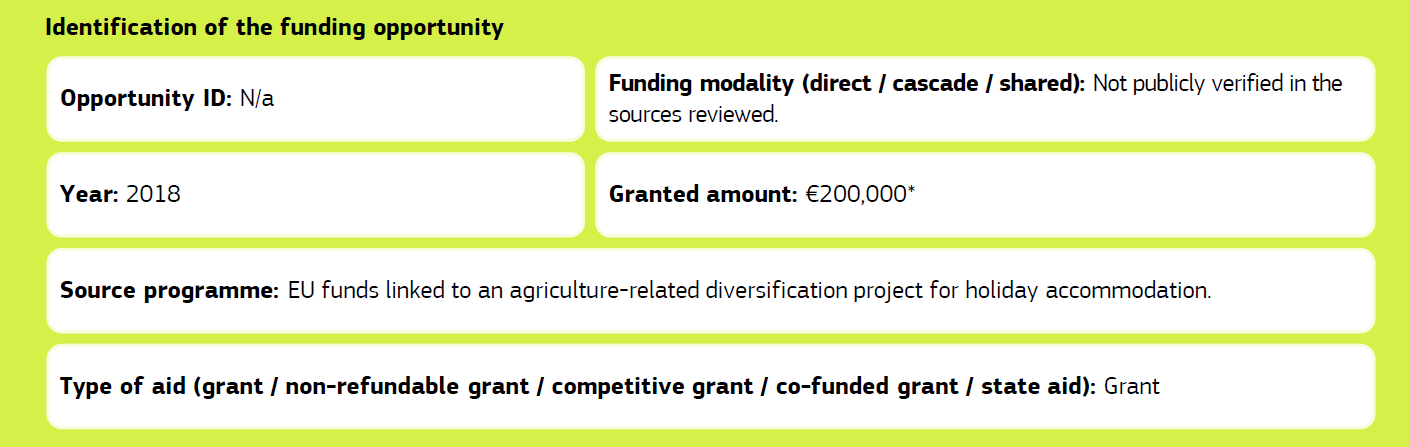
(*) The interview notes also refer to a broader investment effort of around €450,000, with €200,000 coming from government and the funding opportunity.
Editorial team
Topics
Albania
Armenia
Austria
Belgium
Bosnia and Herzegovina
Bulgaria
Croatia
Cyprus
Czechia
Denmark
Estonia
EU-27
Finland
France
Georgia
Germany
Greece
Hungary
Iceland
Ireland
Italy
Kosovo
Latvia
Liechtenstein
Lithuania
Luxembourg
Malta
Moldova
Montenegro
Netherlands
North Macedonia
Norway
Poland
Portugal
Romania
Serbia
Slovakia
Slovenia
Spain
Sweden
Switzerland
Türkiye
Ukraine
Other
Academic / Research and VET Institutions
Business Support Organisation
Company with 250 or more employees
Cluster Organisations
Consumer Organisations
Cultural and Heritage Organisations
Destination Management & Marketing Organisations
EU Institutions
Financial Institutions and Investors
Industry Associations and Chambers of Commerce
International Organisations
Local Authorities
Media / Journalist Organisations
National authorities
Networks and Federations / Confederations
NGOs / Non-profits
Notified Bodies
Regional Authorities
SMEs (a company with less than 250 employees)
Social Economy Entity
Trade Unions
Other
-
Specific types of tourism
-
-
Adventure tourism
-
Coastal, maritime and inland water tourism
-
Cultural tourism
-
Ecotourism
-
Education tourism
-
Festival tourism
-
Gastronomy tourism
-
Health and medical tourism
-
MICE tourism
-
Mountain tourism
-
Religious tourism
-
Rural tourism
-
Sports tourism
-
Urban/city tourism
-
Wellness tourism
-
-
Transition Pathway Strategic Areas
-
-
Accessible tourism services
-
Best practices, peer learning and networking
-
Changes in tourism demand and opportunities
-
Circularity of tourism services
-
Coordinated information on travelling
-
Cross-border travelling
-
Digitalisation of tourism SMEs and destinations
-
Equal and fair tourism jobs
-
Funding and support measures
-
Governance of tourism destinations
-
Green Transition of Tourism Companies and SMEs
-
Improving formal education
-
Improving statistics and indicators
-
Innovative tourism services
-
Multimodal travelling
-
Online visibility of tourism offer
-
Pact for skills
-
Promoting PEF/OEF methods for tourism
-
R&I on climate-friendly tourism
-
R&I on digital tools for tourism
-
Short-term rentals
-
Skills needs for twin transition
-
Sustainable mobility
-
Tools for data on tourism
-
Tourism strategies
-
Training opportunities
-
Well-being of residents
-
-
Business activities
-
-
Activities of amusement parks and theme parks
-
Activities of associations and other organisations supporting tourism
-
Air passenger transport
-
Camping grounds, recreational vehicle parks and trailer parks
-
Events catering and other food services
-
Festivals, cultural and entertainment activities
-
Gardens and nature reserves activities
-
Holiday Housing / Apartments and other short stay accommodation
-
Hotel and similar accommodation
-
Mobile beverage services
-
Mobile food services
-
Museums
-
Operation of historical sites
-
Other
-
Other accommodation
-
Other amusement and recreation activities
-
Other food and beverage services
-
Other holiday reservation services
-
Other tourism transportation activities
-
Rail Passenger transport
-
Recreational and sport activities
-
Restaurants, cafes and bars (Food and Beverage serving activities)
-
Road passenger transport
-
Tour operator activities
-
Travel agency activities
-
Water (sea, coastal and inland) passenger transport
-
Share
Scope of the programme
• Countries impacted: Croatia, through the development of a tourism asset on the island of Brač.
• Thematic axis: Diversification of a family agricultural and heritage-based activity into rural tourism accommodation, linked to olive-oil production, gastronomy and local heritage interpretation.
• Funding programme lineage (EU, national, regional): EU-funded support implemented in Croatia; the exact formal lineage could not be publicly verified in the reviewed sources.
Description of the project
• Project objective(s): The project aimed to diversify the family business by adding a holiday accommodation offer, generating additional income through rural and heritage tourism while connecting guest stays with the museum, olive-oil production and local gastronomy. The interview explicitly refers to extra profit by hosting guests through rural areas and to the fact that they have a house to host. Public information confirms that the EU-funded investment was used to build a luxury holiday house.
• Duration: Approximately 2018–2022.
• Main activities: Preparation of the funding application and administrative documentation; development and construction of Luxury House Natanel; securing permits and categorisation for operation; and integrating the new accommodation offer with the museum’s existing tourism experience based on olive oil, local products and cultural interpretation.
• Outputs: A new holiday accommodation asset, an expanded tourism offer that links museum visits, olive-oil tasting and accommodation, and a more diversified family business model combining heritage, gastronomy and hospitality.
Type of application
• Single applicant: Yes.
• Consortium members: N/A
• Subcontractor: No subcontractor for project delivery; however, an external consultant or firm was engaged to prepare the application and paperwork.
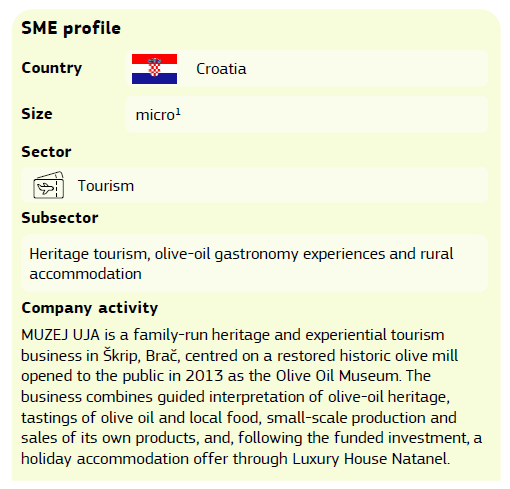
1. (Size) Micro at the time described in the interview, where the business is characterised as a family-owned business employing two people. Publicly available information from a later stage indicates growth to four employees, suggesting expansion after the funded investment.
Success Factors
• Strategic fit with call priorities: The project matched a diversification logic that connected rural accommodation with agriculture, local production, and tourism development.
• Team design & resources: The business already combined complementary activities, including olive-oil production, museum-based heritage interpretation, and hospitality, which strengthened the coherence of the project.
• Access to information: The company benefited from local information channels and advisory support connected to the island ecosystem.
• Use of support ecosystems: Consultants and local support actors played an important role in understanding the opportunity and managing the administrative process.
• Quality of proposal: The project was supported by specialised external expertise, which helped structure the application and manage procedural requirements.
Barriers & Challenges
• Complexity of the Call: The funding process required navigating complex programme requirements and documentation.
• Administrative burden: The preparation of forms and supporting documents represented a significant challenge.
• Time & resource constraints: Limited internal capacity made it difficult to handle the full process without external support
Lessons learned
• Specialised advisory support can be decisive for very small businesses applying for EU funding.
• Diversification is most effective when it builds on existing local assets, identity, and complementary activities.
This best practice illustrates how a very small, family-run heritage tourism business can use EU-supported investment to move from a single-asset model based on museum visits and olive-oil tasting towards a more diversified and resilient tourism offer that combines heritage, gastronomy, agriculture and accommodation. It represents a useful example for rural and island-based tourism SMEs because it shows that funding can be most effective when it reinforces authentic local identity, creates new revenue streams from existing assets, and is backed by a practical support ecosystem able to compensate for limited internal administrative capacity.
Comments (0)
Connected Partnership Opportunities
See also
Casa da Guitarra - Using Specialized Platforms to Accelerate Access to Funding
- Categories
- Coastal, maritime and inland water tourism Cultural tourism Ecotourism +64 more
Conrad Events - Prototype-Driven Access to EU Funding for Innovation-Heavy Tourism SMEs
- Categories
- Coastal, maritime and inland water tourism Cultural tourism Ecotourism +64 more
Fattoria delle Api - Leveraging Small Cascade Funding to Build Sustainability Capacity
- Categories
- Coastal, maritime and inland water tourism Cultural tourism Ecotourism +64 more