

Knowledge documents
07 July 2026
"Awareness of changes in tourism demand and twin transition" Summary
Knowledge documents
07 July 2026
Login / create an account to be able to react
-
77

At a glance
Resilience, Skills and Inclusion
The topic explored how tourism demand across Europe is changing due to climate change and shifting traveller preferences, and how increasing awareness of these changes is essential to support the green and digital transition of the tourism ecosystem. The focus was placed on understanding demand shifts and the role of destinations and tourism actors in responding to, and influencing, these changes.
Why it matters?
Climate-induced changes such as heatwaves, reduced snowfall, and altered seasonality are already affecting tourism demand. Raising awareness of these patterns enables destinations and business to anticipate change, guide demand more sustainably, and align green transition goals with digital tools and knowledge, thereby strengthening long-term resilience in European tourism.
Editorial team
Topics
Albania
Armenia
Austria
Belgium
Bosnia and Herzegovina
Bulgaria
Croatia
Cyprus
Czechia
Denmark
Estonia
EU-27
Finland
France
Georgia
Germany
Greece
Hungary
Iceland
Ireland
Italy
Kosovo
Latvia
Liechtenstein
Lithuania
Luxembourg
Malta
Moldova
Montenegro
Netherlands
North Macedonia
Norway
Poland
Portugal
Romania
Serbia
Slovakia
Slovenia
Spain
Sweden
Switzerland
Türkiye
Ukraine
Other
Academic / Research and VET Institutions
Business Support Organisation
Company with 250 or more employees
Cluster Organisations
Consumer Organisations
Cultural and Heritage Organisations
Destination Management & Marketing Organisations
EU Institutions
Financial Institutions and Investors
Industry Associations and Chambers of Commerce
International Organisations
Local Authorities
Media / Journalist Organisations
National authorities
Networks and Federations / Confederations
NGOs / Non-profits
Notified Bodies
Regional Authorities
SMEs (a company with less than 250 employees)
Social Economy Entity
Trade Unions
Other
-
Specific types of tourism
-
-
Adventure tourism
-
Coastal, maritime and inland water tourism
-
Cultural tourism
-
Ecotourism
-
Education tourism
-
Festival tourism
-
Gastronomy tourism
-
Health and medical tourism
-
MICE tourism
-
Mountain tourism
-
Religious tourism
-
Rural tourism
-
Sports tourism
-
Urban/city tourism
-
Wellness tourism
-
-
Transition Pathway Strategic Areas
-
-
Accessible tourism services
-
Best practices, peer learning and networking
-
Changes in tourism demand and opportunities
-
Circularity of tourism services
-
Coordinated information on travelling
-
Cross-border travelling
-
Digitalisation of tourism SMEs and destinations
-
Equal and fair tourism jobs
-
Funding and support measures
-
Governance of tourism destinations
-
Green Transition of Tourism Companies and SMEs
-
Improving formal education
-
Improving statistics and indicators
-
Innovative tourism services
-
Multimodal travelling
-
Online visibility of tourism offer
-
Pact for skills
-
Promoting PEF/OEF methods for tourism
-
R&I on climate-friendly tourism
-
R&I on digital tools for tourism
-
Short-term rentals
-
Skills needs for twin transition
-
Sustainable mobility
-
Tools for data on tourism
-
Tourism strategies
-
Training opportunities
-
Well-being of residents
-
-
Business activities
-
-
Activities of amusement parks and theme parks
-
Activities of associations and other organisations supporting tourism
-
Air passenger transport
-
Camping grounds, recreational vehicle parks and trailer parks
-
Events catering and other food services
-
Festivals, cultural and entertainment activities
-
Gardens and nature reserves activities
-
Holiday Housing / Apartments and other short stay accommodation
-
Hotel and similar accommodation
-
Mobile beverage services
-
Mobile food services
-
Museums
-
Operation of historical sites
-
Other
-
Other accommodation
-
Other amusement and recreation activities
-
Other food and beverage services
-
Other holiday reservation services
-
Other tourism transportation activities
-
Rail Passenger transport
-
Recreational and sport activities
-
Restaurants, cafes and bars (Food and Beverage serving activities)
-
Road passenger transport
-
Tour operator activities
-
Travel agency activities
-
Water (sea, coastal and inland) passenger transport
-
Share
What is this topic about?
The topic addressed the growing need for awareness and understanding of changing tourism demand, particularly in the context of climate change, and how this awareness underpins the twin transition. Drawing on the monthly article “Sustainable Tourism – Adapting the Climate-Induced Holiday Trends”, the webinar “Changing demand in European tourism: influence and opportunity”, along with the online discussion “Addressing changing holiday patterns due to climate change” in October 2024, the objective was to explore how demand is evolving and how tourism stakeholders can respond strategically and sustainably.
Key themes included:
- Understanding climate-driven demand changes, such as seasonality shifts and destination substitution
- Raising awareness among destinations, business, and tourists about emerging demand patterns
- The role of digital tools and data in analysing demand and supporting emerging demand patterns
- Linking awareness of demand change to sustainability and climate adaptation objectives
Stakeholder stories
The initiatives showcased illustrate practical experiences and reflections that reinforce awareness of changing tourism demand:
- ETC report on climate challenges and future tourism in Europe, ETC: an analysis on the effects of climate change, including heatwaves, wildfire, and floods, impacting tourism and travel patterns.
- “Visit Portugal. It’s not tourism. It’s futurism” campaign, Turismo de Portugal: The campaign presents 12 commitments to encourage action and inspire people to take an active role in the changes being made to tourism, both in Portugal and around the world.
- VisitScotland, Tourism Cares: promoted responsible tourism experiences in Scotland. Key private and public partners collaborated to protect and preserve the natural and cultural assets of Scotland.
- Dalmatian Food and Wine Tour, Adriatic DMC: initiative which aims to promote sustainability in the touristic food experiences.
- Rick Steve’s Europe: creating meaningful travel experiences that connect travellers with local cultures, stressing the importance of diversifying products to spread tourism throughout the year and across different activities.
Key conclusions and emerging trends
Stakeholder stories highlight ongoing efforts to understand demand changes and promote sustainable tourism and travel based on evolving demand patterns.
Key conclusions and emerging trends include:
- Tourism demand across Europe is already changing: Climate change is influencing when and where people travel, affecting seasonality, destination attractiveness, and traditional tourism models.
- Awareness is a critical foundation for action: Understanding demand shifts is a prerequisite for effective adaptation and for aligning green and digital transition efforts in tourism.
- Destinations are encouraged to move from passive response to active influence of demand through communication, narrative-building, and promotion of more sustainable travel choices.
- Diversification of tourism offers is a recurring response to reduce dependency on climate-vulnerable peak seasons.
- Digital tools support awareness and strategic decision-making: While not an end in themselves, digital solutions and data are highlighted as enablers for understanding demand trends and supporting sustainable tourism strategies.
Comments (0)
Connected Partnership Opportunities
See also
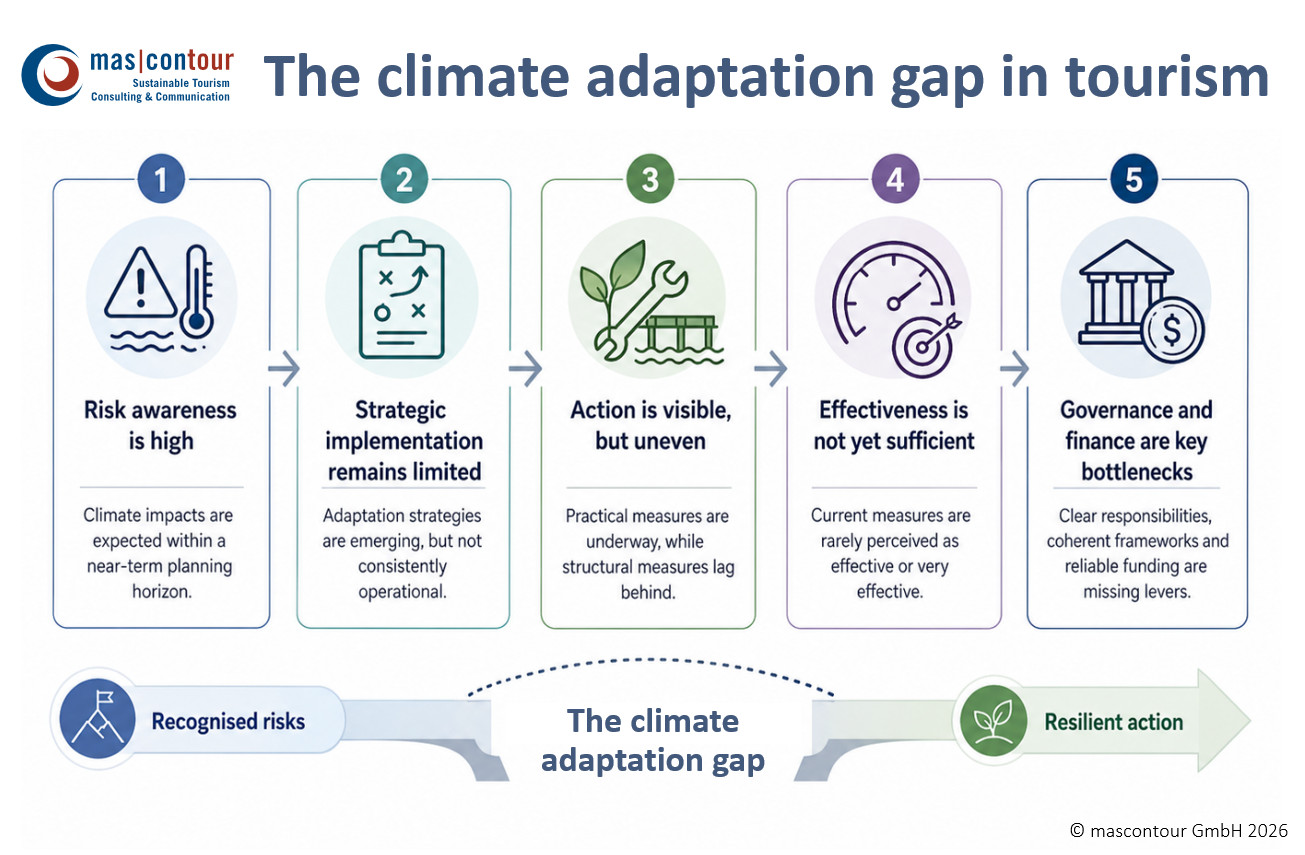
Climate Adaptation in Tourism: New Global White Paper Reveals the Tourism Sector’s Adaptation Gap
- Categories
- Coastal, maritime and inland water tourism Cultural tourism Ecotourism +64 more
“Key updates and trends in 2024” Summary
- Categories
- Coastal, maritime and inland water tourism Cultural tourism Ecotourism +64 more
Deadline Extended: Online Challenge “Future-Proof Tourism - Skills for the Twin Transition”
- Categories
- Coastal, maritime and inland water tourism Cultural tourism Ecotourism +64 more