

Best practices
26 October 2026
B&B Alta Murgia - Aligning the company's purpose with European opportunities
Best practices
26 October 2026
Login / create an account to be able to react
-
2
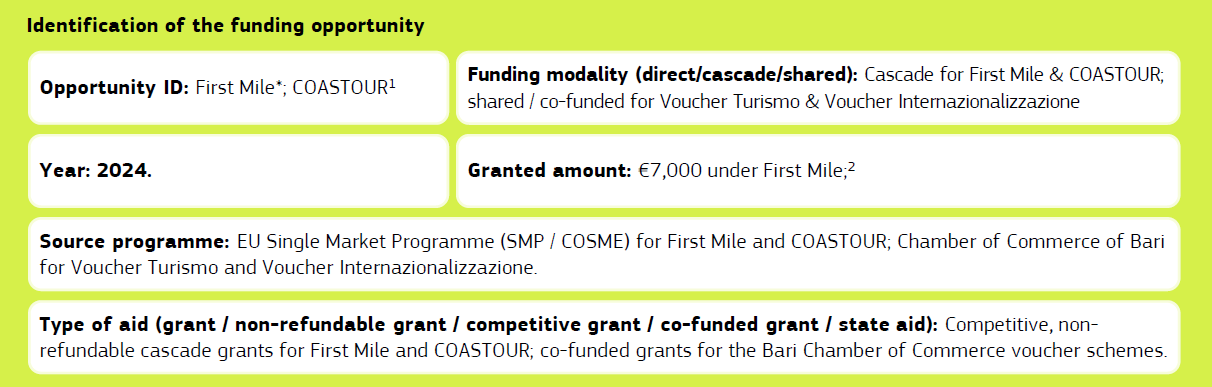
*Enhancing Sustainability in European Tourism SMEs;
1. Sustainable and Resilient Transformation of the Rural Coastal Tourism Industry; Voucher Turismo – Anno 2024; Voucher Internazionalizzazione – Anno 2024.
2. €9,000 under COASTOUR according to the information provided by the SME; 70% co-financing with a maximum contribution of €7,000 under Voucher Turismo; up to 70% co-financing and a maximum contribution of €5,000 under Voucher Internazionalizzazione.
Editorial team
Topics
Albania
Armenia
Austria
Belgium
Bosnia and Herzegovina
Bulgaria
Croatia
Cyprus
Czechia
Denmark
Estonia
EU-27
Finland
France
Georgia
Germany
Greece
Hungary
Iceland
Ireland
Italy
Kosovo
Latvia
Liechtenstein
Lithuania
Luxembourg
Malta
Moldova
Montenegro
Netherlands
North Macedonia
Norway
Poland
Portugal
Romania
Serbia
Slovakia
Slovenia
Spain
Sweden
Switzerland
Türkiye
Ukraine
Other
Academic / Research and VET Institutions
Business Support Organisation
Company with 250 or more employees
Cluster Organisations
Consumer Organisations
Cultural and Heritage Organisations
Destination Management & Marketing Organisations
EU Institutions
Financial Institutions and Investors
Industry Associations and Chambers of Commerce
International Organisations
Local Authorities
Media / Journalist Organisations
National authorities
Networks and Federations / Confederations
NGOs / Non-profits
Notified Bodies
Regional Authorities
SMEs (a company with less than 250 employees)
Social Economy Entity
Trade Unions
Other
-
Specific types of tourism
-
-
Adventure tourism
-
Coastal, maritime and inland water tourism
-
Cultural tourism
-
Ecotourism
-
Education tourism
-
Festival tourism
-
Gastronomy tourism
-
Health and medical tourism
-
MICE tourism
-
Mountain tourism
-
Religious tourism
-
Rural tourism
-
Sports tourism
-
Urban/city tourism
-
Wellness tourism
-
-
Transition Pathway Strategic Areas
-
-
Accessible tourism services
-
Best practices, peer learning and networking
-
Changes in tourism demand and opportunities
-
Circularity of tourism services
-
Coordinated information on travelling
-
Cross-border travelling
-
Digitalisation of tourism SMEs and destinations
-
Equal and fair tourism jobs
-
Funding and support measures
-
Governance of tourism destinations
-
Green Transition of Tourism Companies and SMEs
-
Improving formal education
-
Improving statistics and indicators
-
Innovative tourism services
-
Multimodal travelling
-
Online visibility of tourism offer
-
Pact for skills
-
Promoting PEF/OEF methods for tourism
-
R&I on climate-friendly tourism
-
R&I on digital tools for tourism
-
Short-term rentals
-
Skills needs for twin transition
-
Sustainable mobility
-
Tools for data on tourism
-
Tourism strategies
-
Training opportunities
-
Well-being of residents
-
-
Business activities
-
-
Activities of amusement parks and theme parks
-
Activities of associations and other organisations supporting tourism
-
Air passenger transport
-
Camping grounds, recreational vehicle parks and trailer parks
-
Events catering and other food services
-
Festivals, cultural and entertainment activities
-
Gardens and nature reserves activities
-
Holiday Housing / Apartments and other short stay accommodation
-
Hotel and similar accommodation
-
Mobile beverage services
-
Mobile food services
-
Museums
-
Operation of historical sites
-
Other
-
Other accommodation
-
Other amusement and recreation activities
-
Other food and beverage services
-
Other holiday reservation services
-
Other tourism transportation activities
-
Rail Passenger transport
-
Recreational and sport activities
-
Restaurants, cafes and bars (Food and Beverage serving activities)
-
Road passenger transport
-
Tour operator activities
-
Travel agency activities
-
Water (sea, coastal and inland) passenger transport
-
Share
Scope of the programme
• Countries impacted: Italy, France, Norway and Slovenia under First Mile; Denmark, Italy, Portugal, Slovenia and Lithuania under COASTOUR; Italy at local level under the Bari Chamber of Commerce vouchers.
• Thematic axis: Sustainable tourism, behavioural change, green mobility, sustainability monitoring, SME resilience, tourism competitiveness, quality improvement and internationalisation.
• Funding programme lineage (EU, national, regional): EU and local / regional.
Description of the project
• Project objective(s): To improve the sustainability, competitiveness and long-term resilience of the accommodation business through a progressive combination of behavioural sustainability actions, local community-oriented capacity building, green investment and international visibility measures.
• Duration: 2024 for the Bari Chamber of Commerce vouchers and the COASTOUR participation referenced by the SME; First Mile forms part of a wider project running from 2023 to 2025.
• Main activities: Implementation of behavioural sustainability actions for guests under First Mile; development of pedestrian and mobility-oriented guest materials; participation in COASTOUR with a strong preference for place-based knowledge transfer and practical learning; installation of a solar panel system through Voucher Turismo; and social media advertising and promotional actions through Voucher Internazionalizzazione.
• Outputs: Pedestrian and sustainable mobility maps; improved guest awareness around sustainability; local dissemination of practical knowledge; installation of solar energy infrastructure; and stronger online visibility and market outreach.
• Duration: The funding pathway is best understood as a cumulative sequence of actions implemented during 2024, while also building on the wider First Mile cycle and the SME’s growing experience with public funding.
Type of application
• Single applicant: Yes.
• Consortium members: Not applicable at SME beneficiary level.
• Subcontractor: Not specified as a central feature of the applications; implementation relied mainly on the SME itself and, where relevant, on external service providers linked to the funded activities.
Success Factors
• Access to information: A decisive success factor was the SME owner’s proactive search for opportunities on the web using sustainability-related keywords, which enabled discovery of calls despite limited initial familiarity with formal EU funding portals.
• Strategic fit with call priorities: The business already had a strong sustainability orientation, which made it easier to align proposed actions with the environmental and tourism-transition priorities of the funding schemes.
• Previous experience with funding: Although First Mile was described as the first EU-level application, each subsequent opportunity increased the SME’s confidence, learning and ability to identify and use further schemes.
• Use of support ecosystems: Explanatory sessions and direct clarification from project organisers helped the SME understand the opportunities and reduced the difficulty of first-time participation.
• Team design & resources: The lean structure of the SME enabled fast decision-making and the direct translation of small grants into practical, visible improvements in the business.
• Quality of proposal / practical relevance: The funded actions were concrete, realistic and closely linked to real operational needs of the company, which strengthened the coherence of the applications and implementation.
Barriers & Challenges
• Complexity of the Call: The SME explained that some calls did not clearly specify key practical elements at the outset, such as budget logic, timeframe or level of expected ambition.
• Administrative burden: Local voucher schemes required substantial paperwork, invoicing and reimbursement procedures, making implementation more bureaucratic and time-consuming for a micro enterprise.
• Time & resource constraints: As a very small business, the SME had limited internal capacity to deal with repeated administrative and funding-management requirements.
• Partnership & consortium: The SME highlighted that many EU opportunities are difficult to access because they require international partners or destination structures that are not easily available in its local context.
• Lack of support ecosystem: The interview pointed to the absence of easily accessible trusted partnership ecosystems and structured matchmaking support for small rural tourism actors.
• Trust barrier: The SME also stressed that working with unknown organisations abroad can be difficult because trust and reliability are harder to assess in advance.
Lessons learned
• Start with accessible and relatively small funding instruments, as these can provide the confidence and practical experience needed to progressively engage with more opportunities.
• Funding works best when it is used strategically across several complementary schemes rather than as a one-off isolated opportunity.
• Small grants can generate significant impact when they are tightly connected to real business needs, such as sustainability improvements, visibility actions or energy investments.
• Better information visibility, simpler procedures and stronger partner-search support would make funding more accessible for rural micro tourism enterprises.
This best practice shows how a micro rural tourism SME can build a progressive and coherent funding pathway by combining EU cascade support with local co-financed instruments. Rather than relying on a single grant, B&B Parco Alta Murgia used different opportunities to improve sustainability, strengthen operational capacity, invest in green infrastructure and enhance external visibility. The case represents a practical example of how small tourism businesses can gradually develop funding capability, provided that opportunities are accessible, relevant and closely linked to their real development needs.
Comments (0)
Connected Partnership Opportunities
See also
ENNOV Solutions - Building a Competitive EU Funding Proposal as a Solo Founder
- Categories
- Coastal, maritime and inland water tourism Cultural tourism Ecotourism +64 more
Merill Rural Network - Using EU-Funded Digital Innovation to Strengthen Rural Tourism in Malta
- Categories
- Coastal, maritime and inland water tourism Cultural tourism Ecotourism +64 more
JHT Sweden - Evidence-Led Destination Marketing with Strong Ecosystem Anchoring
- Categories
- Coastal, maritime and inland water tourism Cultural tourism Ecotourism +64 more