

Best practices
26 October 2026
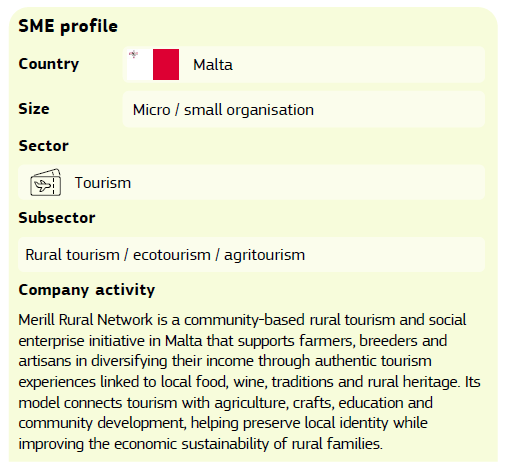
Merill Rural Network - Using EU-Funded Digital Innovation to Strengthen Rural Tourism in Malta
Best practices
26 October 2026
Login / create an account to be able to react
-
2
Editorial team
Topics
Albania
Armenia
Austria
Belgium
Bosnia and Herzegovina
Bulgaria
Croatia
Cyprus
Czechia
Denmark
Estonia
EU-27
Finland
France
Georgia
Germany
Greece
Hungary
Iceland
Ireland
Italy
Kosovo
Latvia
Liechtenstein
Lithuania
Luxembourg
Malta
Moldova
Montenegro
Netherlands
North Macedonia
Norway
Poland
Portugal
Romania
Serbia
Slovakia
Slovenia
Spain
Sweden
Switzerland
Türkiye
Ukraine
Other
Academic / Research and VET Institutions
Business Support Organisation
Company with 250 or more employees
Cluster Organisations
Consumer Organisations
Cultural and Heritage Organisations
Destination Management & Marketing Organisations
EU Institutions
Financial Institutions and Investors
Industry Associations and Chambers of Commerce
International Organisations
Local Authorities
Media / Journalist Organisations
National authorities
Networks and Federations / Confederations
NGOs / Non-profits
Notified Bodies
Regional Authorities
SMEs (a company with less than 250 employees)
Social Economy Entity
Trade Unions
Other
-
Specific types of tourism
-
-
Adventure tourism
-
Coastal, maritime and inland water tourism
-
Cultural tourism
-
Ecotourism
-
Education tourism
-
Festival tourism
-
Gastronomy tourism
-
Health and medical tourism
-
MICE tourism
-
Mountain tourism
-
Religious tourism
-
Rural tourism
-
Sports tourism
-
Urban/city tourism
-
Wellness tourism
-
-
Transition Pathway Strategic Areas
-
-
Accessible tourism services
-
Best practices, peer learning and networking
-
Changes in tourism demand and opportunities
-
Circularity of tourism services
-
Coordinated information on travelling
-
Cross-border travelling
-
Digitalisation of tourism SMEs and destinations
-
Equal and fair tourism jobs
-
Funding and support measures
-
Governance of tourism destinations
-
Green Transition of Tourism Companies and SMEs
-
Improving formal education
-
Improving statistics and indicators
-
Innovative tourism services
-
Multimodal travelling
-
Online visibility of tourism offer
-
Pact for skills
-
Promoting PEF/OEF methods for tourism
-
R&I on climate-friendly tourism
-
R&I on digital tools for tourism
-
Short-term rentals
-
Skills needs for twin transition
-
Sustainable mobility
-
Tools for data on tourism
-
Tourism strategies
-
Training opportunities
-
Well-being of residents
-
-
Business activities
-
-
Activities of amusement parks and theme parks
-
Activities of associations and other organisations supporting tourism
-
Air passenger transport
-
Camping grounds, recreational vehicle parks and trailer parks
-
Events catering and other food services
-
Festivals, cultural and entertainment activities
-
Gardens and nature reserves activities
-
Holiday Housing / Apartments and other short stay accommodation
-
Hotel and similar accommodation
-
Mobile beverage services
-
Mobile food services
-
Museums
-
Operation of historical sites
-
Other
-
Other accommodation
-
Other amusement and recreation activities
-
Other food and beverage services
-
Other holiday reservation services
-
Other tourism transportation activities
-
Rail Passenger transport
-
Recreational and sport activities
-
Restaurants, cafes and bars (Food and Beverage serving activities)
-
Road passenger transport
-
Tour operator activities
-
Travel agency activities
-
Water (sea, coastal and inland) passenger transport
-
Share
Scope of the programme
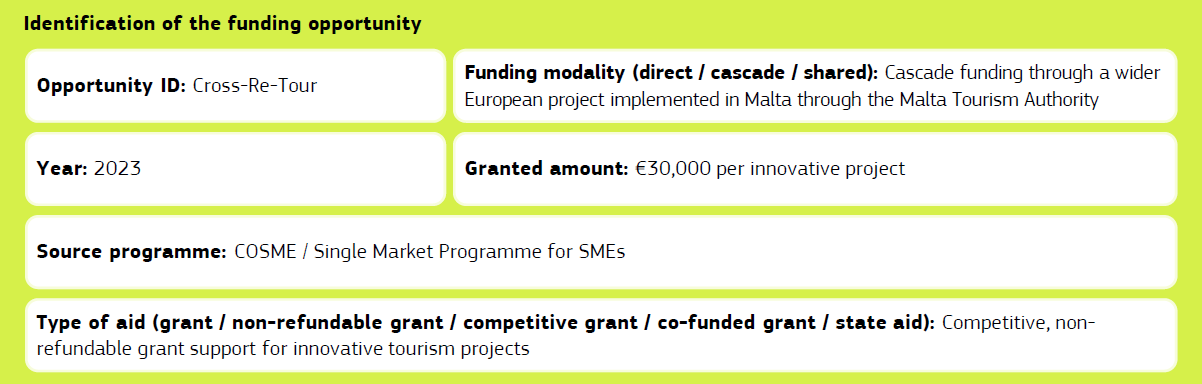
• Countries impacted: The wider Cross-Re-Tour project is transnational and involves several European countries, while the funded Merill action specifically focused on Malta
• Thematic axis: Green and digital innovation in tourism, with a focus on sustainability, digitalisation, resilience, and improved operational models for tourism SMEs
• Funding programme lineage (EU, national, regional): EU
Description of the project
• Project objective(s):
- Strengthen the way rural tourism operates in Malta through digital innovation
- Simplify the coordination and booking process for rural experiences hosted by farmers, breeders and artisans
- Increase the resilience and long-term viability of community-based rural tourism
- Use digital tools to improve the organisation, visibility and efficiency of the rural tourism ecosystem while remaining aligned with the network’s social and environmental values
• Duration: The parent project runs for three years from September 2023, while Merill’s supported action was launched during the project implementation period
• Main activities:
- Development of the Merill Rural SmartBook, a digital platform designed to improve coordination in rural tourism
- Creation of a tool through which members of the network can manage bookings, availability and communication more efficiently
- Collaboration with the tourism coordination team to centralise logistics and reduce the need for manual coordination
- Co-creation of the platform with network members, especially farmers and artisans, through consultations, presentations and surveys to ensure that the solution truly reflected their needs and capacities
• Outputs:
- The Merill Rural SmartBook digital platform
- A more efficient and better coordinated booking system for rural tourism experiences in Malta
- Improved communication and availability management for members of the network
- A practical digital tool that strengthens the resilience and long-term sustainability of the rural tourism ecosystem
Type of application
• Single applicant: Yes, as a beneficiary under the Cross-Re-Tour support scheme in Malta
• Consortium members: Not applicable at beneficiary level, as the wider programme was implemented through a European partnership and nationally through the Malta Tourism Authority
• Subcontractor: Yes. The digital platform developed under the project was built in collaboration with a local IT company providing tailor-made digital solutions.
Success Factors
• Deep roots in the rural community: what makes this case especially interesting is that Merill’s strength comes from its legitimacy on the ground, working directly with farmers, breeders and artisans.
• Tourism as a tool for rural diversification: tourism is not the final goal, but a vehicle to help rural families diversify income, preserve traditions and strengthen local resilience.
• Ability to turn small funding into practical system change: the supported digital project is interesting because it addressed a concrete coordination problem in rural tourism and improved the functioning of the whole network.
• Strategic fit with call priorities: The project aligned strongly with the programme’s priorities because it combined two core policy themes: sustainability and digitalisation. It aimed to modernise rural tourism operations while supporting a community-based, low-impact tourism model that reinforces local identity and strengthens small-scale rural actors.
• Previous experience with funding: Merill had already gained experience through previous EU-supported actions, including earlier structural-fund support and smaller tourism-focused schemes. This prior exposure helped the organisation understand how to position itself, how to identify relevant opportunities, and how to use funding strategically to support its mission.
• Effective Partnership Building: The organisation’s success was strongly linked to its growing network at both local and European level. Participation in European forums, engagement with expert-led initiatives, and strong cooperation with the Malta Tourism Authority helped position Merill as a credible and attractive beneficiary for innovation-oriented tourism support.
• Access to information: Merill accessed opportunities both through its own proactive scanning of programmes and through the networks it had built over time. Participation in forums, events and exchanges allowed the team to identify calls, understand priorities, and connect with relevant stakeholders.
• Use of support ecosystems: A decisive factor was the organisation’s ability to operate within several support ecosystems at once: local rural communities, tourism institutions, European project circles and purpose-driven support organisations. This gave Merill access not only to funding opportunities but also to the right partnerships and implementation support.
Barriers & Challenges
• Local ecosystems can be harder than European ones: an especially distinctive point in this interview is that the organisation often finds more friction locally than in EU-level collaboration, particularly in agriculture-related environments.
• Domestic funding structures do not always fit grassroots innovation: some local rural schemes are perceived as being more infrastructure-focused and less suited to organisations building community-based diversification models.
• Social-enterprise-type organisations often underinvest in networking: unlike business actors, they do not always develop partnerships and funding networks proactively enough.
• Need to balance innovation with institutional diplomacy: the organisation must remain outward-looking and visionary while also maintaining workable relations with more cautious public bodies.
Lessons learned
• Ground-level credibility is one of the strongest funding assets: being close to real communities and real operational problems is what makes the organisation valuable to wider project ecosystems.
• EU projects are useful not only for money, but for learning and internationalisation: they provide access to new practices, new technologies and wider networks.
• Mission-first organisations should use funding strategically: projects work best when they strengthen an existing purpose-driven model instead of pushing the organisation away from its core identity.
• Bridges and connectors are essential: people who can connect grassroots actors with funding systems and institutions make a major difference in whether opportunities can be used effectively.
This best practice illustrates how a small, purpose-driven rural tourism organisation can use EU support not only to develop a digital tool, but to strengthen an entire community-based tourism model. Merill Rural Network’s experience shows that successful access to funding depends on a combination of grassroots legitimacy, mission alignment, trusted institutional relationships, and the capacity to transform local operational needs into practical innovation. It represents a highly relevant example for rural tourism, agritourism and social-enterprise actors across Europe, demonstrating that digital transformation can be designed in a way that empowers local communities, preserves traditional livelihoods and improves the resilience of the wider tourism ecosystem.
Comments (0)
Connected Partnership Opportunities
See also
ENNOV Solutions - Building a Competitive EU Funding Proposal as a Solo Founder
- Categories
- Coastal, maritime and inland water tourism Cultural tourism Ecotourism +64 more
B&B Alta Murgia - Aligning the company's purpose with European opportunities
- Categories
- Coastal, maritime and inland water tourism Cultural tourism Ecotourism +64 more
JHT Sweden - Evidence-Led Destination Marketing with Strong Ecosystem Anchoring
- Categories
- Coastal, maritime and inland water tourism Cultural tourism Ecotourism +64 more