

Best practices
26 October 2026
EUPOLIS GRUPA - Building Long-Term European Collaboration Ecosystems to Access Tourism Funding
Best practices
26 October 2026
Login / create an account to be able to react
-
1 view
Editorial team
Topics
Albania
Armenia
Austria
Belgium
Bosnia and Herzegovina
Bulgaria
Croatia
Cyprus
Czechia
Denmark
Estonia
EU-27
Finland
France
Georgia
Germany
Greece
Hungary
Iceland
Ireland
Italy
Kosovo
Latvia
Liechtenstein
Lithuania
Luxembourg
Malta
Moldova
Montenegro
Netherlands
North Macedonia
Norway
Poland
Portugal
Romania
Serbia
Slovakia
Slovenia
Spain
Sweden
Switzerland
Türkiye
Ukraine
Other
Academic / Research and VET Institutions
Business Support Organisation
Company with 250 or more employees
Cluster Organisations
Consumer Organisations
Cultural and Heritage Organisations
Destination Management & Marketing Organisations
EU Institutions
Financial Institutions and Investors
Industry Associations and Chambers of Commerce
International Organisations
Local Authorities
Media / Journalist Organisations
National authorities
Networks and Federations / Confederations
NGOs / Non-profits
Notified Bodies
Regional Authorities
SMEs (a company with less than 250 employees)
Social Economy Entity
Trade Unions
Other
-
Specific types of tourism
-
-
Adventure tourism
-
Coastal, maritime and inland water tourism
-
Cultural tourism
-
Ecotourism
-
Education tourism
-
Festival tourism
-
Gastronomy tourism
-
Health and medical tourism
-
MICE tourism
-
Mountain tourism
-
Religious tourism
-
Rural tourism
-
Sports tourism
-
Urban/city tourism
-
Wellness tourism
-
-
Transition Pathway Strategic Areas
-
-
Accessible tourism services
-
Best practices, peer learning and networking
-
Changes in tourism demand and opportunities
-
Circularity of tourism services
-
Coordinated information on travelling
-
Cross-border travelling
-
Digitalisation of tourism SMEs and destinations
-
Equal and fair tourism jobs
-
Funding and support measures
-
Governance of tourism destinations
-
Green Transition of Tourism Companies and SMEs
-
Improving formal education
-
Improving statistics and indicators
-
Innovative tourism services
-
Multimodal travelling
-
Online visibility of tourism offer
-
Pact for skills
-
Promoting PEF/OEF methods for tourism
-
R&I on climate-friendly tourism
-
R&I on digital tools for tourism
-
Short-term rentals
-
Skills needs for twin transition
-
Sustainable mobility
-
Tools for data on tourism
-
Tourism strategies
-
Training opportunities
-
Well-being of residents
-
-
Business activities
-
-
Activities of amusement parks and theme parks
-
Activities of associations and other organisations supporting tourism
-
Air passenger transport
-
Camping grounds, recreational vehicle parks and trailer parks
-
Events catering and other food services
-
Festivals, cultural and entertainment activities
-
Gardens and nature reserves activities
-
Holiday Housing / Apartments and other short stay accommodation
-
Hotel and similar accommodation
-
Mobile beverage services
-
Mobile food services
-
Museums
-
Operation of historical sites
-
Other
-
Other accommodation
-
Other amusement and recreation activities
-
Other food and beverage services
-
Other holiday reservation services
-
Other tourism transportation activities
-
Rail Passenger transport
-
Recreational and sport activities
-
Restaurants, cafes and bars (Food and Beverage serving activities)
-
Road passenger transport
-
Tour operator activities
-
Travel agency activities
-
Water (sea, coastal and inland) passenger transport
-
Share
Scope of the programme
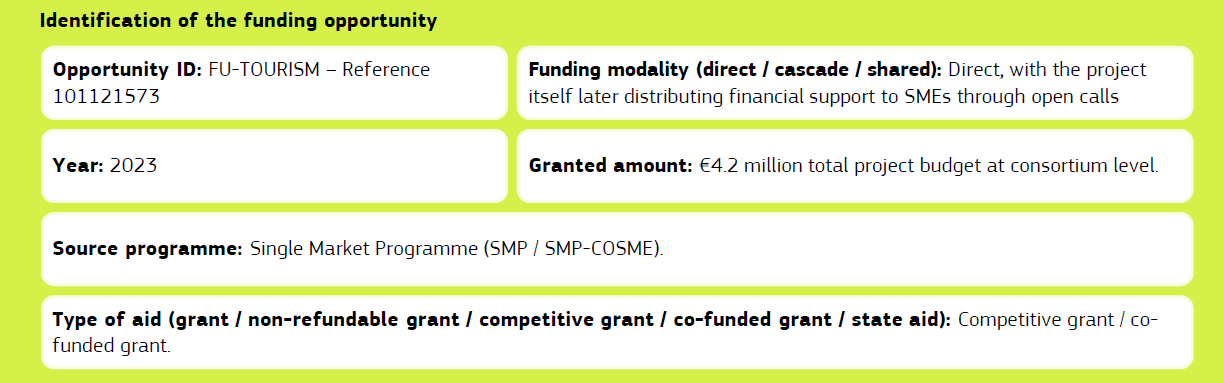
• Countries impacted: Croatia, Spain, Belgium, Greece, Austria and Poland, with pilot destination-level work in Valencia and Poreč-Parenzo.
• Thematic axis: Green and digital transition of tourism SMEs, including sustainability, innovation, resilience, regenerative practices, new business models, Living Labs, and collaboration ecosystems for tourism.
• Funding programme lineage (EU, national, regional): EU.
Description of the project
• Project objective(s):
- Support tourism SMEs to become more resilient, competitive, sustainable, innovative and digitalised.
- Build a future-ready support ecosystem for the green and digital transition of tourism SMEs.
- Create long-term collaboration structures, cluster dynamics and Living-Lab-type approaches that connect SMEs with innovation support organisations and other stakeholders.
- Provide direct and expert support to SMEs and help them develop new business models, solutions and innovation pathways linked to tourism transition.
• Duration: 36 months (09/2023 – 09/2026).
• Main activities:
- Coordinate and develop a European collaboration ecosystem for tourism SME transition.
- Launch and manage open calls providing financial and expert support to tourism SMEs.
- Mobilise SMEs through networks, campaigns, partners and existing ecosystem relationships.
- Promote strategic capacity-building, destination-level pilots and 4-Helix / Living-Lab collaboration approaches.
- Develop long-term cooperation between project partners and related ecosystems beyond the single project cycle.
• Outputs:
- A transnational support ecosystem for tourism SMEs in transition.
- Financial support and expertise for 102 SME projects.
- Open calls and an acceleration programme offering grants and mentoring to selected SMEs.
- Destination-level pilot activities and strategic collaboration models in Valencia and Poreč-Parenzo.
- Wide dissemination and mobilisation of tourism SMEs through partner networks and campaigns.
Type of application
• Single applicant: No.
• Consortium members: EUPOLIS GRUPA (Coordinator), Finnova, Envolve, SYNYO, Vestbee, Open Impact, and destination-related partners linked to Valencia and Poreč-Parenzo.
• Subcontractor: Not specified.
Success Factors
• Previous experience with funding: The company had significant prior experience with European projects and EU funding applications. During the interview, it referred not only to FU-TOURISM but also to broader experience with demanding calls such as LIFE and Horizon, which contributed to its internal capacity and proposal readiness.
• Team design & resources: A key strength was the company’s combination of project development capacity, ecosystem-building experience, partner engagement know-how and thematic expertise across tourism, regional development, culture, nature protection, agriculture and innovation. This multidisciplinary profile supported both proposal design and consortium coordination.
• Effective Partnership Building: Partnership building was one of the strongest enabling factors. The company was invited to join the consortium through its existing European network of collaborators, and that network had been built over time through conferences, exchanges and prior contact around common interests. The proposal therefore benefited from trust, continuity and a shared strategic direction.
• Access to information: The company explained that its first contact with EU funding opportunities historically came through newsletters, emails and the monitoring of specialised websites. In the case of FU-TOURISM specifically, however, the opportunity came directly through its transnational network, with partners proposing the call and supporting joint preparation.
• Use of support ecosystems: EUPOLIS GRUPA’s own role as an ecosystem builder was itself a major advantage. Existing networks of collaborators, SMEs and support partners enabled the consortium not only to prepare the proposal, but also to spread information quickly, reach potential beneficiaries efficiently and ensure strong participation in the project’s calls
• Long-term collaboration as a source of credibility: the consortium was not improvised; it reflected ongoing shared interests, which gave the proposal greater coherence and strategic depth.
• Capacity to mobilise real SME and stakeholder networks: EUPOLIS was able not only to design the project, but also to activate relevant ecosystems of SMEs and support actors quickly and effectively.
Barriers & Challenges
• High complexity of EU calls: even for experienced organisations, the preparation of European proposals remains demanding and administratively heavy.
• Slow funding timelines: one of the most concrete challenges mentioned was the long delay between submission and project start, which reduces momentum and creates uncertainty.
• Fragmented access to funding information: opportunities are still often discovered through scattered newsletters, websites and informal channels, even for experienced applicants.
• Some calls are too technical for most SMEs: certain programmes require such a high level of expertise that they remain inaccessible for many smaller actors.
Lessons learned
• Invest in ecosystem-building before the call opens: A central lesson from this case is that successful European collaboration does not begin when the call is published. Relationships, shared concepts and common interests built years in advance became a major competitive advantage at proposal stage.
• Strong networks improve both access to calls and project implementation: Networks helped the company identify opportunities, shape the proposal, form the consortium and later reach SMEs quickly through existing contacts and campaigns. This makes network-building a highly transferable lesson for other tourism stakeholders.
• Simpler and more phased application processes would improve accessibility: The company clearly argued that EU funding procedures could be improved through simplification, phased application models and faster timelines. This is particularly relevant for SMEs, which often lack the internal capacity to absorb long and complex preparation processes.
• Better information-sharing systems are still needed for SMEs: Another important lesson is that discovering relevant EU funding remains too dependent on fragmented information channels and on the applicant’s own initiative. Even experienced actors find funding websites difficult to navigate, which suggests a strong need for better notification systems and clearer information flows.
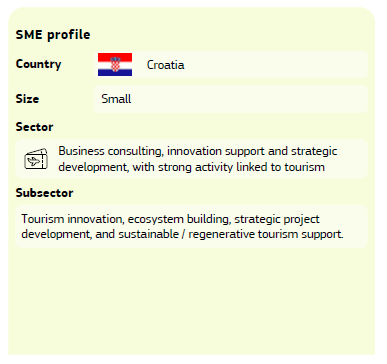
This best practice shows how a small tourism-related innovation and consulting SME can successfully access EU funding by building a long-term European collaboration ecosystem rather than approaching funding only as an isolated proposal-writing exercise. EUPOLIS GRUPA’s experience demonstrates that ecosystem-building, sustained transnational networking, thematic alignment and a clear continuation vision can make a proposal more competitive and more sustainable over time. It represents a strong example for tourism stakeholders seeking to improve their access to funding not only through technical proposal skills, but also through deliberate investment in partnerships, shared concepts and trusted collaboration structures that exist before the funding opportunity appears.
Comments (0)
Connected Partnership Opportunities
See also
Casa da Guitarra - Using Specialized Platforms to Accelerate Access to Funding
- Categories
- Coastal, maritime and inland water tourism Cultural tourism Ecotourism +64 more
MUZEJ UJA (Olive Oil Museum) - Diversifying Heritage Olive-Oil Tourism through EU-Supported Rural Accommodation
- Categories
- Coastal, maritime and inland water tourism Cultural tourism Ecotourism +64 more
Conrad Events - Prototype-Driven Access to EU Funding for Innovation-Heavy Tourism SMEs
- Categories
- Coastal, maritime and inland water tourism Cultural tourism Ecotourism +64 more