

Best practices
26 October 2026
Hungarian Hospitality Employers' Association (VIMOSZ) - Combining Small Grants, Expert Support and Peer Learning
Best practices
26 October 2026
Login / create an account to be able to react
-
2
Editorial team
Topics
Albania
Armenia
Austria
Belgium
Bosnia and Herzegovina
Bulgaria
Croatia
Cyprus
Czechia
Denmark
Estonia
EU-27
Finland
France
Georgia
Germany
Greece
Hungary
Iceland
Ireland
Italy
Kosovo
Latvia
Liechtenstein
Lithuania
Luxembourg
Malta
Moldova
Montenegro
Netherlands
North Macedonia
Norway
Poland
Portugal
Romania
Serbia
Slovakia
Slovenia
Spain
Sweden
Switzerland
Türkiye
Ukraine
Other
Academic / Research and VET Institutions
Business Support Organisation
Company with 250 or more employees
Cluster Organisations
Consumer Organisations
Cultural and Heritage Organisations
Destination Management & Marketing Organisations
EU Institutions
Financial Institutions and Investors
Industry Associations and Chambers of Commerce
International Organisations
Local Authorities
Media / Journalist Organisations
National authorities
Networks and Federations / Confederations
NGOs / Non-profits
Notified Bodies
Regional Authorities
SMEs (a company with less than 250 employees)
Social Economy Entity
Trade Unions
Other
-
Specific types of tourism
-
-
Adventure tourism
-
Coastal, maritime and inland water tourism
-
Cultural tourism
-
Ecotourism
-
Education tourism
-
Festival tourism
-
Gastronomy tourism
-
Health and medical tourism
-
MICE tourism
-
Mountain tourism
-
Religious tourism
-
Rural tourism
-
Sports tourism
-
Urban/city tourism
-
Wellness tourism
-
-
Transition Pathway Strategic Areas
-
-
Accessible tourism services
-
Best practices, peer learning and networking
-
Changes in tourism demand and opportunities
-
Circularity of tourism services
-
Coordinated information on travelling
-
Cross-border travelling
-
Digitalisation of tourism SMEs and destinations
-
Equal and fair tourism jobs
-
Funding and support measures
-
Governance of tourism destinations
-
Green Transition of Tourism Companies and SMEs
-
Improving formal education
-
Improving statistics and indicators
-
Innovative tourism services
-
Multimodal travelling
-
Online visibility of tourism offer
-
Pact for skills
-
Promoting PEF/OEF methods for tourism
-
R&I on climate-friendly tourism
-
R&I on digital tools for tourism
-
Short-term rentals
-
Skills needs for twin transition
-
Sustainable mobility
-
Tools for data on tourism
-
Tourism strategies
-
Training opportunities
-
Well-being of residents
-
-
Business activities
-
-
Activities of amusement parks and theme parks
-
Activities of associations and other organisations supporting tourism
-
Air passenger transport
-
Camping grounds, recreational vehicle parks and trailer parks
-
Events catering and other food services
-
Festivals, cultural and entertainment activities
-
Gardens and nature reserves activities
-
Holiday Housing / Apartments and other short stay accommodation
-
Hotel and similar accommodation
-
Mobile beverage services
-
Mobile food services
-
Museums
-
Operation of historical sites
-
Other
-
Other accommodation
-
Other amusement and recreation activities
-
Other food and beverage services
-
Other holiday reservation services
-
Other tourism transportation activities
-
Rail Passenger transport
-
Recreational and sport activities
-
Restaurants, cafes and bars (Food and Beverage serving activities)
-
Road passenger transport
-
Tour operator activities
-
Travel agency activities
-
Water (sea, coastal and inland) passenger transport
-
Share
Scope of the programme
• Countries impacted: Spain, Germany, Estonia, the Netherlands, Denmark, Croatia and Hungary
• Thematic axis: Sustainable urban tourism, innovation, circular economy, resource efficiency, knowledge exchange and SME capacity-building
• Funding programme lineage (EU, national, regional): EU
Description of the project
• Project objective(s):
- Help tourism SMEs adapt to more sustainable, innovative and resource-efficient business models
- Strengthen SME capacity to respond to sustainability challenges in urban tourism
- Support the uptake of innovation, sustainability practices and more efficient operations
- Foster knowledge exchange and best-practice learning between similar tourism SMEs from different European countries
• Duration: 2020–2023
• Main activities:
- Launch of an open national call in Hungary to select tourism SMEs for participation
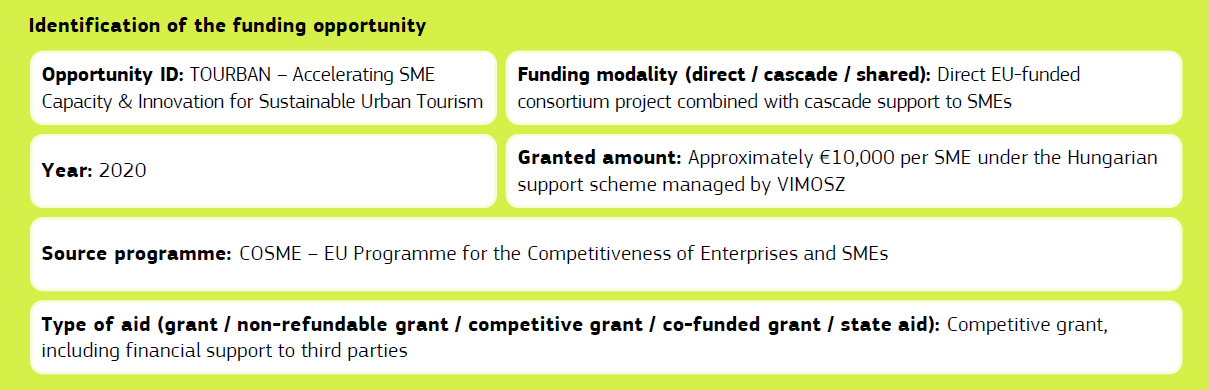
- Allocation of approximately €10,000 per selected SME
- Participation of selected SMEs in networking events, webinars and thematic workshops
- Access to a pool of consultants from which SMEs could choose the most relevant support
- Training on issues such as energy efficiency, water management, marketing, sustainability & design thinking
- Facilitation of targeted meetings between similar SMEs from different countries to discuss common problems and solutions
• Outputs:
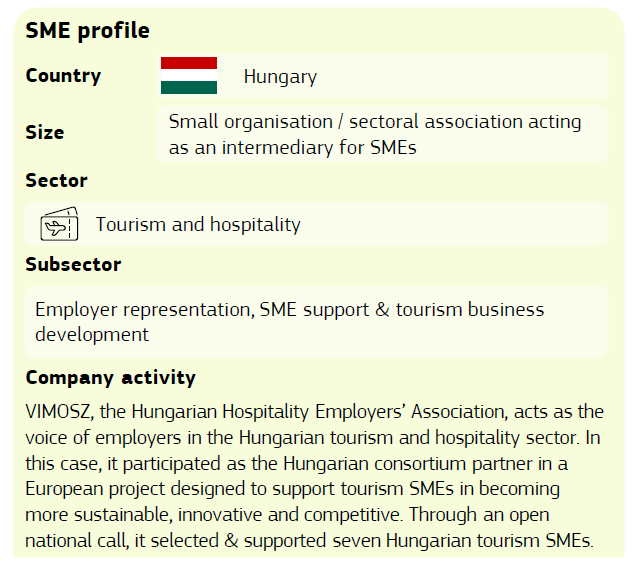
- Direct support to seven Hungarian tourism SMEs
- Participation of Hungarian SMEs in a wider European community of practice
- Adoption of new sustainability approaches, business ideas and service models by the supported SMEs
- Practical improvements in business strategy, including energy efficiency, sustainability certification, accessibility and innovation
- New business developments inspired by the support received, including more sustainable tourism models and new niche tourism activities.
Type of application
• Single applicant: No
• Consortium members: The project was implemented by a consortium including organisations from Spain, Germany, Estonia, the Netherlands, Denmark, Croatia and Hungary, coordinated by the Barcelona Chamber of Commerce
• Subcontractor: No specific subcontractor was highlighted. Instead, selected SMEs could access support through a pre-selected pool of consultants
Success Factors
• Quality of proposal: One of the strongest aspects of the project was its practical design. It did not rely only on financial support, but combined funding with training, consultancy and peer exchange. This made the intervention more useful and more transformative for SMEs.
• Strategic fit with call priorities: The project was closely aligned with the programme’s objectives because it focused directly on helping tourism SMEs become more sustainable, more innovative and more competitive. It addressed practical issues such as energy, water, marketing, sustainability and business model adaptation in urban tourism.
• Previous experience with funding: VIMOSZ already had experience with EU-funded projects before TOURBAN, which helped the organisation join the consortium and contribute effectively. This prior experience also made it easier to organise the Hungarian call and support SMEs through the programme.
• Team design & resources: The support mechanism worked well because it was not only a funding channel. SMEs also had access to consultants, webinars, training sessions and structured networking moments. This created a broader support environment in which companies could choose what was most relevant to them.
• Effective Partnership Building: A very positive factor was the international consortium structure. It created opportunities for Hungarian SMEs to meet similar companies from other countries, exchange ideas and discuss shared problems in an organised way. This European peer-learning dimension was one of the most valuable elements of the initiative.
• Access to information: VIMOSZ was able to publicise the open call effectively through strong sector communication channels, including a tourism daily bulletin reaching around 15,000 people and enterprises. This made it possible to attract interested SMEs through an open and visible selection process.
• Use of support ecosystems: The project benefited strongly from the surrounding support ecosystem created by the consortium. The combination of financial help, consultancy, networking events, webinars and community-building turned the programme into more than a grant scheme; it became a practical support platform for SME transition.
Barriers & Challenges
• Language was a real barrier for SMEs: one of the clearest obstacles was that participation required working in English, which made the process harder for some companies.
• Young professionals often lack any training on EU funding systems: the interview highlighted a structural gap in education, with graduates entering the labour market without understanding EU project logic, administration or accounting.
• Nationally co-managed schemes are often far more bureaucratic: compared with TOURBAN, other Hungarian or mixed national-EU schemes were described as much more burdensome and discouraging.
• Access to good partnerships is itself competitive: VIMOSZ joined the consortium at a late stage and still had to compete to be selected as the Hungarian partner.
Lessons learned
• Small grants can trigger major transformation when embedded in wider support: even modest funding amounts can have strong effects when they are paired with expert guidance and structured learning.
• Tailored support matters more than generic support: the SMEs benefited most when they could choose the consultant, topic and support path that best matched their specific challenge.
• Cross-border peer exchange is a strong accelerator of innovation: some of the most valuable learning came from seeing how similar companies in other countries addressed comparable problems.
• Programme design should create trust, not fear: the experience suggests that SMEs respond far better to support models built on flexibility and confidence than to over-controlled, highly bureaucratic systems.
This best practice shows that SME support is most effective when it combines direct financial assistance with learning, expert guidance and peer exchange. Through TOURBAN, VIMOSZ helped seven Hungarian tourism SMEs not only access a modest grant, but also connect with a wider European ecosystem of ideas, consultants and practical solutions. The case demonstrates that even relatively small funding amounts can trigger major change when they are embedded in a broader support framework. It represents a highly relevant example for tourism support organisations, chambers and intermediary bodies across Europe, showing how to design SME support in a way that is practical, trusted and genuinely transformative. This best practice shows that SME support is most effective when it combines direct financial assistance with learning, expert guidance and peer exchange. Through TOURBAN, VIMOSZ helped seven Hungarian tourism SMEs not only access a modest grant, but also connect with a wider European ecosystem of ideas, consultants and practical solutions. The case demonstrates that even relatively small funding amounts can trigger major change when they are embedded in a broader support framework. It represents a highly relevant example for tourism support organisations, chambers and intermediary bodies across Europe, showing how to design SME support in a way that is practical, trusted and genuinely transformative.
Comments (0)
Connected Partnership Opportunities
See also
ENNOV Solutions - Building a Competitive EU Funding Proposal as a Solo Founder
- Categories
- Coastal, maritime and inland water tourism Cultural tourism Ecotourism +64 more
B&B Alta Murgia - Aligning the company's purpose with European opportunities
- Categories
- Coastal, maritime and inland water tourism Cultural tourism Ecotourism +64 more
Merill Rural Network - Using EU-Funded Digital Innovation to Strengthen Rural Tourism in Malta
- Categories
- Coastal, maritime and inland water tourism Cultural tourism Ecotourism +64 more