

Best practices
26 October 2026
MASCONTOUR - Leveraging Specialised Expertise and European Partnerships to Access EU Tourism Funding
Best practices
26 October 2026
Login / create an account to be able to react
-
1 view
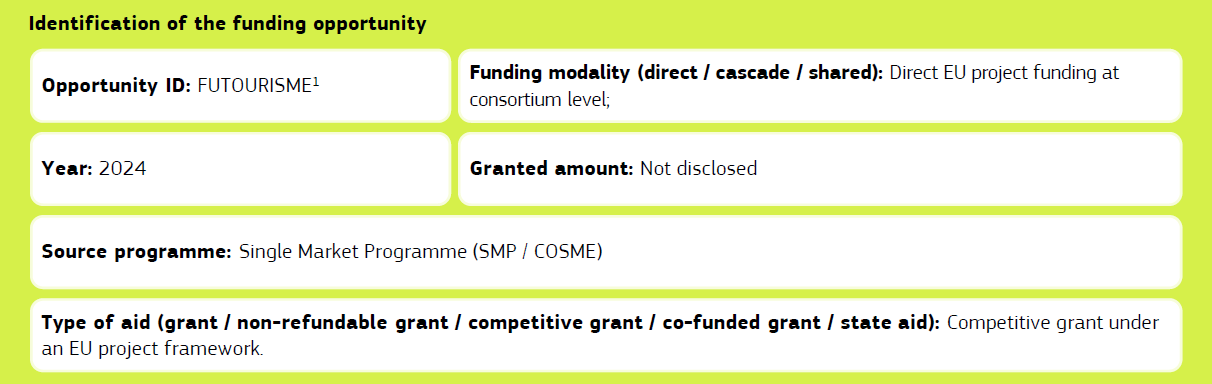
1. Fostering Digital & Sustainable Transition of Tourism SMEs for Future Innovation and Resilience; Project ID 101121578.
Editorial team
Topics
Albania
Armenia
Austria
Belgium
Bosnia and Herzegovina
Bulgaria
Croatia
Cyprus
Czechia
Denmark
Estonia
EU-27
Finland
France
Georgia
Germany
Greece
Hungary
Iceland
Ireland
Italy
Kosovo
Latvia
Liechtenstein
Lithuania
Luxembourg
Malta
Moldova
Montenegro
Netherlands
North Macedonia
Norway
Poland
Portugal
Romania
Serbia
Slovakia
Slovenia
Spain
Sweden
Switzerland
Türkiye
Ukraine
Other
Academic / Research and VET Institutions
Business Support Organisation
Company with 250 or more employees
Cluster Organisations
Consumer Organisations
Cultural and Heritage Organisations
Destination Management & Marketing Organisations
EU Institutions
Financial Institutions and Investors
Industry Associations and Chambers of Commerce
International Organisations
Local Authorities
Media / Journalist Organisations
National authorities
Networks and Federations / Confederations
NGOs / Non-profits
Notified Bodies
Regional Authorities
SMEs (a company with less than 250 employees)
Social Economy Entity
Trade Unions
Other
-
Specific types of tourism
-
-
Adventure tourism
-
Coastal, maritime and inland water tourism
-
Cultural tourism
-
Ecotourism
-
Education tourism
-
Festival tourism
-
Gastronomy tourism
-
Health and medical tourism
-
MICE tourism
-
Mountain tourism
-
Religious tourism
-
Rural tourism
-
Sports tourism
-
Urban/city tourism
-
Wellness tourism
-
-
Transition Pathway Strategic Areas
-
-
Accessible tourism services
-
Best practices, peer learning and networking
-
Changes in tourism demand and opportunities
-
Circularity of tourism services
-
Coordinated information on travelling
-
Cross-border travelling
-
Digitalisation of tourism SMEs and destinations
-
Equal and fair tourism jobs
-
Funding and support measures
-
Governance of tourism destinations
-
Green Transition of Tourism Companies and SMEs
-
Improving formal education
-
Improving statistics and indicators
-
Innovative tourism services
-
Multimodal travelling
-
Online visibility of tourism offer
-
Pact for skills
-
Promoting PEF/OEF methods for tourism
-
R&I on climate-friendly tourism
-
R&I on digital tools for tourism
-
Short-term rentals
-
Skills needs for twin transition
-
Sustainable mobility
-
Tools for data on tourism
-
Tourism strategies
-
Training opportunities
-
Well-being of residents
-
-
Business activities
-
-
Activities of amusement parks and theme parks
-
Activities of associations and other organisations supporting tourism
-
Air passenger transport
-
Camping grounds, recreational vehicle parks and trailer parks
-
Events catering and other food services
-
Festivals, cultural and entertainment activities
-
Gardens and nature reserves activities
-
Holiday Housing / Apartments and other short stay accommodation
-
Hotel and similar accommodation
-
Mobile beverage services
-
Mobile food services
-
Museums
-
Operation of historical sites
-
Other
-
Other accommodation
-
Other amusement and recreation activities
-
Other food and beverage services
-
Other holiday reservation services
-
Other tourism transportation activities
-
Rail Passenger transport
-
Recreational and sport activities
-
Restaurants, cafes and bars (Food and Beverage serving activities)
-
Road passenger transport
-
Tour operator activities
-
Travel agency activities
-
Water (sea, coastal and inland) passenger transport
-
Share
Scope of the programme
• Countries impacted: The project involved partners from Italy, Greece, Cyprus, Germany, France and Spain, and it was designed to support tourism SMEs in the experiential tourism field.
• Thematic axis: Digital and sustainable transition of tourism SMEs, including new business models, innovative services, skills development, e-learning, coaching and twin transition solutions.
• Funding programme lineage (EU, national, regional): EU.
Description of the project
• Project objective(s): To support tourism SMEs in the experiential tourism sector in their digital and sustainable transition through new business models, innovative services, skills development, training and technical support. For MASCONTOUR specifically, the project also represented an opportunity to contribute specialised expertise in tourism, e-learning and sustainability to a European consortium.
• Duration: The project was structured as a multiannual initiative with work packages running from M1 to M36.
• Main activities: MASCONTOUR supported proposal preparation for the work packages in which it was involved or mainly responsible, contributed expertise on e-learning and tourism, participated in implementation activities linked to training and SME support, and engaged in consortium coordination and reporting processes.
• Outputs: Contribution to project work packages, training and coaching activities, and specialised content linked to digital and sustainable tourism transition for SMEs. The company briefing sheet also indicates that MASCONTOUR appears in project-related outputs as an active content-producing partner. From MASCONTOUR’s perspective, the project represents a sustained, multi-stage collaboration rather than a one-off funding action, combining proposal preparation, implementation and reporting over the life of the project.
Type of application
• Single applicant: No.
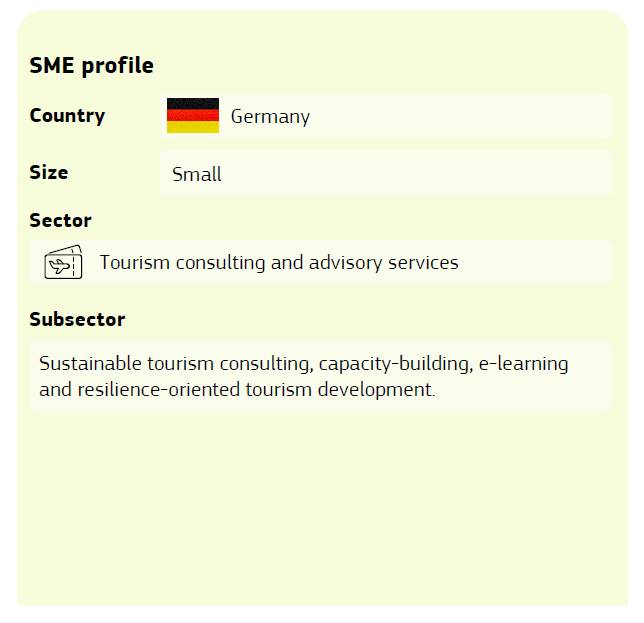
• Consortium members: MASCONTOUR participated as part of a European consortium and was approached by third parties that were looking for specific expertise and a German partner profile that fit the proposal needs.
• Subcontractor: No.
Success Factors
• Previous experience with funding: MASCONTOUR already had prior experience in several international and EU-related programmes, including Interreg-related work, Switch Asia and Erasmus involvement. This previous exposure helped the company enter the project with a stronger understanding of European collaboration dynamics.
• Team design & resources: A key success factor was MASCONTOUR’s highly specialised expertise in sustainable tourism, e-learning and tourism business support, which made the company attractive as a consortium partner. The interview explicitly states that the company was approached because others were looking for this concrete expertise.
• Effective Partnership Building: The consortium-building process worked because MASCONTOUR was invited by external actors who already had a first outline of the project and were seeking the right country and expertise fit. MASCONTOUR then assessed the proposal logic and joined on that basis.
• Strategic fit with call priorities: The project matched MASCONTOUR’s profile very well, as the call focused on digital and sustainable transition in tourism and the company already works precisely in resilience, sustainability, training and implementation support.
• Access to information: In this case, access to the opportunity came mainly through European project networks and direct approach by third parties, rather than through open discovery by the company itself. However, the interview also notes that MASCONTOUR is now increasingly proactive in scanning new calls.
• Use of support ecosystems: The company’s broader European consulting and project ecosystem was clearly an enabling factor, since relationships with other actors opened the door to collaboration opportunities and later to new calls under discussion.
Barriers & Challenges
• Complexity of the Call: MASCONTOUR explained that this was its first COSME project and that the company was not fully familiar with all the technical and financial details at the beginning, which created a significant learning curve.
• Administrative burden: One of the clearest barriers mentioned in the interview was the amount of documentation and formal material that had to be reviewed and processed. MASCONTOUR described receiving very long documents and needing substantial time just to go through them.
• Eligibility criteria / financial interpretation: A major challenge arose because the company owner was initially considered as a consultant within the project logic, but later, after reporting, was treated differently due to ownership status. According to the interview, this re-interpretation had a significant financial impact and led to substantial losses for the company.
• Time & resource constraints: The company noted that proposal preparation and compliance work take considerable time, which is demanding for a small, specialised business. The burden is high not only during application but also during implementation and reporting.
• Partnership & consortium: MASCONTOUR acknowledged that partnership-building in EU projects always entails risk because consortia frequently involve actors that are not deeply known in advance. Although due diligence was carried out, the uncertainty remains an inherent feature of this type of funding.
• Lack of user-friendly support tools: The interview explicitly suggests that funding systems could be easier to navigate if practical tools such as better question-answering systems or chatbot-style support existed to
Lessons learned
• Strong thematic expertise is one of the most effective ways for a small company to access EU consortium projects, because partners actively look for niche knowledge and credible implementation capacity.
• Previous project experience matters, but each funding programme still has its own rules and requires a dedicated learning effort, especially in financial interpretation and eligibility details.
• Small technical misunderstandings in EU funding can have very large financial consequences, so the interpretation of staff categories, ownership roles and budget rules must be clarified in detail as early as possible.
• For small, specialised firms, joining as a partner can be a realistic and effective route into EU funding, while becoming lead partner may remain difficult until administrative confidence and internal capacity are further strengthened.
This best practice illustrates how a small, specialised tourism consultancy can successfully access EU funding by positioning itself as a high-value expert partner within a European consortium. MASCONTOUR’s experience shows that thematic credibility, international project experience and a clear niche in sustainable tourism and e-learning can open the door to participation in ambitious EU projects. At the same time, the case also represents the tensions that many small expert organisations face: they can contribute strongly to project substance and impact, but still encounter significant complexity in administrative and financial implementation. Overall, the case is a useful example of how access to EU funding for tourism stakeholders is not only about generating ideas, but also about being visible, trusted and strategically positioned within European collaboration networks.
Comments (0)
Connected Partnership Opportunities
See also
Casa da Guitarra - Using Specialized Platforms to Accelerate Access to Funding
- Categories
- Coastal, maritime and inland water tourism Cultural tourism Ecotourism +64 more
MUZEJ UJA (Olive Oil Museum) - Diversifying Heritage Olive-Oil Tourism through EU-Supported Rural Accommodation
- Categories
- Coastal, maritime and inland water tourism Cultural tourism Ecotourism +64 more
Conrad Events - Prototype-Driven Access to EU Funding for Innovation-Heavy Tourism SMEs
- Categories
- Coastal, maritime and inland water tourism Cultural tourism Ecotourism +64 more