

Best practices
26 October 2026
Museumsverein Klostertal - Leveraging Program Alignment and Strategic Partnerships to Secure EU Funding
Best practices
26 October 2026
Login / create an account to be able to react
-
4
Editorial team
Topics
Albania
Armenia
Austria
Belgium
Bosnia and Herzegovina
Bulgaria
Croatia
Cyprus
Czechia
Denmark
Estonia
EU-27
Finland
France
Georgia
Germany
Greece
Hungary
Iceland
Ireland
Italy
Kosovo
Latvia
Liechtenstein
Lithuania
Luxembourg
Malta
Moldova
Montenegro
Netherlands
North Macedonia
Norway
Poland
Portugal
Romania
Serbia
Slovakia
Slovenia
Spain
Sweden
Switzerland
Türkiye
Ukraine
Other
Academic / Research and VET Institutions
Business Support Organisation
Company with 250 or more employees
Cluster Organisations
Consumer Organisations
Cultural and Heritage Organisations
Destination Management & Marketing Organisations
EU Institutions
Financial Institutions and Investors
Industry Associations and Chambers of Commerce
International Organisations
Local Authorities
Media / Journalist Organisations
National authorities
Networks and Federations / Confederations
NGOs / Non-profits
Notified Bodies
Regional Authorities
SMEs (a company with less than 250 employees)
Social Economy Entity
Trade Unions
Other
-
Specific types of tourism
-
-
Adventure tourism
-
Coastal, maritime and inland water tourism
-
Cultural tourism
-
Ecotourism
-
Education tourism
-
Festival tourism
-
Gastronomy tourism
-
Health and medical tourism
-
MICE tourism
-
Mountain tourism
-
Religious tourism
-
Rural tourism
-
Sports tourism
-
Urban/city tourism
-
Wellness tourism
-
-
Transition Pathway Strategic Areas
-
-
Accessible tourism services
-
Best practices, peer learning and networking
-
Changes in tourism demand and opportunities
-
Circularity of tourism services
-
Coordinated information on travelling
-
Cross-border travelling
-
Digitalisation of tourism SMEs and destinations
-
Equal and fair tourism jobs
-
Funding and support measures
-
Governance of tourism destinations
-
Green Transition of Tourism Companies and SMEs
-
Improving formal education
-
Improving statistics and indicators
-
Innovative tourism services
-
Multimodal travelling
-
Online visibility of tourism offer
-
Pact for skills
-
Promoting PEF/OEF methods for tourism
-
R&I on climate-friendly tourism
-
R&I on digital tools for tourism
-
Short-term rentals
-
Skills needs for twin transition
-
Sustainable mobility
-
Tools for data on tourism
-
Tourism strategies
-
Training opportunities
-
Well-being of residents
-
-
Business activities
-
-
Activities of amusement parks and theme parks
-
Activities of associations and other organisations supporting tourism
-
Air passenger transport
-
Camping grounds, recreational vehicle parks and trailer parks
-
Events catering and other food services
-
Festivals, cultural and entertainment activities
-
Gardens and nature reserves activities
-
Holiday Housing / Apartments and other short stay accommodation
-
Hotel and similar accommodation
-
Mobile beverage services
-
Mobile food services
-
Museums
-
Operation of historical sites
-
Other
-
Other accommodation
-
Other amusement and recreation activities
-
Other food and beverage services
-
Other holiday reservation services
-
Other tourism transportation activities
-
Rail Passenger transport
-
Recreational and sport activities
-
Restaurants, cafes and bars (Food and Beverage serving activities)
-
Road passenger transport
-
Tour operator activities
-
Travel agency activities
-
Water (sea, coastal and inland) passenger transport
-
Share
Scope of the programme
• Countries impacted: All 27 EU Member States
• Thematic axis:
- Preservation of cultural heritage
- Sustainable tourism development
- Use of hiking trails as a tool to connect tourism and heritage protection
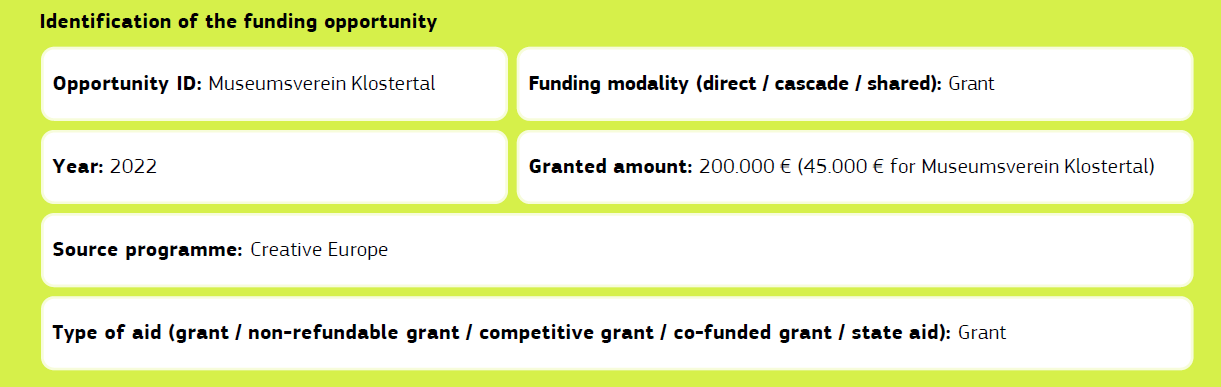
• Funding programme lineage (EU, national, regional): national.
Description of the project
• Project objective(s): To preserve cultural heritage and use cultural heritage as a sustainable tourism asset, specifically through the development of hiking-based cultural routes and training of hiking guides.
• Duration: 36 months
• Main activities:
- Development of heritage-based hiking concepts
- Training and pilot testing with hiking guides
- Cross-border exchange of practices between mountain regions
- Collaboration with local tourism boards, municipalities, and hiking associations
• Outputs:
- Training activities for hiking and heritage professionals
- Pilot actions in four countries
- Strengthened cooperation between cultural heritage and tourism stakeholders
- Basis for follow-up projects and scaling to additional countries
Type of application
• Single applicant: No
• Consortium members:
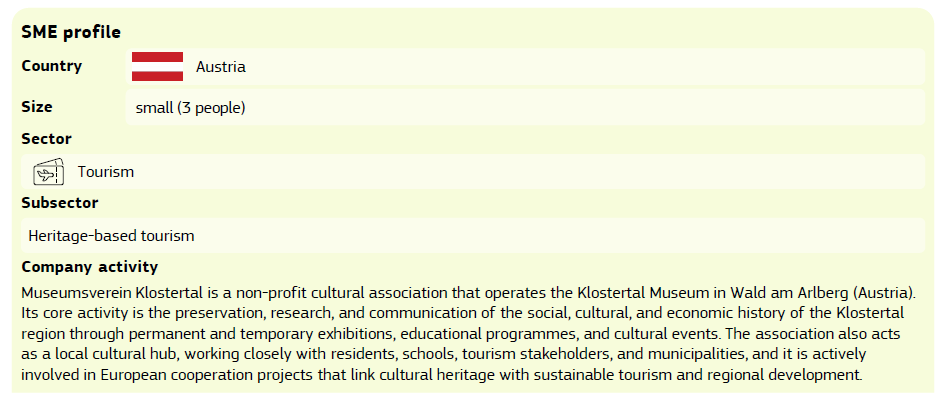
- Museumsverein Klostertal (Austria) – project partner representing a regional museum & cultural heritage institution.
- Urban Development Center (UDC) (Serbia) – lead/major partner with expertise in cultural heritage, innovation, and EU projects.
- Gornjesavski muzej Jesenice (Slovenia) – museum partner involved in heritage protection and trail development.
- Arouca Geopark (Portugal) – partner contributing mountain and geopark heritage expertise.
• Subcontractor: No
Success Factors
• Previous experience with funding: Museumsverein has experience across EU programmes (LEADER rural areas, Interreg, Erasmus+ including accreditation, etc.), giving the organisation credibility in delivery and compliance.
• Effective Partnership Building: The consortium spans four countries and different mountain contexts, which the interview frames as a reason the consortium was viewed positively by the European Commission. The four-country partnership (Serbia, Slovenia, Austria, Portugal) and positions it as a collaborative European network combining heritage + outdoor tourism expertise. The consortium composition was also “narratively strong”: Alps + Serbia’s mountains + Arouca Geopark context are explicitly referenced as a positive factor.
• Use of support ecosystem: A critical success factor was combining European networking with local stakeholder engagement—tourism boards, municipalities, alpine/hiking associations—described as a “fundamental base” for the project. This is the kind of credibility point evaluators look for: implementation is not isolated within the consortium; it is embedded in the local tourism/heritage ecosystem
Barriers & Challenges
• Complexity of the Call: A specific friction point is that they are used to Erasmus+ style processes, while “projects going directly to the European Commission” have different procedural characteristics, so switching programme logic increases cognitive and administrative load.
• Administrative burden: The formal aspects and navigating “all the documents” without overlooking anything were “still challenging,” even with simplification efforts.
• Time & resource constraints: Museumsverein operates with three part-time staff, which naturally amplifies the burden of compliance and documentation management. Even when implementation is strong, limited internal bandwidth makes it harder to manage reporting, contracting, evidence collection, and multi-country coordination demands.
Lessons learned
• Choose experienced partners you can trust: This is the clearest lesson learned stated: identify experienced and valuable partners and, crucially, partners you can trust. In practice, INHERIT shows the value of letting a capable lead partner handle proposal mechanics while others contribute domain substance
• Define common goals early, then design around real capacity: The company stress the need for common goals and good preparation, including an honest assessment of what you can and cannot deliver with your internal capacity. This is particularly relevant for micro entities: scope ambition must be matched to available staff time and operational reality.
• Build a two-level network: EU/international + local implementers: The project design uses training and “ambassador” diffusion plus ongoing dissemination via social networks and public events (which is a strong sustainability mechanism after funding).
This best practice is easily transferable to other small tourism and heritage-based SMEs, as it shows that EU funding success depends less on size and more on clear alignment with programme priorities, strong partnerships, and practical project design. By joining consortia with experienced partners and anchoring projects in local tourism ecosystems, SMEs with limited resources can remain competitive and access EU funding effectively.
Comments (0)
Connected Partnership Opportunities
See also
Watershed Fly Fishing - Securing EU Funding Through Program Alignment
- Categories
- Coastal, maritime and inland water tourism Cultural tourism Ecotourism +64 more
Anonymous accommodation company - A Lean SME's Path to Tourism Modernisation
- Categories
- Coastal, maritime and inland water tourism Cultural tourism Ecotourism +64 more
Nature Park Our - Using Interregional Cooperation to Turn Environmental Protection into Sustainable Dark-Sky Tourism
- Categories
- Coastal, maritime and inland water tourism Cultural tourism Ecotourism +64 more