

Best practices
26 October 2026
Sailway - Accessing Circular Tourism Funding Through an Intermediated EU Support Scheme
Best practices
26 October 2026
Login / create an account to be able to react
-
1 view
Editorial team
Topics
Albania
Armenia
Austria
Belgium
Bosnia and Herzegovina
Bulgaria
Croatia
Cyprus
Czechia
Denmark
Estonia
EU-27
Finland
France
Georgia
Germany
Greece
Hungary
Iceland
Ireland
Italy
Kosovo
Latvia
Liechtenstein
Lithuania
Luxembourg
Malta
Moldova
Montenegro
Netherlands
North Macedonia
Norway
Poland
Portugal
Romania
Serbia
Slovakia
Slovenia
Spain
Sweden
Switzerland
Türkiye
Ukraine
Other
Academic / Research and VET Institutions
Business Support Organisation
Company with 250 or more employees
Cluster Organisations
Consumer Organisations
Cultural and Heritage Organisations
Destination Management & Marketing Organisations
EU Institutions
Financial Institutions and Investors
Industry Associations and Chambers of Commerce
International Organisations
Local Authorities
Media / Journalist Organisations
National authorities
Networks and Federations / Confederations
NGOs / Non-profits
Notified Bodies
Regional Authorities
SMEs (a company with less than 250 employees)
Social Economy Entity
Trade Unions
Other
-
Specific types of tourism
-
-
Adventure tourism
-
Coastal, maritime and inland water tourism
-
Cultural tourism
-
Ecotourism
-
Education tourism
-
Festival tourism
-
Gastronomy tourism
-
Health and medical tourism
-
MICE tourism
-
Mountain tourism
-
Religious tourism
-
Rural tourism
-
Sports tourism
-
Urban/city tourism
-
Wellness tourism
-
-
Transition Pathway Strategic Areas
-
-
Accessible tourism services
-
Best practices, peer learning and networking
-
Changes in tourism demand and opportunities
-
Circularity of tourism services
-
Coordinated information on travelling
-
Cross-border travelling
-
Digitalisation of tourism SMEs and destinations
-
Equal and fair tourism jobs
-
Funding and support measures
-
Governance of tourism destinations
-
Green Transition of Tourism Companies and SMEs
-
Improving formal education
-
Improving statistics and indicators
-
Innovative tourism services
-
Multimodal travelling
-
Online visibility of tourism offer
-
Pact for skills
-
Promoting PEF/OEF methods for tourism
-
R&I on climate-friendly tourism
-
R&I on digital tools for tourism
-
Short-term rentals
-
Skills needs for twin transition
-
Sustainable mobility
-
Tools for data on tourism
-
Tourism strategies
-
Training opportunities
-
Well-being of residents
-
-
Business activities
-
-
Activities of amusement parks and theme parks
-
Activities of associations and other organisations supporting tourism
-
Air passenger transport
-
Camping grounds, recreational vehicle parks and trailer parks
-
Events catering and other food services
-
Festivals, cultural and entertainment activities
-
Gardens and nature reserves activities
-
Holiday Housing / Apartments and other short stay accommodation
-
Hotel and similar accommodation
-
Mobile beverage services
-
Mobile food services
-
Museums
-
Operation of historical sites
-
Other
-
Other accommodation
-
Other amusement and recreation activities
-
Other food and beverage services
-
Other holiday reservation services
-
Other tourism transportation activities
-
Rail Passenger transport
-
Recreational and sport activities
-
Restaurants, cafes and bars (Food and Beverage serving activities)
-
Road passenger transport
-
Tour operator activities
-
Travel agency activities
-
Water (sea, coastal and inland) passenger transport
-
Share
Scope of the programme
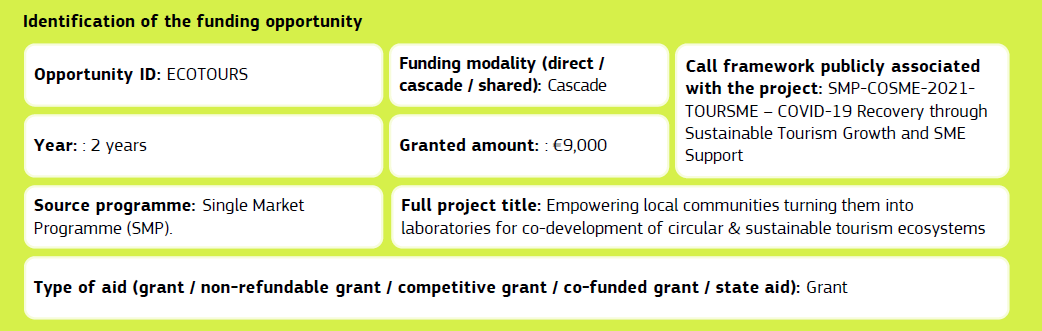
• Countries impacted: Italy, Greece, France, Hungary, Spain & Cyprus. Public ECOTOURS sources state that the project targeted local communities in these six countries, including Galicia/Vigo in Spain.
• Thematic axis: Circular and sustainable tourism, community-based tourism ecosystems, environmental principles and standards, peer learning, and support for tourism SMEs.
• Funding programme lineage: EU. The project is described publicly as co-funded by the European Union under the Single Market Programme / COSME framework.
Description of the project
• Project objective(s):
- Support tourism SMEs in adopting more circular and sustainable practices.
- Strengthen local tourism ecosystems through collaboration, peer learning and community-based approaches.
- Contribute to the development of shared tourism solutions and digital tools linked to sustainable destination development.
• Duration: 2 years
• Main activities:
- Participation in a structured support process involving international exchange and project-related activities.
- Engagement in actions linked to collaborative destination development and digital tourism solutions.
- Use of the grant to reinforce marketing, visibility and selected digitalisation-related needs within the business.
• Outputs:
- Participation in international project activities and networking processes.
- Contribution to a wider circular tourism initiative involving shared tools and destination-level cooperation.
- Improved short-term business capacity through promotional and operational support.
Type of application
• Single applicant: Yes, at beneficiary level.
• Consortium members: The ECOTOURS partners includes PRISM, Universidade de Vigo, Petra Patrimonia Corsica, ENOROS Consulting Ltd, The Community Foundation of Agrigento and Trapani, ANKO, and The Chamber of Commerce and Industry Csongrad-Csanad County (CSMKIK).
• Subcontractor: No
Success Factors
• Access to information: The opportunity became accessible through tourism-sector networking and intermediary support, which facilitated the SME’s participation in a scheme that would have been difficult to access independently.
• Use of support ecosystems: The involvement of an intermediary structure reduced the distance between the European initiative and the SME, enabling participation through a more localised support channel.
• Strategic value for the SME: Although the scheme was operationally demanding, the funding generated tangible value by providing liquidity and supporting marketing and promotional activities that were directly relevant to the business.
• Learning and networking dimension: The transnational format contributed to knowledge exchange, exposure to other practices, and professional networking with actors in the tourism ecosystem.
Barriers & Challenges
• Administrative burden: The main challenge was the volume and complexity of administrative and justification requirements, which created a disproportionate burden for a micro-enterprise.
• Time & resource constraints: The SME had to manage the process largely with its own limited internal capacity, making compliance highly demanding in operational terms.
• Strategic fit with implementation reality: The overall project design was perceived as only partially aligned with the practical needs and working methods of very small tourism businesses.
• Effectiveness of outputs: Some of the project’s digital components were seen as having limited long-term practical value for the business and for the intended tourism market.
Lessons learned
• Funding schemes targeting micro tourism SMEs should be more closely aligned with concrete business needs, particularly those related to liquidity, promotion, market access and manageable operational improvements.
• Administrative and reporting requirements should be proportionate to the size and capacity of the beneficiary in order to avoid discouraging participation.
• Support instruments are more effective when they build on existing market realities and practical sector dynamics rather than relying excessively on top-down or overly prescriptive project outputs.
• Intermediated support models can help micro-enterprises access EU funding, but their impact depends on balancing strategic ambition with implementation simplicity and operational relevance.
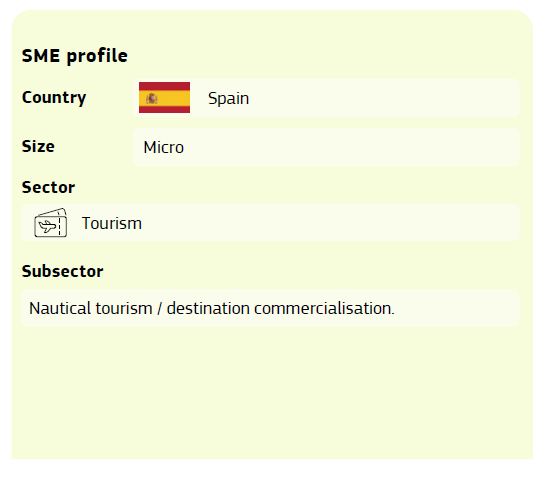
This best practice shows how a micro tourism SME can benefit from EU-supported sustainability schemes when funding is channelled through an enabling ecosystem. At the same time, it illustrates the importance of proportional administration, realistic project design and practical relevance for ensuring that very small tourism businesses can convert support into meaningful business value.
Comments (0)
Connected Partnership Opportunities
See also
Casa da Guitarra - Using Specialized Platforms to Accelerate Access to Funding
- Categories
- Coastal, maritime and inland water tourism Cultural tourism Ecotourism +64 more
MUZEJ UJA (Olive Oil Museum) - Diversifying Heritage Olive-Oil Tourism through EU-Supported Rural Accommodation
- Categories
- Coastal, maritime and inland water tourism Cultural tourism Ecotourism +64 more
Conrad Events - Prototype-Driven Access to EU Funding for Innovation-Heavy Tourism SMEs
- Categories
- Coastal, maritime and inland water tourism Cultural tourism Ecotourism +64 more