

Best practices
26 October 2026
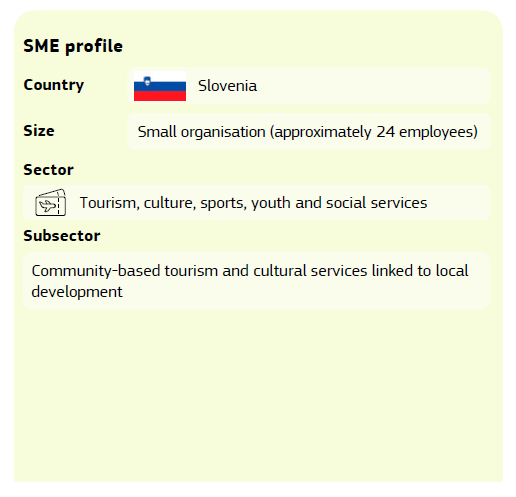
Zavod Sotočje Medvode - Leveraging Local Development Funds to Strengthen Community-Based Tourism and Services
Best practices
26 October 2026
Login / create an account to be able to react
-
3
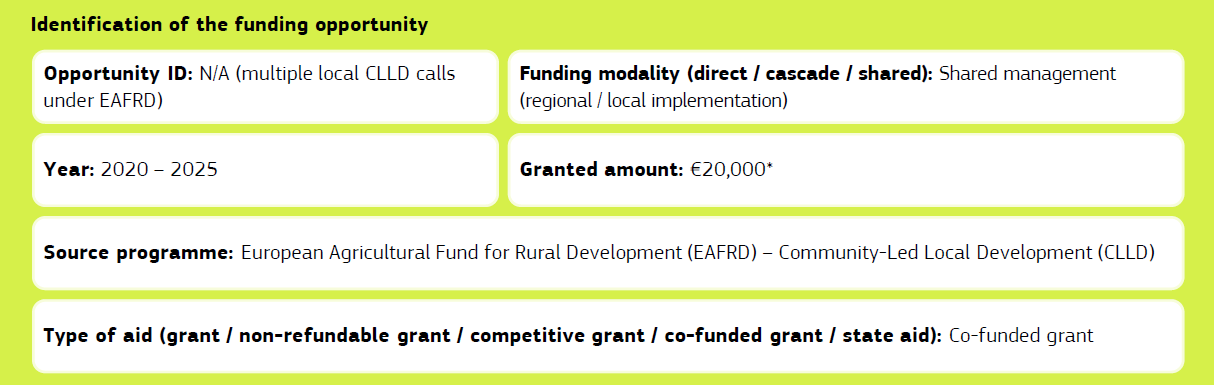
(*) Between €20,000 and €70,000 per project, depending on the specific action
Editorial team
Topics
Albania
Armenia
Austria
Belgium
Bosnia and Herzegovina
Bulgaria
Croatia
Cyprus
Czechia
Denmark
Estonia
EU-27
Finland
France
Georgia
Germany
Greece
Hungary
Iceland
Ireland
Italy
Kosovo
Latvia
Liechtenstein
Lithuania
Luxembourg
Malta
Moldova
Montenegro
Netherlands
North Macedonia
Norway
Poland
Portugal
Romania
Serbia
Slovakia
Slovenia
Spain
Sweden
Switzerland
Türkiye
Ukraine
Other
Academic / Research and VET Institutions
Business Support Organisation
Company with 250 or more employees
Cluster Organisations
Consumer Organisations
Cultural and Heritage Organisations
Destination Management & Marketing Organisations
EU Institutions
Financial Institutions and Investors
Industry Associations and Chambers of Commerce
International Organisations
Local Authorities
Media / Journalist Organisations
National authorities
Networks and Federations / Confederations
NGOs / Non-profits
Notified Bodies
Regional Authorities
SMEs (a company with less than 250 employees)
Social Economy Entity
Trade Unions
Other
-
Specific types of tourism
-
-
Adventure tourism
-
Coastal, maritime and inland water tourism
-
Cultural tourism
-
Ecotourism
-
Education tourism
-
Festival tourism
-
Gastronomy tourism
-
Health and medical tourism
-
MICE tourism
-
Mountain tourism
-
Religious tourism
-
Rural tourism
-
Sports tourism
-
Urban/city tourism
-
Wellness tourism
-
-
Transition Pathway Strategic Areas
-
-
Accessible tourism services
-
Best practices, peer learning and networking
-
Changes in tourism demand and opportunities
-
Circularity of tourism services
-
Coordinated information on travelling
-
Cross-border travelling
-
Digitalisation of tourism SMEs and destinations
-
Equal and fair tourism jobs
-
Funding and support measures
-
Governance of tourism destinations
-
Green Transition of Tourism Companies and SMEs
-
Improving formal education
-
Improving statistics and indicators
-
Innovative tourism services
-
Multimodal travelling
-
Online visibility of tourism offer
-
Pact for skills
-
Promoting PEF/OEF methods for tourism
-
R&I on climate-friendly tourism
-
R&I on digital tools for tourism
-
Short-term rentals
-
Skills needs for twin transition
-
Sustainable mobility
-
Tools for data on tourism
-
Tourism strategies
-
Training opportunities
-
Well-being of residents
-
-
Business activities
-
-
Activities of amusement parks and theme parks
-
Activities of associations and other organisations supporting tourism
-
Air passenger transport
-
Camping grounds, recreational vehicle parks and trailer parks
-
Events catering and other food services
-
Festivals, cultural and entertainment activities
-
Gardens and nature reserves activities
-
Holiday Housing / Apartments and other short stay accommodation
-
Hotel and similar accommodation
-
Mobile beverage services
-
Mobile food services
-
Museums
-
Operation of historical sites
-
Other
-
Other accommodation
-
Other amusement and recreation activities
-
Other food and beverage services
-
Other holiday reservation services
-
Other tourism transportation activities
-
Rail Passenger transport
-
Recreational and sport activities
-
Restaurants, cafes and bars (Food and Beverage serving activities)
-
Road passenger transport
-
Tour operator activities
-
Travel agency activities
-
Water (sea, coastal and inland) passenger transport
-
Share
Scope of the programme
• Countries impacted: Slovenia
• Thematic axis: Local development, social inclusion, cultural services, mobility, community cohesion and quality of life in rural and semi-rural areas
• Funding programme lineage (EU, national, regional): Regional / local implementation of an EU programme
Description of the project
• Project objective(s): The funded projects aimed to improve the quality of life of local residents by strengthening community services, enhancing mobility, reinforcing social cohesion and expanding access to cultural and recreational activities. Tourism-related actions were embedded within a broader local development logic rather than treated as stand-alone commercial initiatives.
• Duration: Between 1 and 3 years, depending on the project
• Main activities:
- Provision of free transport services for elderly residents (e.g. access to hospitals, pharmacies and health centres)
- Purchase of equipment to support cultural activities (e.g. cinema equipment)
- Acquisition of electric bicycles to improve local mobility
- Organisation of cultural and social programmes for residents
- Networking and cooperation activities between local stakeholders
• Outputs:
- New or improved local services for residents
- Enhanced access to mobility and cultural activities
- Strengthened cooperation between public, private and community actors
- Tangible improvements in local service infrastructure
Success Factors
• Strategic fit with call priorities: Projects were deliberately adapted to align closely with the specific objectives and scoring criteria of each call, ensuring strong coherence with programme priorities.
• Previous experience with funding: Repeated participation in local and regional funding schemes built institutional familiarity with procedures, expectations and reporting requirements.
• Team design & resources: Responsibilities were clearly distributed internally, with staff members specialising in specific thematic areas and proactively identifying relevant calls.
• Effective partnership building: Strong cooperation with municipalities and local institutions enabled the organisation to build credible consortia and design projects grounded in real local needs.
• Use of support ecosystems: Support from the regional development agency (RRA LUR) played a key role in navigating administrative requirements and improving proposal quality.
Barriers & Challenges
• Complexity of the call: At the beginning, understanding funding rules and application requirements was perceived as difficult and time-consuming.
• Administrative burden: Reporting, documentation and reimbursement procedures required significant effort and attention.
• Time & resource constraints: Limited internal capacity made it challenging to manage proposal preparation and implementation alongside day-to-day operations.
• Partnership & consortium coordination: Coordinating multiple partners sometimes required additional time and effort, particularly when responsiveness varied.
• Eligibility criteria: While not a major obstacle, careful screening was necessary to ensure that only suitable calls were pursued.
Lessons learned
• Alignment is decisive: Selecting calls that genuinely match the organisation’s mission and adapting project ideas to call priorities is essential for success.
• Capacity grows through repetition: Repeated participation in funding schemes gradually reduces uncertainty and improves efficiency in both application and implementation phases
This best practice demonstrates how a locally rooted organisation can successfully use EU co-funded rural development programmes to strengthen community-based tourism and services. Zavod Sotočje Medvode’s experience shows that funding success does not necessarily rely on highly innovative or large-scale projects, but on strong alignment with local development objectives, stable partnerships and growing institutional capacity. The case is particularly relevant for small tourism and cultural organisations operating in rural or semi-rural areas, illustrating how EU funds can be used pragmatically to deliver tangible social and territorial benefits while progressively building long-term funding competence.
Comments (0)
Connected Partnership Opportunities
See also
Watershed Fly Fishing - Securing EU Funding Through Program Alignment
- Categories
- Coastal, maritime and inland water tourism Cultural tourism Ecotourism +64 more
Anonymous accommodation company - A Lean SME's Path to Tourism Modernisation
- Categories
- Coastal, maritime and inland water tourism Cultural tourism Ecotourism +64 more
ENNOV Solutions - Building a Competitive EU Funding Proposal as a Solo Founder
- Categories
- Coastal, maritime and inland water tourism Cultural tourism Ecotourism +64 more