

Reports
28 July 2026
CEEV report on the EU Code of Conduct (2026)
Reports
28 July 2026
Login / create an account to be able to react
-
16
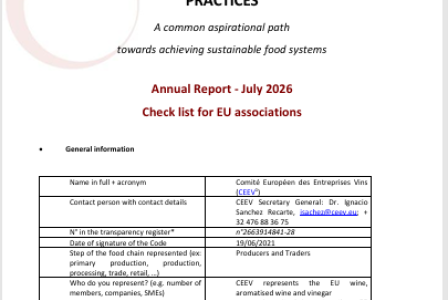
CEEV 2026 Annual Report - EU Code of Conduct - Reporting checklist EU associations.
CEEV continued implementing its commitments under the EU Code of Conduct on Responsible Food Business and Marketing Practices in 2025–2026. Key actions included expanding the U-label digital platform, promoting responsible wine consumption through Wine in Moderation and VITÆVINO, and advancing sustainability, research, and innovation across the European wine sector. These initiatives strengthen transparency, sustainability, and the resilience of the EU wine value chain
CEEV
CEEV
Topics
EU-27
Industry Associations and Chambers of Commerce
-
CoC aspirational objectives
-
-
1. Healthy, balanced and sustainable diets for all European consumers
-
3. A climate - neutral food chain in Europe by 2050
-
4. An optimised circular and resource-efficient food chain in Europe
-
6. Sustainable value creation in the European food supply chain through partnership
-
7. Sustainable sourcing in food supply chains
-
Share
EU Code of Conduct on responsible FOOD business and marketing practices A common aspirational path towards achieving sustainable food systems Annual Report - July 2026
EU Code of Conduct on
responsible FOOD business and marketing practices
A common aspirational path
towards achieving sustainable food systems
Annual Report - July 2026
Check list for EU associations
General information
Name in full + acronym | Comité Européen des Entreprises Vins (CEEV) |
Contact person with contact details | CEEV Secretary General: Dr. Ignacio Sanchez Recarte, isachez@ceev.eu; + 32 476 88 36 75 |
N° in the transparency register* | n°2663914841-28 |
Date of signature of the Code | 19/06/2021 |
Step of the food chain represented (ex: primary production, production, processing, trade, retail, …) | Producers and Traders |
Who do you represent? (e.g. number of members, companies, SMEs) | CEEV represents the EU wine, aromatised wine and vinegar companies. It brings together 25 national organisations from 13 EU Member States, plus Switzerland, the United Kingdom and Ukraine, a consortium of 4 leading European wine companies and the European Vinegar Association. Our members produce and market the large majority of wines with and without GI and exports 90% of EU wines. CEEV members produce and market the vast majority of quality European wines, both with and without a geographical indication, and account for over 90% of European wine exports. |
* if available
European Associations pledge to:
endorse the aspirational objectives set out in this Code (where applicable)
CEEV endorsed the aspirational objectives applicable to the wine sector set out in the “Code of Conduct for Responsible Business and Marketing Practices”.
The triple approach towards sustainability – people, planet and profit – is at the heart of the European Union wine sector’s philosophy. Only by embracing the principles of sustainability, has the EU wine sector been able to maintain for centuries an activity that cannot be delocalised and to preserve its vineyards, rural areas and rural communities.
CEEV recognizes the important role that the code of conduct is playing in uniting EU food operators behind a common aspiration towards sustainable food systems and foster wine companies’ commitment to tangibly improve and communicate their sustainability performance and is therefore committed to tangibly contribute to the environmental, health, economic and social sustainability of the EU wine system and value chain.
CEEV’s Pledge to the Code of Conduct is made up by the following four specific sectoral commitments including:
COMMITMENT 1: Provide digital information to consumer by means of an e-label Platform
COMMITMENT 2: Promote consumer’s awareness of healthy, balanced and sustainable diets through the Wine in Moderation program
COMMITMENT 3: Promote sustainable production practices
COMMITMENT 4: Reinforce the resilience and competitiveness of the full wine supply chain
promote and disseminate this Code with(in) their constituency/ies;
Describe the dissemination and promotion activities taken. For ex.: Internal meetings (ex: working group, task force, board meeting, AGM), workshop, webinars, other events, communication, mailings, messages, documents, leaflets, website, newsletter, etc
CEEV is closely following the Code of Conduct initiative
CEEV is closely following different initiatives arising from the adoption of the Code of Conduct and is keeping close contacts with the Commission, other stakeholders and the Code of Conduct Task Force chaired by FoodDrinkEurope.
CEEV active communication toward its members
CEEV Members are informed on a regular basis on the development of the Code of conduct. Communication focused on the role and the ambition of the CoC, its structure and the contribution of the wine sector to achieve the main objective to increase the availability and affordability of healthy sustainable food options and to improve the sustainability of the food system
- An update on the Code of conduct is given on a regular basis during the CEEV internal meetings and thematic Working Committees that gather experts representing CEEV’s member association
- To promote the U-label platform, the tool initiated by CEEV and developed in collaboration with spirits Europe, to provide digital information to consumers CEEV Secretariat organized many presentation sessions. More information is available hereunder in the CEEV report on the implementation on its pledge commitments.
encourage their members to align their sustainability actions and/or business practices to the aspirational objectives and targets of the Code and invite them, on a voluntary basis, to adhere to this Code, as appropriate;
Was it part of the messages delivered under the promotion activities?
Any specific action? Ex: inclusion of the CoC in the vision/mission, roadmap/working programme, …
Any indication that the message has been considered by members? If relevant, please give examples.
Information transferred to the members
Shift toward more sustainability is a long-standing topic of discussion among wine sector. CEEV and its members acknowledge the important role that the CoC is playing in fostering wine companies’ commitment to further improve their sustainability performance.
CEEV members endorsed the Code of conduct objectives and contributed to draft CEEV specific sectoral commitments included in CEEV’s pledge to the CoC. Those commitments include actions to be implemented by members at national level
CEEV included in its 2023 – 2027 Strategic Action Plan many key actions in line with objective of the Code of Conducts and CEEV’s commitments included in its Pledge to the CoC to better deliver on sustainability.
CEEV and its members worked on embodying its roadmap on sustainability. This Roadmap can be considered as a deliverable of the Code of Conduct and will guide the wine sector and its companies towards more sustainability. The roadmap was drafted in collaboration with members and adopted by CEEV General Assembly in March 2022.
CEEV developed, in collaboration with spiritsEUROPE the U-Label platform. This digital platform is contributing to CEEV’s commitment included in its pledge to the Code of conduct to better inform consumers and provide digital information.
Research and Development. CEEV adopted a strategic approach structured around three levels, namely R&D Agenda, R&D Pitches and R&D Database in 2021. The first step of the CEEV R&D Action – i.e. the EU Wine R&D Agenda – partially inspired by The EU CoC was adopted by CEEV’s General Assembly in March 2022. In 2025 CEEV established 2 consortia to present research projects on Copper and Agroecology topics within Horizon Europe work programme 2025.
CEEV is continuously calling on its member to strongly support the Wine in Moderation programme to fight harmful use of alcohol and promote responsible and moderated drinking patterns.
explore the possibility of developing sector-specific tools and resources in support of this Code;
Did your EU association explore the possibility of developing sector-specific tools and resources in support of this Code?
How? Which type of tools? On which aspirational objective(s)? Any achievement?
For example, did you collect best practices? did you allocate human resources? Budget? Etc
CEEV and its members developed several specific tools to promote sustainability in the wine sector and achieve commitments taken in the framework of the CEEV pledge to the Code of Conduct signed in June 2021. While the tools have been inspired by the Code of conduct other already existing or in preparation have been adapted or enhanced to align to the CoC objectives.
Adoption of CEEV’s Strategic plan 2023 - 2027
CEEV included in its 2023 – 2027 Strategic Plan many key actions in line with objectives of the Code of Conduct and CEEV’s commitments included in its Pledge to the CoC to better deliver on sustainability.
Embodiment of sustainability roadmap
The CEEV Roadmap on Sustainability was adopted by CEEV‘s General Assembly on 17th March 2022. As part of our Farm to Fork EU Code of Conduct commitments, it is guiding the wine sector in their sustainability journey in line with the EU green commitments and consumers expectations, as well as positively improve communication on the EU wine sector’s sustainability from the vineyard to consumer.
The CEEV Strategic Action Plan 2023 – 2027 included many key actions aimed to increase sustainability of the EU wine sector.
Aspirational objective(s):
2. Prevention and reduction of food loss and waste
3. A climate neutral food chain in Europe by 2050
5. Sustained, inclusive and sustainable economic growth, employment and decent work for all
6. Sustainable value creation in the European food supply chain through partnership
7. Sustainable sourcing in food supply chains
Research & Development Agenda
On 17 March 2022 CEEV adopted its EU Wine R&D Agenda. The document was revised in June 2026. In 2025 CEEV established 2 Consortia to submit research projects on Copper and Agroecology. The first one is on a reserve list the second one will be resubmitted.
Aspirational objective(s):
3. A climate neutral food chain in Europe by 2050
4. An optimized circular and resource-efficient food chain in Europe
6. Sustainable value creation in the European food supply chain through partnership
7. Sustainable sourcing in food supply chains
U-label platform
CEEV has promoted the development of a digital platform for all wine and aromatised wine companies also extended so far to spirits company to promote and facilitate the digital provision to consumers of transparent information on the characteristics of wine products, on their sustainability and on responsible wine consumption so that they could make informed choices.
Aspirational objective(s):
1. Healthy, balanced and sustainable diets for all European consumers
Wine in Moderation
The sector ranging from small family-owned wineries to multinational companies is strongly committed to continue its action through the Wine in Moderation movement to promote responsible wine consumption and contribute to reduce the harm related to excessive/irresponsible drinking. The mission to self-regulate commercial communication, to educate, inform and communicate on the topic of moderate and responsible wine drinking as part of a healthy diet and lifestyle is achieved through a variety of actions at local and international level targeting wine professionals as well as consumers.
Aspirational objective(s):
1. Healthy, balanced and sustainable diets for all European consumers
continue to engage in dialogue with other food chain/systems actors and EU and international policy-makers to forge (new) relationships, exchange good practices and discuss challenges encountered, learn from each other (studies, projects) and create better mutual understanding, and identify opportunities for collaboration and potential partnership.
Did you engage with other partners of the food chain?
Can you give examples of engagements, which partners, on which aspirational objective(s), …
CEEV continued promoting the U-label digital platform with EU policy - makers and sectorial associations active in the supply chain, including through Exhibition on the Future of Digital Labelling “Digital Labels: shaping the future of consumer information”! organised on 9 April 2025
Contacts with associations representing other EU alcoholic beverages took place to discuss a future possible extension of the U-Label platform to further alcoholic beverages categories.
CEEV is exchanging on a regular basis with other actor of the wine chain to discuss topics related to sustainability and enhance engagement towards Wine in Moderation programme
REPORT ON THE IMPLEMENTATION OF CEEV COMMITMENTS – July 2026
Please find hereunder a report on the implementation of CEEV commitments included in its pledge to the Code of Conduct signed in June 2021
Commitment 1: Provide digital information to consumer by means of an e-label platform
Action: Develop and contribute to the success of the U-label platform
CEEV continued to work on the improvement of the U-Label digital platform for all wine companies that will facilitate the digital provision to consumers of transparent information on the characteristics of wine and aromatised wine products, on their sustainability and on responsible wine consumption so that they could make informed choices.
Today’s consumers expect more transparency on the products they consume, and digital labelling can respond to this demand by boosting the information that wine companies share with their consumers. Digitalisation is a way to empower the consumer helping them to make better and more informed choice. In this context, one of the main assets of digital communication in general, and U-label in particular, is the capacity to inform the consumer in a language that can be easily understood by them.
The development U-label platform respond to three major objectives.
- Provide a service/support, primarily to National associations members of CEEV and in fine to all wine, aromatised wine and spirits companies wishing to use e-labels. In this scope, U-label collaborates with different actors in the digital world to facilitate the inter-connection between different platforms and simplify the life of companies and/or consumers
- Reinforce the concept and feasibility of e-labels by demonstrating that information can be and is already provided through electronic means and all the more important is easy to access. A fair, correct and harmonised system shall support this approach. On the other hand, by facilitating the development of e-labels, we could scale-up its use.
- Spread and reinforce CEEV expertise of how the labelling information should be provided for wines, aromatised wine products and spirit drinks in line with the Regulation(s), sparing them the hassle of finding relevant regulatory requirements and updates. In this context, the U-label is meant to be adapted to possible future regulatory requirements, whether at EU level, national level or global level
Aspirational objective(s):
- Healthy, balanced and sustainable diets for all European consumers
Achievements. Updated in July 2026:
- The U-label platform has been operational since end of 2021, allowing all EU and non-EU wine, aromatised wine and spirits companies to create e-labels for their products. In March 2024, U-label has joined forces with Scantrust, a leading company active in QR code technology, to propose a new upgraded version of the platform now called “U-label by Scantrust”.
- To this date, more than 2.500 companies have joined U-label by Scantrust, jointly creating more than 115.000 e-labels.
- Those e-labels total more than 10.1 million scans by consumers to this date.
- The U-label by Scantrust platform is continuously updated and improved, in close collaboration with CEEV, to ensure full compliance with the EU legislation and cover, when possible, also national regulation (cf. Italian and Spanish recycling labelling requirements).
- QR codes generated by the U-label by Scantrust platform are digital link ready
- Several information webinars are organised by U-label by Scantrust each month in several languages, in cooperation with CEEV, spiritsEUROPE, GS1, and/or national wine / spirits associations, to inform companies on how to use the U-label by Scantrust platform and how to best implement the EU labelling regulations.
Commitment 2: promote consumer’s awareness of healthy, balanced and sustainable diets through the wine in moderation program
Actions:
Support the implementation at national level of Wine in Moderation programme
Support the progress of the VITÆVINO Campaign
The wine sector is strongly committed to continuing and enhancing its efforts to promote responsible wine consumption and reduce the harm associated with excessive or irresponsible drinking. This commitment was reaffirmed with the 2024 relaunch of the Wine in Moderation movement, which aims to embed moderate wine consumption as part of a healthy, balanced, and sustainable lifestyle. The programme’s mission—to self-regulate commercial communication and to educate, inform, and engage both professionals and consumers—is implemented through a wide range of actions at local and international levels.
Supporting this mission, the CEEV (Comité Européen des Entreprises Vins) plays a key role in coordinating national-level implementation and increasing the visibility of the Wine in Moderation programme across Europe. Complementing these efforts, the VITÆVINO grassroots campaign was launched to defend the cultural, social, and economic value of wine. At its core is a strong affirmation of the legitimate place of moderate wine consumption within a healthy and balanced lifestyle, countering the growing tendency to conflate alcohol abuse with responsible enjoyment. The campaign’s Wine Declaration invites citizens and wine communities to stand by wine as a symbol of conviviality, cultural heritage, and sustainability. It celebrates wine’s role in fostering social bonds, supporting rural economies, and contributing to environmental stewardship—values recognised by UNESCO as part of humanity’s intangible cultural heritage.
Aspirational objective(s):
1. Healthy, balanced and sustainable diets for all European consumers
Achievements. Updated in July 2026 concerning WIM 2025 activities:
To support Commitment 2—promoting consumer awareness of healthy, balanced, and sustainable diets through the Wine in Moderation programme—several key elements have been instrumental in 2025. Central to this commitment are the following:.
In 2025, the Wine in Moderation programme continued to expand its global impact by promoting moderation through education, scientific communication, professional training, and positive engagement with consumers and the wine sector. The year also marked the launch of the 2025–2030 Strategy and the Digital Responsible Service Training, reinforcing the programme's long-term vision.
- A total of 22,620 professionals were trained worldwide through 9,187 training sessions, including the launch of the new Digital Responsible Service Training and the continued rollout of the Train-the-Trainer programme, equipping professionals with practical tools to promote responsible service and informed consumption.
- The programme implemented 835 communication actions, reaching 1,185,631 participants through campaigns, events and awareness-raising activities, including the third edition of Wine in Moderation Day, demonstrating the programme's growing visibility and engagement.
- The international network continued to grow, with activities coordinated through 15 National Coordinators across 12 national programmes, supported by 6 Ambassador Companies, 30 partners, and 69 Wine in Moderation supporters, while extending its outreach to 115 countries and territories.
- Scientific credibility remained a cornerstone of the programme. The Wine Information Council added 238 new scientific abstracts to its database, organised the 2nd Lifestyle, Diet, Wine and Health Congress, contributed to the 46th OIV Congress, and continued disseminating evidence-based scientific information to stakeholders.
- The programme strengthened its global footprint by welcoming Caviro as its 6th Ambassador Company and Enologica Vason as a new partner, further reinforcing industry engagement and international collaboration.
- Overall investment in the programme reached more than €6.9 million, including €4.83 million dedicated to communication activities, €959,000 to education and training, and additional investments in staff, coordination and scientific work, underlining the sector's long-term commitment to responsible drinking initiatives.
- Together, these achievements demonstrate the continued evolution of Wine in Moderation as the global social responsibility movement of the wine sector, strengthening a culture of moderation through science, education, professional empowerment and international cooperation
Achievements. Updated in July 2026 concerning VITÆVINO Campaign in 2025:
By July 2026, the VITÆVINO campaign had become the leading grassroots initiative promoting wine culture and responsible consumption across Europe. Building on its successful launch in October 2024, the campaign continued to expand through national events and political engagement, particularly in countries such as Italy, Spain and Germany, where additional regional events further strengthened public and stakeholder support.
- Launched across Europe in October 2024, with high-level national events in Italy, Spain, Germany, France, Portugal, Austria and Slovenia, as well as international initiatives in Argentina and the United States.
- Continued to grow throughout 2025 and into 2026, with additional VITÆVINO events and stakeholder activities organised across Europe, including Germany.
- By July 2026, more than 25,000 people from over 80 countries had signed the VITÆVINO Declaration, demonstrating broad international support for wine culture and moderation.
- The campaign also brought together a growing community of supporters through video testimonials featuring wine professionals, consumers and Members of the European Parliament, highlighting wine's cultural, social and economic value.
- VITÆVINO has become a recognised platform advocating for science-based, balanced policies that protect wine as part of Europe's cultural heritage and promote responsible consumption within a healthy lifestyle.
Commitment 3: Promote sustainable production practices
Action:
Support the implementation of more sustainable production system (including GHG emissions)
Encourage wine companies to take up sustainable certification schemes
Sustainability is a key priority for Europe’s wine sector and has become a central focus at CEEV in light of the latest EU strategies and action plans and consumers expectations.
Aspirational objective(s):
2. Prevention and reduction of food loss and waste
3. A climate neutral food chain in Europe by 2050
5. Sustained, inclusive and sustainable economic growth, employment and decent work for all
6. Sustainable value creation in the European food supply chain through partnership
7. Sustainable sourcing in food supply chains
Achievements - Updated in July 2026:
Adoption of sustainability roadmap. Following the adoption of CEEV’s Roadmap on Sustainability during CEEV‘s General Assembly on 17th March 2022, CEEV continued to promote its commitments that guide the wine sector in their sustainability journey in line with the EU green commitments and consumers expectations, as well as positively improve communication on the EU wine sector’s sustainability from the vineyard to consumer.
The roadmap clearly sets sustainability as a key priority. It states that for the EU wine sector, sustainability is most often linked to the protection and maintenance of our vineyards, our communities, our qualitative products and our wine companies, and actually impacts traditional rules and practices in production facilities, processes, packaging, distribution and information to consumers across the whole supply chain. CEEV will always proactively promote the balance between all 3 pillars that make up sustainability – economic, social and environmental – towards policymakers and consumers, as there is the risk of jeopardizing the global sustainability of the wine sector by addressing or valuing only one of them – the environmental one which seems to be the main priority in the political agenda.
The roadmaps states CEEV‘s support of the final objectives of the EU Green Deal as well as the EU Circular Economy Action Plan and acknowledges its commitment to work to secure that actions and initiatives adopted to reach these objectives are efficient, relevant, science based and do not put at risk the global sustainability of the EU wine sector. Throughout the year, CEEV leveraged several opportunities within its internal Working Committees and ad hoc working groups to inform its members and facilitate dialogue with European policymakers. Key topics included the Nature Restoration Law, the EU Deforestation Regulation, the Corporate Sustainability Reporting Directive (CSRD), the Corporate Sustainability Due Diligence Directive (CSDDD), the Packaging and Packaging Waste Regulation and its articulated implementation, the New Genomic techniques regulation and the Soil Monitoring Directive. These efforts contributed significantly to improving understanding of the legislation and its potential impact on wine companies.
CEEV is promoting a “wine sustainability initiative” in collaboration with OIV and involving Member States and retailers with the main objective to promoting the recognition of key certification and curb multiplication of sustainability programmes and initiatives, which often include different requirements, procedures and approaches to sustainability that significantly increases the administrative burden for wine companies.
CEEV initiative would establish a framework under which sustainability certifications obtained through systems and programmes complying with OIV principles - including key elements such as third-party audits, continuous improvement and the concept of additionality - would be recognised and considered sufficient, without requiring additional data or alternative requirements to demonstrate a company’s sustainability performance. The initiative would contribute to the reduction of greenwashing.
To be efficient, an acknowledgement of this framework would be included in EU legislation, following a similar approach to the recognition of sustainable forest management under the Forest Europe process.
Commitment 4: reinforce the resilience and competitiveness of the full wine supply chain
Action:
Strengthening supply chain relations to support resilience and competitiveness of wine operators
Support research and innovation programmes on wine sustainability and disseminate results
CEEV supports the creation of partnerships and fostering the transfer of know-how and supports the resilience and competitiveness of all EU wine operators.
CEEV also supports and is engaged in the development of research and innovation programmes on wine sustainability and disseminates the results.
Aspirational objective(s):
3. A climate neutral food chain in Europe by 2050
4. An optimized circular and resource-efficient food chain in Europe
6. Sustainable value creation in the European food supply chain through partnership
7. Sustainable sourcing in food supply chains
Achievements - Updated in July 2026:
On June 2026 CEEV adopted a revised version of its EU Wine R&D Agenda. The aim is to better coordinate the research and innovation layer of CEEV work, respond to the wine companies’ concerns and needs as well as to the EU policy-makers agenda. The document reflects the vision of a modern and forward-looking sector that relies on research and innovation to address future challenges. CEEV will continue to implement its R&D agenda.
The European wine sector needs to strengthen its international competitiveness and accelerate its green and digital transitions. Research, Development and Innovation (R&D&I) play a key role in achieving these objectives and enhancing the resilience of the sector.
.
Members will be invited to comment on and adopt the revised document, as well as discuss the strategy to be implemented for communicating and promoting the Agenda.
The CEEV agenda is divided in two types of priorities, short term and long term.
Short term priorities focusing calls for projects already planned for the next three years. Including adaptation and mitigation to climate change, biodiversity, soil and genetic resources, plant protection, circular economy and sustainability of production process, quality and sustainability of food system, digitalisation in wine sector value chain.
Long-term priorities to address emerging technologies and knowledge in line with perceived future challenges. Including quality and sustainability of food system, consumer focused information and innovation in new products, social and economic sustainability, energy, mobility, digital advanced technologies for data management in wine sector.
Since establishing a dedicated Working Committee on Research & Development and adopting guidelines for CEEV's participation in research projects, CEEV has become involved in sevent research projects.
In addition, CEEV has established two research consortia and submitted two proposals under the Horizon Europe programme, focusing on agroecology and the optimisation of copper use.
The first proposal was not selected despite receiving a positive evaluation and is currently being revised for resubmission. The second proposal received a very positive evaluation and is currently on the reserve list.
Documents
Comments (0)
See also
EuropaBio report on the Code of Conduct (2025)
- Categories
- 2. Prevention and reduction of food loss and waste 3. A climate - neutral food chain in Europe by 2050 4. An optimised circular and resource-efficient food chain in Europe +3 more
WFA - Responsible Marketing Pact (RMP) report on the Code of Conduct (2022)
- Categories
- 2. Prevention and reduction of food loss and waste 3. A climate - neutral food chain in Europe by 2050 4. An optimised circular and resource-efficient food chain in Europe +3 more
ANFACO-CYTMA report on the Code of Conduct (2025)
- Categories
- 2. Prevention and reduction of food loss and waste 3. A climate - neutral food chain in Europe by 2050 4. An optimised circular and resource-efficient food chain in Europe +3 more